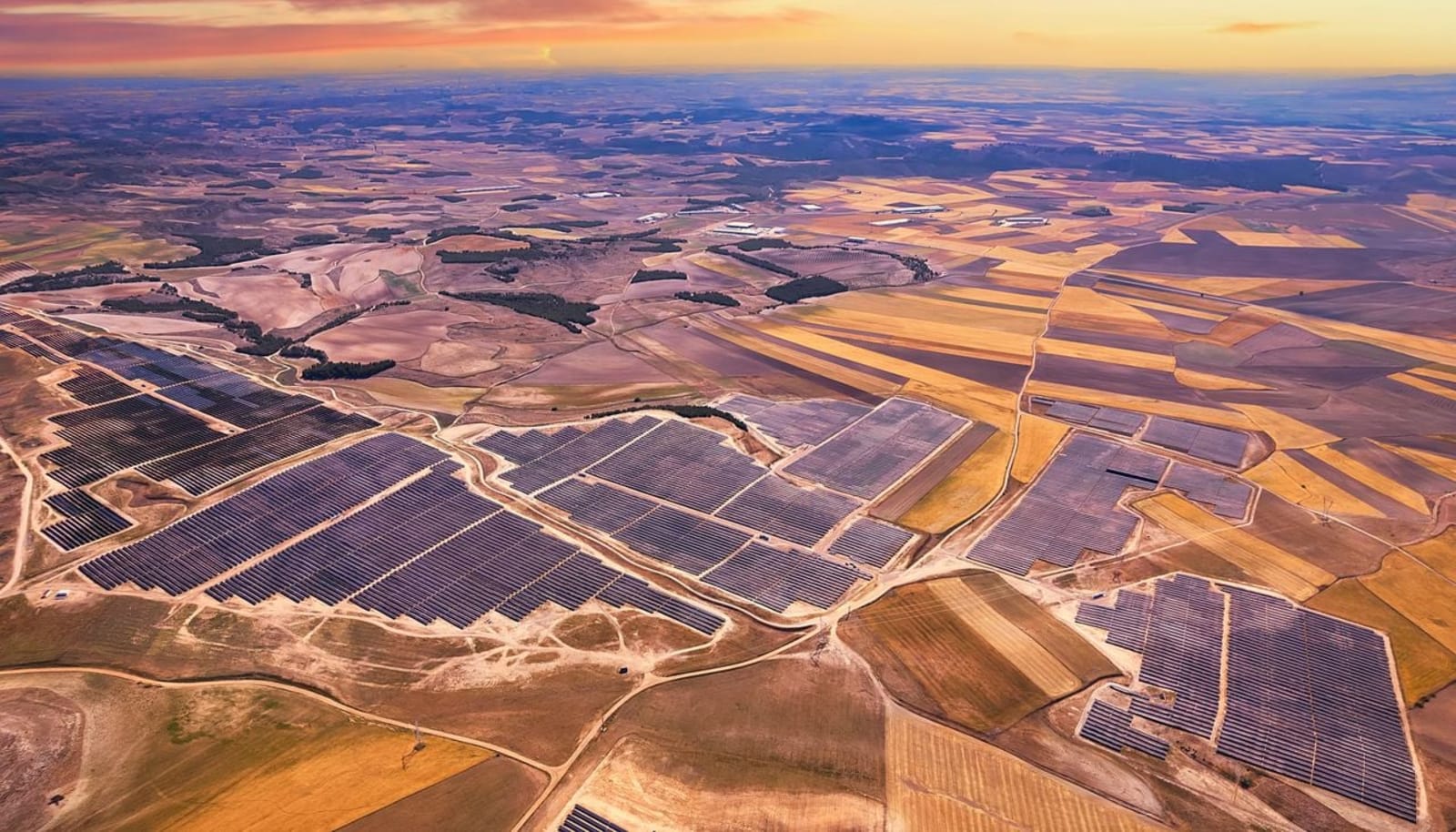
Photovoltaics is already Spain's main source of electricity, but its growing importance opens up a different challenge than simply adding more power: shifting that abundance to the hours when the sun disappears.
In August alone, it produced 7,445 GWh , 27.5% more than a year ago, reaching 29.2% of the energy mix. At the same time, batteries and pumped storage enabled the integration of 954 GWh, a sign that storage is beginning to gain ground as renewable energy penetration increases.
It is on this new stage of the market that the International Renewable Energy Agency (IRENA) introduces a metric that changes the way technologies are compared.
The organization proposes looking beyond the conventional LCOE and calculating the Firm LCOE , which incorporates the investment needed to transform variable production into a stable delivery profile. This primarily involves two tools: additional renewable capacity and batteries.

To measure it in Spain, it takes Tabernas, Almería as a reference, and proposes a system designed to cover consumption for 95% of the time.
The 2025 snapshot shows where the biggest outlay still lies. Producing a photovoltaic MWh costs about $33 , while ensuring its availability adds another $58 through storage and oversizing.
In other words, today it is more expensive to move and back up electricity than to generate it .
Technological advancements are beginning to narrow that gap, however. By 2030, IRENA projects that the photovoltaic component will fall to $20/MWh and the firming premium to $41/MWh .
This second component is precisely what will determine much of the competitiveness of the new hybrid systems. It's not about the panels producing energy at night, but about installing a system capable of storing surplus energy and making it available when sunlight disappears.
And the greater the guarantee required, the more complex the calculation becomes.
The jump from 95% to 100% changes the economy
IRENA warns that the relationship between availability and price is not linear. Covering most hours can be achieved with relatively limited amounts of additional capacity and batteries, but approaching continuous supply requires sizing assets for increasingly less frequent events.
Saied Dardour, co-author of the study 24/7 Renewables: The Economics of Firm Solar and Wind , explained during the presentation webinar that the reliability objective is one of the main factors behind the firming premium .
In the case of a purely photovoltaic system, the cost increases rapidly beyond certain coverage levels. The installation must store enough electricity to last not only through each night, but also through days with lower energy availability and adverse weather conditions.
This introduces a relevant difference compared to the traditional LCOE: two projects capable of producing one MWh of renewable electricity at the same price can have very different economics when they are required to deliver electricity at a given time .
Location also plays a role. High solar irradiance allows for greater production with the same installed capacity and reduces the additional infrastructure needed to support the delivery profile. Therefore, the results from Tabernas serve as a benchmark for a Spanish site with favorable solar resources and not as a price that can be automatically extrapolated to any location in the country.
The same logic explains why the technology with the lowest LCOE is not necessarily the most economical alternative once continuity is required.
IRENA finds a particularly visible paradox in wind power. Although it can produce very competitive electricity, there are prolonged periods of low wind that are much more difficult to cover solely with batteries.
During the webinar, Dardour focused on so-called " Dunkelflautes ," periods of low renewable energy production that can last for several days. In contrast to the relatively predictable daily cycle of photovoltaics, these periods require the system to be prepared for longer-lasting deficits.
Here's another alternative: instead of oversizing a single source, combine different profiles .
Solar and wind power can partially offset each other depending on the location and time of year. This diversification reduces the hours that must be covered exclusively by storage and, therefore, the amount of batteries needed to achieve the same objective.
Therefore, one of the most relevant results of IRENA's work is that the solar-wind-BESS combination can achieve a more favorable economic curve than trying to convert each technology individually into a continuous supply .
Continue reading
Batteries are driving the decline, and Spain is starting to deploy them.
The speed of this change has one main driver. Since 2010, IRENA has calculated a reduction of nearly 93% in the costs of battery storage systems , even greater than the cumulative decrease for photovoltaics during the same period.
The trend still has room to grow. The organization projects that firm renewable solutions will reduce their costs by around another 30% by 2030 and approximately 40% by 2035. In the most competitive international sites, they could then break the $50/MWh barrier.
Spain is beginning to build capacity in that direction.
A survey by Energía Estratégica of projects with administrative actions registered in the Official State Gazette between January and September 7 identified 5,044.4 MW among the selected developments. Of that volume, 2,257.3 MW correspond to photovoltaics and another 1,429.5 MW to batteries, meaning that these two technologies account for 73% of the analyzed sample .
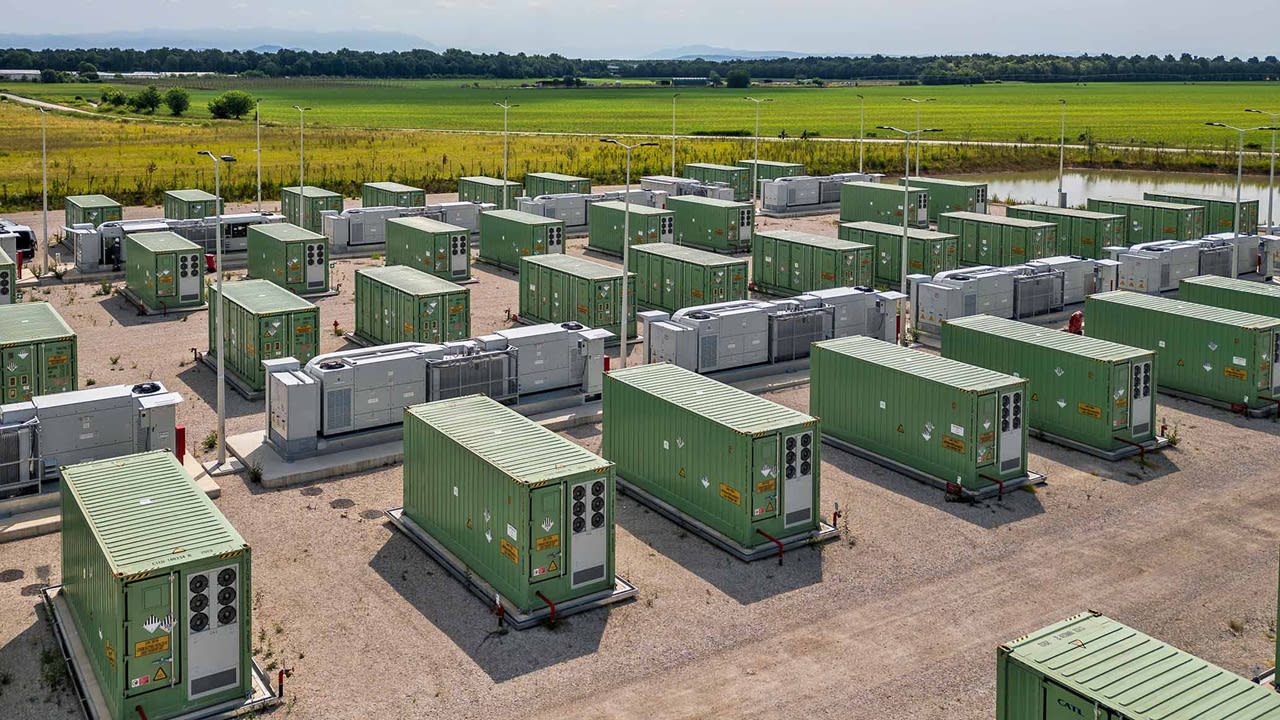
Not all of this storage follows the same model. Some of it is being developed as independent installations, while other parts are being directly integrated into existing or planned renewable energy plants.
This last configuration allows you to take advantage of shared infrastructure, shift production, and otherwise use a connection whose capacity is limited.
The administrative map itself already shows examples of this convergence. In Cuenca, the Aitana, Aspe, Bañuela, and Turbón modules add up to 86.76 MW of battery storage , each associated with a photovoltaic plant of around 49 MW. Iberdrola has another 140 MW using four Bat Tagus modules in Cáceres, and Saeta Yield is processing permits for 259.456 MW associated with Valle Solar in Valencia.
Configurations with more than two technologies are also beginning to appear. Frontones Phase II, by Elawan in Albacete, proposes incorporating another 20 MW of batteries into a complex that already has 50 MW of wind power, 26.25 MW of photovoltaics and 4 MW of storage .
These structures approximate the economic principle proposed by IRENA: to take advantage of different profiles and storage capacity to increase availability without depending exclusively on one source.
But physical assets are only one part of the transformation. The Spanish market is also beginning to value time more accurately.
The recent reform approved by the CNMC will increase the continuous intraday market from 24 to 96 rounds , allowing positions to be modified every 15 minutes. Producers, consumers, and storage operators will be able to adjust their schedules closer to physical delivery and respond better to variations in solar radiation, wind, or demand.
The change completes the transition to quarter-hourly products initiated in 2025 and represents something more profound for the renewable business: an MWh produced at 2:00 PM is no longer economically interchangeable with one available several hours later .
For a battery, that time difference is precisely the product.
From selling cheap energy to selling availability
IRENA places this change within a broader international transformation. Buyers are beginning to demand contracts with a greater temporal correlation between consumption and renewable production, while large loads with relatively constant profiles need solutions that do not depend exclusively on hours of sunshine or wind.
This scenario modifies the commercial proposal of the projects.
Until now, much of the advantage of photovoltaics has been built around reducing the cost of producing electricity. But the greater the installed capacity during the same time periods, the more relevant it becomes to capture value outside of them .
The solution also does not necessarily involve turning each power plant into an island capable of guaranteeing all hours of the year on its own.
IRENA acknowledges that an electricity system has other flexibility tools at its disposal, from interconnections and networks to demand response, dispatchable generation, and shared storage. The Firm LCOE seeks to isolate another question: how much would it cost to achieve that result within the project's own constraints?
This distinction also allows for a comparison of renewable energy alternatives with new fossil fuel generation under more equivalent conditions. It's no longer simply a matter of comparing the LCOE of a variable solar plant with that of a dispatchable power plant, but rather the investment required to provide a more consistent product.
In several regions, that gap has already narrowed considerably. IRENA's calculations place solar systems with storage in competitive ranges compared to new thermal capacity and predict that successive price reductions for modules and batteries will widen that advantage over the next few years.
For Spain, the conclusion goes beyond the projected decline in Tabernas.
The country already has a photovoltaic capacity capable of leading its energy mix for months, a growing portfolio of BESS projects, and a market that is beginning to operate with greater temporal granularity. The next phase consists of connecting these three elements.

 By Florencia Guglielmetti
 By Energía Estratégica

 By Matías Medinilla
 By Ailén Pedrotti