


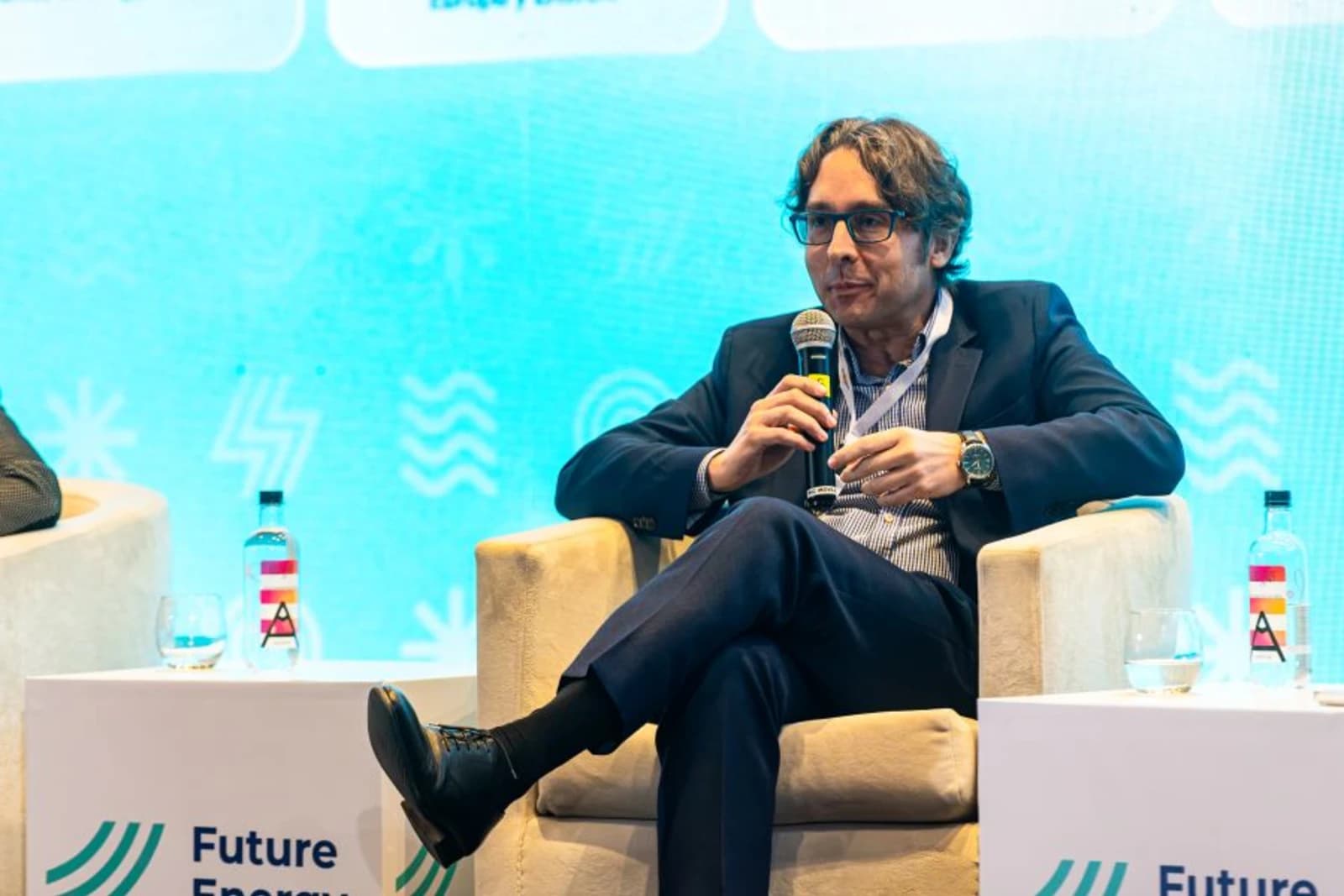
Before discussing TOPCon technology, new module sizes, or cost evolution, Luis Contreras , Managing Director of Yingli Solar , chose to begin with an event that the firm experienced more than a decade ago in Peru.
“I am going to tell you about a painful and traumatic experience that ended in a success story,” he said during his participation in the Future Energy Summit (FES) Peru on September 28.
The memory took them back to the period between 2013 and 2014, when the company supplied around 62 MW in the country and encountered a phenomenon that at the time still posed significant questions for the photovoltaic industry: potential-induced degradation, or PID . “The module was losing power and production was dropping drastically,” he summarized. The issue had been diagnosed in conjunction with the client, and the plant was able to recover to the expected parameters without any lawsuits or warranty claims .
The most relevant result? It was in the lessons learned from that episode about materials, encapsulants and design, knowledge that was later incorporated into more advanced product generations, as the executive explained.

More than a decade later, that lesson reappeared in the criteria by which large buyers evaluate new solutions.
“ Beyond the price, there is a very strong focus on aspects such as bifaciality, temperature, degradation, behavior at low irradiance and more technical parameters ,” Contreras explained.
To that list he added customer support throughout the asset's lifespan: " With the 30-year warranty, we have to be providing that support ," in addition to ESG traceability throughout the entire value chain.
Those initial 62 MW thus took on a new dimension. The manufacturer itself shifted the focus of photovoltaic competition beyond the dollar per watt and towards how much a module could produce, how it performed over time, and what support the company behind the equipment could offer.
TOPCon and modules up to 720 W: Yingli's response to the new demands of the market
In this scenario, Yingli positions itself with its n-type TOPCon platform, with modules ranging from 650 to 670 W and other formats close to 720 W , among the most in demand in the quotes analyzed by the company.
The trend accompanies a global shift: in 2025 around 690 GW of photovoltaic capacity was installed, while n-type technology already accounted for nearly 82% of the crystalline silicon wafers intended for cells.
Bankability thus began to demand more than just a competitive module from the outset: verifiable performance, controlled degradation, and a manufacturer capable of supporting the asset throughout its useful life .
This technological change is especially relevant in Peru, where the portfolio of solar projects continues to advance towards new stages of development.
In 2026 alone, five large photovoltaic initiatives obtained definitive generation concessions and accumulated 1,247.9 MW : Ruta del Sol, Sunny III, Yuramayo, Arenarosa and Locumba.
Continue reading
The advancement of these projects poses an additional challenge for developers and suppliers: transforming authorized capacity into effectively operational power plants , guaranteeing competitive equipment, long-term performance, and supply conditions that allow construction schedules to be sustained.
In this context, the bankability of projects begins to demand more than just low-cost modules: verifiable performance, controlled degradation, and manufacturers capable of supporting assets throughout their useful life .
However, renewable growth began to shift the pressure to another front: how much flexibility the Peruvian system could absorb . With around 4.5 GW of new clean capacity planned , estimates presented during FES placed the potential need for BESS between 300 MW and close to 1 GW . Aurora Energy Research extended the projection and calculated around 3 GW of new flexible capacity by 2035 , including batteries and peak thermal generation.
Contreras, however, set a precondition: “Demand must align with everything that is intended to be incorporated into the market in terms of renewables.”
And he added the second limitation: although Peru has a relatively solid electrical infrastructure, "to put all the desired capacity into the system, it is always necessary to reinforce the network and investments are needed."
The expansion has already begun to move capital. ISA Energía projected more than USD 1.3 billion , with 1,400 kilometers of new lines, six substations and 20 expansions, while the maximum demand of the SEIN had exceeded 8,200 MW during 2026.
The challenge was thus quite clear: more generation required both a larger grid and greater flexibility . For future solar projects, storage could gain ground, but its deployment would also depend on transmission and demand keeping pace with the new GW.
China shifted the equation, and the 2027-2028 CODs began demanding decisions earlier.
For developments with a construction horizon of one or two years, Contreras focused on the global supply chain.
“My biggest concern would be that raw materials in the supply chain don’t become too volatile in the coming months and that there aren’t any new taxes,” he warned.
The signal came after years of oversupply and falling prices. At the end of September, OPIS's reference price for Chinese TOPCon modules under 645W stood at USD 0.108/W FOB China , as China moved forward with withdrawing tax incentives for photovoltaic exports and implementing new energy efficiency and consumption requirements by 2027.
For Peruvian projects with a COD (Certificate of Delivery) of 2027-2028, the change reduced the room for speculation on further price reductions. With almost 1.25 GW of solar projects receiving final concessions during 2026 , cost stability and equipment availability began to weigh more heavily in purchasing decisions.
Contreras anticipated that the technology would continue to improve, but set another condition for the upcoming closures: “We expect that the cost-price level in the market will be stable.”
The pressure wasn't limited to the modules. During the last FES event in Peru, cables, high-voltage equipment, and transformers also emerged as components capable of impacting schedules. To meet the upcoming COD deadlines, the challenge thus shifted from simply securing a good price to ensuring supply and keeping it within the planned financial model .