

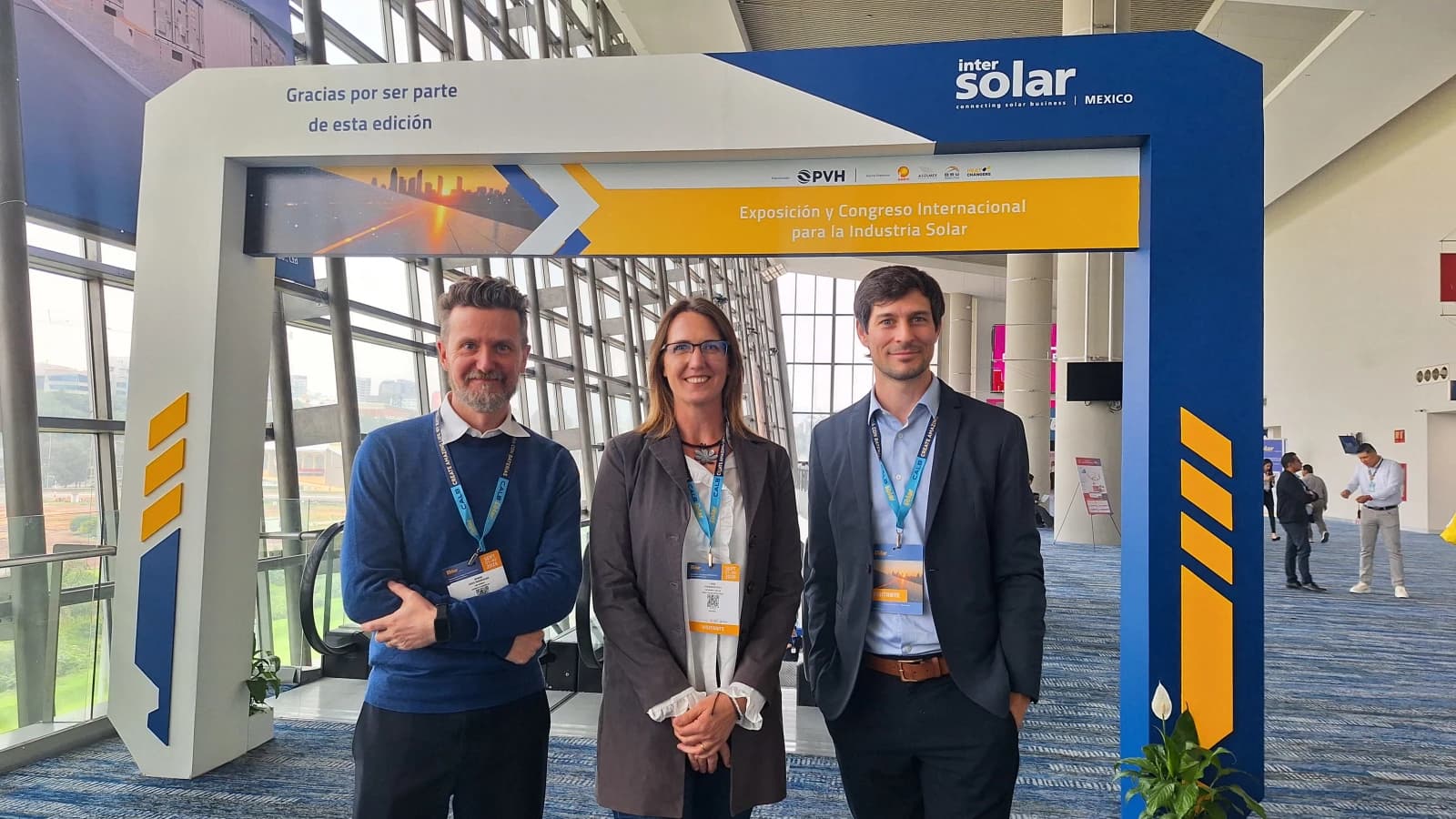
360Energy plans its expansion into Mexico and advances in its international growth strategy, with a proposal that combines two scales of development: a utility portfolio and self-consumption projects intended to support the energy transition of large industrial consumers.
“ We are talking about four or five projects, of 100, 150 or 200 MW, that will allow us to have a pipeline of around 500 MW ,” said Juan Pablo Alagia, Development and Technology Manager of 360Energy , in an exclusive interview at Intersolar Mexico.
“For projects here in Mexico, we have to talk about hundreds of megawatts ,” Alagia added.
Based on this roadmap, the company is working on identifying land near transmission and distribution substations to develop greenfield projects , which could later be geared towards off-site PPAs or be prepared to participate in future calls for tenders and other mechanisms enabled by the Mexican electricity market.
On that front, 360Energy is closely following the calls for tenders that are beginning to take shape in Mexico , including processes related to storage and schemes that contemplate mixed participation with the Federal Electricity Commission (CFE).
“We are waiting for a call for proposals from the private sector, where we might be able to present these projects that we have been developing ,” the executive explained.
To compete in these processes, Alagia stated that they consider it necessary to have at least 30 to 60 days' notice , a period that allows them to prepare the documentation, ensure the availability of the land, and complete the presentations required by the authorities.
However, he pointed out: “ Just because we’re waiting doesn’t mean we’re going to apply for the next one. We’re quite cautious at 360. ”
In this way, the company intends to follow the processes from an early stage, prepare projects and land, but define its participation only when the technical, regulatory and commercial conditions are compatible with its strategy .
But while the utility segment will depend in part on upcoming regulatory definitions and the mechanisms enabled by the market , 360Energy identifies a more immediate way to deepen its presence: industrial self-consumption.
Self-consumption as a gateway: what projects does it aim for?
360Energy aims to build an initial self-consumption portfolio of at least 100 MW , grouping four or five projects. This scale surpasses the benchmark it operates in Argentina, where such initiatives average 10 to 15 MW , according to its executives.
“ It’s a huge market. Not just in terms of financing. The stakes are high, and the projects have to be big too ,” highlighted the Development and Technology Manager of 360Energy .
To build that pipeline, 360Energy moved forward with a commercial roadshow in Mexico to identify opportunities and define where it can position itself, in parallel with the development of its first contracted project in the country.
“ We are touring with companies, entrepreneurs, consultants, manufacturers, trying to get a feel for the Mexican market, seeing where 360Energy can position itself ,” explained Edwin King, Commercial Manager of 360Energy .
The executive points out that the intention is to replicate the self-generation model that the firm is already developing in Argentina and which began to scale up in Brazil, taking advantage of its first contract in Mexican territory as a platform to expand the portfolio.
“ Now that we’ve established a presence in Mexico with a contract and a defined project, we’re trying to see where we can locate ourselves and where we can grow ,” King added, referring to his Saltillo Complex project.
In that strategy, self-consumption appears as the available mechanism to move forward while other ways to incorporate renewable generation into the Mexican market are being finalized.
“ Until other regulations are clearly defined that will allow for a more massive decarbonization of the country, self-consumption is an opportunity for Mexican industries to move forward in this, and we can work hand in hand as partners in this energy transition ,” said Ana Ivanissevich, Director of Strategy and New Business at 360Energy .
The directive argues that the decarbonization needs of industries are advancing at a speed that does not necessarily coincide with the timelines of electricity market definitions , thus opening up space for behind-the-meter solutions.
From there, 360Energy proposes projects designed according to the physical and energy conditions of each installation , rather than replicating a single configuration. Their proposal includes everything from rooftop and carport systems to fixed structures, trackers, and floating photovoltaic alternatives.
Continue reading
“ 360Energy’s technical know-how allows us to create tailor-made projects ,” the company emphasizes.
Engineering, in fact, appears as another area where 360Energy identifies opportunities in Mexico. According to its executives, after several years of slower growth in renewable energy and the departure of various players, they still observe a limited availability of technical capabilities in areas such as design and EPC (Engineering, Procurement, and Construction) , in anticipation of a potential market recovery.
Beyond traditional industrial consumers, 360Energy is also closely monitoring the growth of data centers, a segment whose high electricity demands could drive new generation capacity. The company sees opportunities in Mexico, Brazil, and the United States and believes that the Mexican market's proximity to the latter could favor projects associated with new, large-scale loads.
“ To set up operations, they will be required to come with a generation project already in hand ,” warns 360Energy regarding the energy needs that will accompany the growth of this type of infrastructure.
Saltillo and a new window for self-consumption
The strategy already has a first concrete project in Saltillo Complex , where 360Energy has a signed contract for 20 MW and plans to start construction in 2027, subject to the progress of permits.
“ 360Energy has a signed contract, we will start construction next year and we expect it to be operational in 2028 ,” Alagia stated.
The executive clarifies that the main variable affecting the timeline is not construction itself, but obtaining the necessary permits . The project is backed by a 20-year contract, a timeframe within which the company seeks to solidify its presence in Mexico.
In this context, the Single Window for Self-Consumption (VUA) stands out as one of the regulatory changes that 360Energy is watching with the greatest interest . The company had signed its first Mexican PPA before the new procedure existed and originally expected longer administrative times.
“ This is where we are leveraging the most to establish a firm foothold in Mexico. When we signed the PPA, this regulation didn't yet exist. We thought everything was going to be much slower ,” added Ana Ivanissevich.
The new tool establishes priority, expedited, and simultaneous processing for applications for self-consumption power plants ranging from 0.7 MW to 20 MW , both isolated and grid-connected. The procedure streamlines the necessary steps with the various institutions involved through a single file.
In terms of deadlines, CENACE has up to 30 business days to notify the results of self-consumption studies , while the generation permit must be resolved within 30 business days after its acceptance for processing . For interconnected self-consumption, the complete scheme also includes the stages of interconnection, asset registration, and testing.
For 360Energy, the emergence of this mechanism coincided with an advanced stage of maturation of its first development , allowing it to face the process with some of the information already prepared.
“ It suddenly emerged, and we were quite prepared in terms of information. Therefore, we felt strong enough to present ourselves ,” added the executive, who believes the decision hinges on moving forward with established projects to respond quickly to the process's requirements.
The company acknowledges, however, that the implementation of the Single Window will involve a learning curve for both developers and authorities .
To replicate the “contagion effect” of Argentina and Brazil
The strategy that 360Energy projects for Mexico takes as a reference the experience accumulated with industrial self-generation projects in Argentina and Brazil , where the company seeks to use the first developments as a calling card to present itself to new clients.
In Brazil, the company has already commissioned the first of three plants linked to Stellantis and is progressing with the remaining ones, while in Argentina it has self-generation experience in Córdoba and Palomar, exceeding 100 MW of installed capacity within this model. It is this track record that it now intends to replicate in the Mexican market.
“ We want to somewhat replicate the ripple effect we're seeing in Argentina and Brazil, where companies that have seen the self-generation projects in Córdoba and Palomar are saying, 'I want to do the same. I want what my neighbor is doing ,'” King explained.
The Mexican advance also fits into the planning that 360Energy is developing for its different markets during the next five years , a period in which the company must define the pace and scale of growth of each of its operations.
Mexico thus appears as one of the geographies where the Argentine energy company seeks to build a long-term position , combining income through self-consumption with the preparation of larger-scale assets and monitoring the opportunities that the market enables.
For 360Energy, the challenge will be to transform that first step in Saltillo into a growth platform over the next five years , building on the experience accumulated in Argentina and Brazil and maintaining projects prepared to support the new utility scale stage of the Mexican renewable market.