


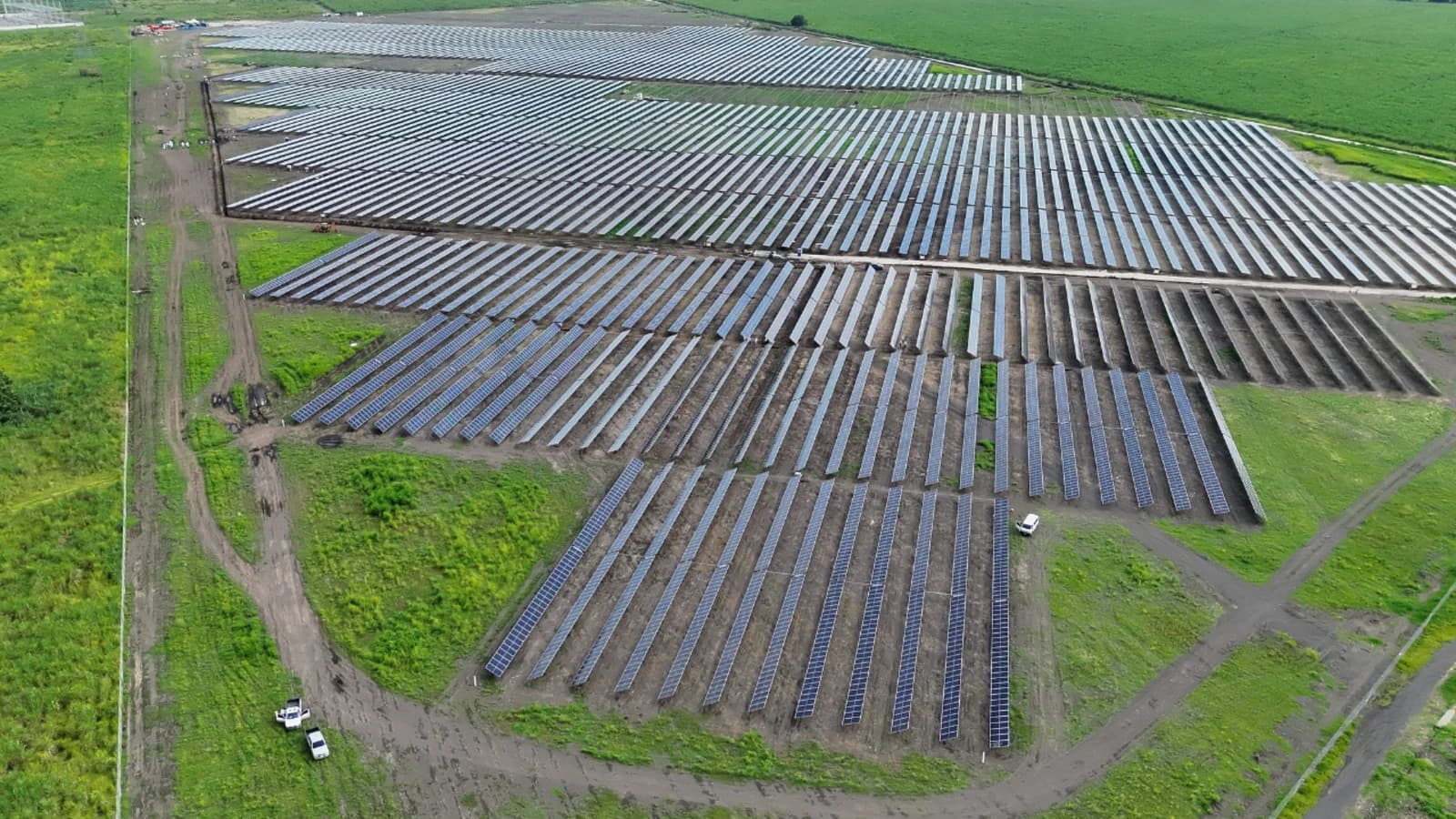
Magdalena was one of the winning companies in Guatemala's PEG-5 tender and is making progress in the development of its awarded 495 MW solar with batteries.
The company obtained contracts to install 350 MW photovoltaic plants with six hours of storage and another 145 MW linked to existing power plants.
“It is a 350 MW solar project with 6 hours of battery storage and 145 MW of solar projects associated with existing plants,” explained Juan Augusto Vidal , Commercial Director of Magdalena, in a dialogue with Energía Estratégica .
The projects will begin supplying energy in stages from May 2030 and will reach their maximum volume in 2033. The last contracted block will be valid for 15 years, until 2048.

The PEG-5 represented one of the most relevant electricity procurement processes in Guatemala by awarding 1258 MW through 57 projects to meet the growing demand of the distributors.
The call also consolidated storage as a core technology, with a renewable share close to 73% and a strong presence of hybrid solar solutions with batteries.
Magdalena secured volumes in all sections and will organize the construction of its assets according to the progressive growth of contractual obligations.
“We started in 2030 building ascending steps, and we have a contract awarded in 2033 that ends 15 years later in 2048,” Vidal explained.
The award opens a new stage for a company that already supplies between 11% and 12% of Guatemala's energy , mainly through biomass generation linked to its sugar activity.
In the sugar production process, the company uses residual sugarcane fiber to generate electricity. This approach has allowed it to accumulate technical, regulatory, and commercial expertise within the Guatemalan system.
Magdalena also evaluated hydroelectric alternatives, liquefied natural gas projects, and photovoltaic solutions before defining its strategy for PEG-5. The company ultimately focused its studies on combining solar power generation and batteries.
“The one we dedicated the most time to was the solar panel. We installed some projects beforehand to know how complex or difficult the installation would be if successful,” said Jorge R. Leal , Chief Executive Officer of Magdalena.
As a result, the company structured two proposals: "One to supply energy during the day and deliver 6 hours from batteries, and another more aggressive offer to deliver energy 24 hours a day with a massive battery park."
Magdalena offered 5600 MWh of storage and, as a result of the process, Leal reported an award of close to 2100 MWh of batteries and an approximate reach of 950 MW of solar within the different configurations presented.
Meanwhile, Vidal specified that the central contractual blocks correspond to 350 MW with six hours of storage and 145 MW associated with existing plants , whose incorporation will occur progressively between 2030 and 2033.
The PEG-5 tender awarded 1258 MW through 57 projects , of which approximately 73% correspond to renewable technologies. Hybrid solar power plants with batteries accounted for a significant portion of the new contracted capacity.
The average single-unit price was close to $101 per MWh , below various contracting values in force in the Guatemalan market.
“The participation of so many solar and biomass projects was key to maintaining competitive prices, and I believe they are sustainable going forward,” Leal stated.
“Batteries will help us utilize the energy from the solar park and will open up the possibility of storing surplus energy to deliver it during times of lower availability or higher energy costs. Systems with storage set a new standard, and we will see more competitive prices that will contribute to the country's development and industrialization,” he added.
Continue reading
Financing, engineering, and supplier selection
The projects are currently in the financial structuring, detailed engineering, and supplier contracting phases. Magdalena has already identified the entities that will lead the operation and is in discussions with international institutions.
Banco Industrial de Guatemala and IDB Invest will lead the financing. Several European banks may also join this structure.
On the supplier side, the company has already visited potential manufacturers and drawn up a shortlist, but the final selection will be made together with the financial entities, after reviewing technical, commercial and contractual conditions.
Immediate objectives include completing the engineering, defining the equipment, and signing the bank agreements, so that it plans to start the installations well in advance to reduce construction risks and meet the established delivery stages.
“We intend to start installations next year in a conservative manner, to have one park in 2030, another in 2031 and the other in 2033,” Leal anticipated.
Energy sovereignty and lessons from PEG-5
Magdalena links the expansion of solar energy with batteries to Guatemala's energy sovereignty. The country does not have large local reserves of coal, oil, or natural gas and depends on imports to supply part of its energy mix.
“ The reason for our strong conviction in solar power generation with batteries is energy sovereignty ,” Vidal stated.
The commercial director considered that the use of local renewable resources can reduce exposure to international prices, logistical problems and possible supply disruptions.
“ In Guatemala and in many countries in the region, we don't have coal or gas. Energy is the engine of a country's development, and how much better if one can do it in a country where the sun shines 365 days a year ,” he said.
The company also highlighted regulation, legal certainty and the track record of compliance with electricity contracts as decisive factors in attracting international financing.
“It’s a whole package: it’s the regulation, the legislation, Guatemala’s record of not having any defaults in energy businesses, and the way in which private businesses are closed in a regulated manner,” Leal listed.
These conditions make it possible to support large-scale investments and could serve as a reference for other Central American markets.
However, Magdalena identified aspects of PEG-5 that should be reviewed before future auctions. Her main concern focused on the implementation of a virtual bidding process after the last participant with natural gas withdrew.
“We have things to learn from the PEG-5; not everything was perfect. The maximum price to be charged was lower for 24-hour taxis than for those with fewer hours, which doesn't make sense,” Leal acknowledged.
Guatemala as a base for international expansion
Magdalena will keep Guatemala at the center of its strategy, but is already analyzing opportunities to replicate the solar with storage model in other markets.
The first target is Central America, where several countries share a high dependence on imported fuels and require regulatory changes to facilitate the entry of batteries and the new renewable generation.
The company sees opportunities in Honduras, El Salvador, Nicaragua, and Costa Rica. Meanwhile, in South America, it is evaluating alternatives in Ecuador and Peru.
“We will continue to be players in the local market, but we are already analyzing other options where solar energy with batteries is a viable solution,” the CEO confirmed.
Magdalena also does not rule out studying projects in Africa or European islands, markets where storage can replace expensive thermal generation and reduce dependence on transported fuels.
“We haven’t done any projects abroad yet, but I think it will happen soon,” Leal said.