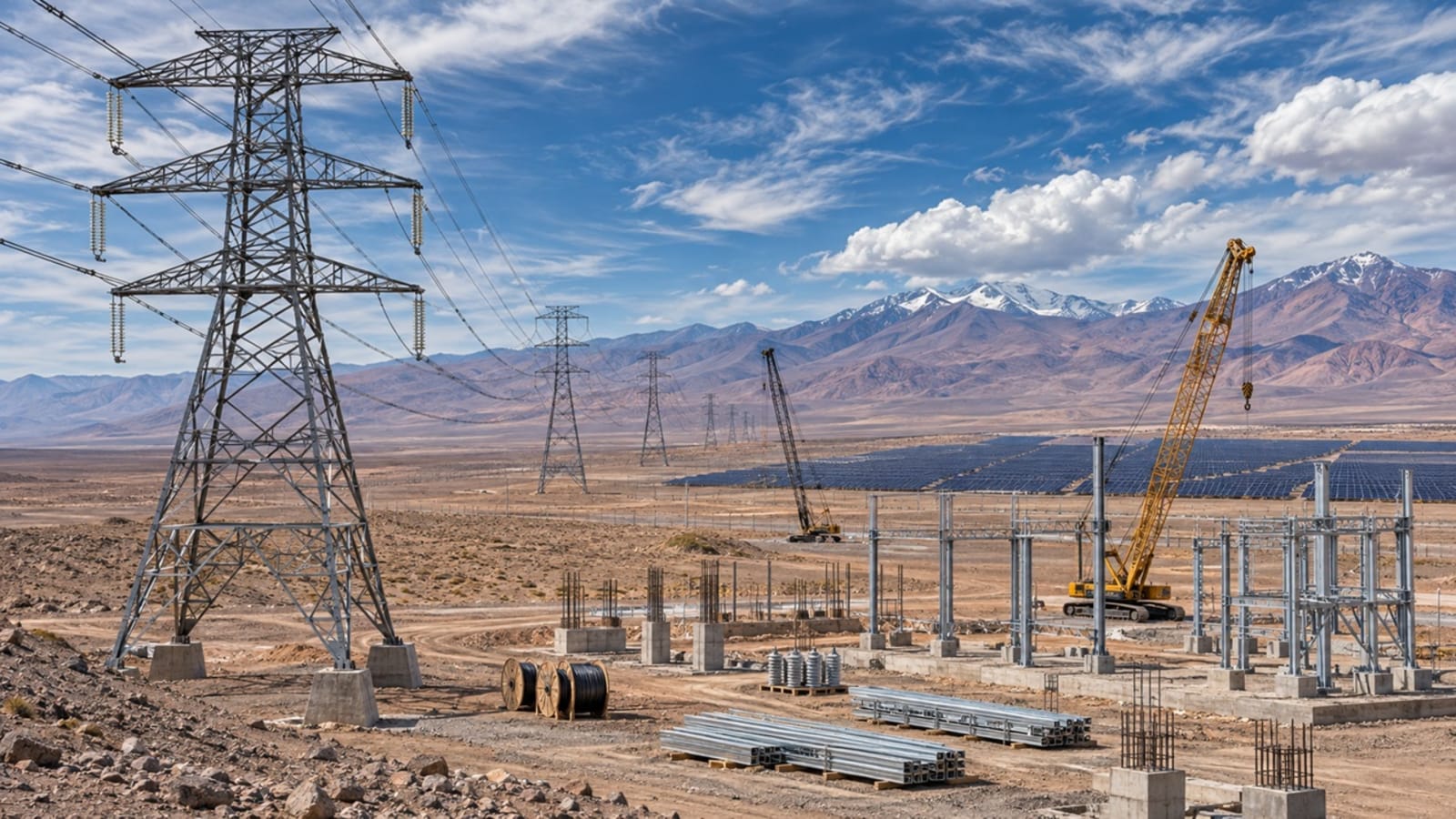
The expansion of renewable energy in Chile faces a growing challenge in its electrical infrastructure. As of September 2026, 65% of the 144 transmission projects monitored by the National Electric Coordinator were behind schedule , a situation that could exacerbate grid congestion, increase operating costs, and restrict the addition of new generation capacity.
Meanwhile, 31.9% of the expansion tenders analyzed were unsuccessful because the bids exceeded the maximum allowed value , compared to 20.4% in the previous period.
This data is particularly significant because this situation occurs despite increased business participation. The average number of bids per project rose from 1.19 to 1.66, while the proportion of awarded contracts decreased from 47.2% to 42.6%.
This combination highlights the difficulties in securing infrastructure investments, even when companies are interested in participating in their implementation.

In that context, Javier Tapia , executive director of Transmisoras de Chile , explained in a dialogue with Energía Estratégica that a major project can require between eight and ten years from its planning to its entry into operation.
“The problem is that, when a project finally comes into service, the generation, demand and operating conditions may be different from those that motivated its planning,” he noted.
Unsuccessful tenders and construction costs
The report identifies a possible mismatch between the investment values established as a reference and the actual costs of construction, equipment and supplies at the time of submitting the bids.
This difference can cause the maximum budgets to be insufficient and the calls for proposals to have to be repeated, extending the time needed to incorporate new facilities into the system.
In fact, 148 of the 466 projects that had been tendered at least once participated in more than one process , equivalent to 32% of the total.
Among the most representative cases are the expansion of the Río Blanco substation and the increase in capacity of the El Maitén–El Paico–El Monte line, which accumulated six calls each.
Difficulties are also observed in projects that were awarded contracts but faced problems during their development.
Tapia mentioned the case of the 2x66 kV Maule–Talca line , included in the 2016 expansion plan. He explained that the project was awarded, subsequently abandoned by the contractor, and its re-tendering was unsuccessful.
Currently, that infrastructure is operating at its maximum capacity, and the Coordinator proposed an urgent solution in 2026 that combines network expansions with storage, which is estimated to be operational by 2031.
Given this scenario, the agency recommends updating the benchmark investment values using recent market data.
It also proposes incorporating indexation formulas between the award and the commissioning , taking into account variations in materials, exchange rate and labor.
The proposal aims to reduce the risk of new failed tenders or stoppages that delay the availability of infrastructure.
How do delays impact renewable energy?
The difficulties are not evenly distributed among the different types of projects.
According to the survey, 74% of the new zonal transmission works were behind schedule , while 48% showed deviations greater than 10% from the planned progress.
Among the identified causes are environmental obstacles, easements, supplies, construction, and dependencies with other electrical installations.
The consequences could extend beyond the projects themselves. The Coordinator warns that their delayed commissioning could increase congestion, limit renewable energy integration, and reduce security of supply margins.
The problem becomes relevant in a market where solar and wind technologies together represent 50.5% of installed capacity , on a system that reached approximately 40.7 GW as of June 2026.
Furthermore, according to data from the Chilean Association of Renewable Energies and Storage (ACERA), between January and September 2026, 3546 GWh of solar and wind energy were accumulated , although the volume registered a year-on-year decrease of 4.6%.
These generation reductions are due to different operating conditions and system constraints, so they cannot be attributed exclusively to transmission delays.
The challenge of modernizing existing infrastructure
The problem is not limited to new constructions either.
The document reveals that more than 27% of the 500 kV lines failed to meet at least one of the indicators of duration of scheduled or forced unavailability .
At this point, Tapia identified an additional difficulty in improving the electrical transport capacity: the facilities that most need intervention are usually those that operate under greater demands.
“To upgrade a line or change its conductors, it has to be taken out of service, and the facilities that most need these improvements are precisely those that operate under the most demanding conditions,” he explained.
The executive warned that the lack of available capacity or redundant infrastructure restricts the windows for carrying out work, which may force the rescheduling of interventions or resort to more expensive alternatives.
He also noted that there are technologies capable of increasing the efficiency of current facilities, such as advanced conductors and dynamic line capacity systems, whose economic recognition still faces regulatory limitations.
In response to this situation, the Coordinator proposes evaluating a complementary performance indicator that considers both the disconnections and their economic consequences.
The methodology would include factors such as congestion, marginal cost decouplings, and renewable energy spillovers, with the possibility of gradually linking the operation of the facilities to their annual remuneration .
Thus, the agency's recommendations aim to improve the conditions for carrying out new expansions and strengthen the availability of existing infrastructure, two aspects necessary to support renewable growth and the country's future electricity demands.
 By Matías Medinilla

 By Emilia Lardizabal
 By Energía Estratégica