Peru faces a defining energy policy on the future of its hydroelectric plants at a time when the expansion of solar and wind power generation poses new challenges to ensuring the stability of the system.
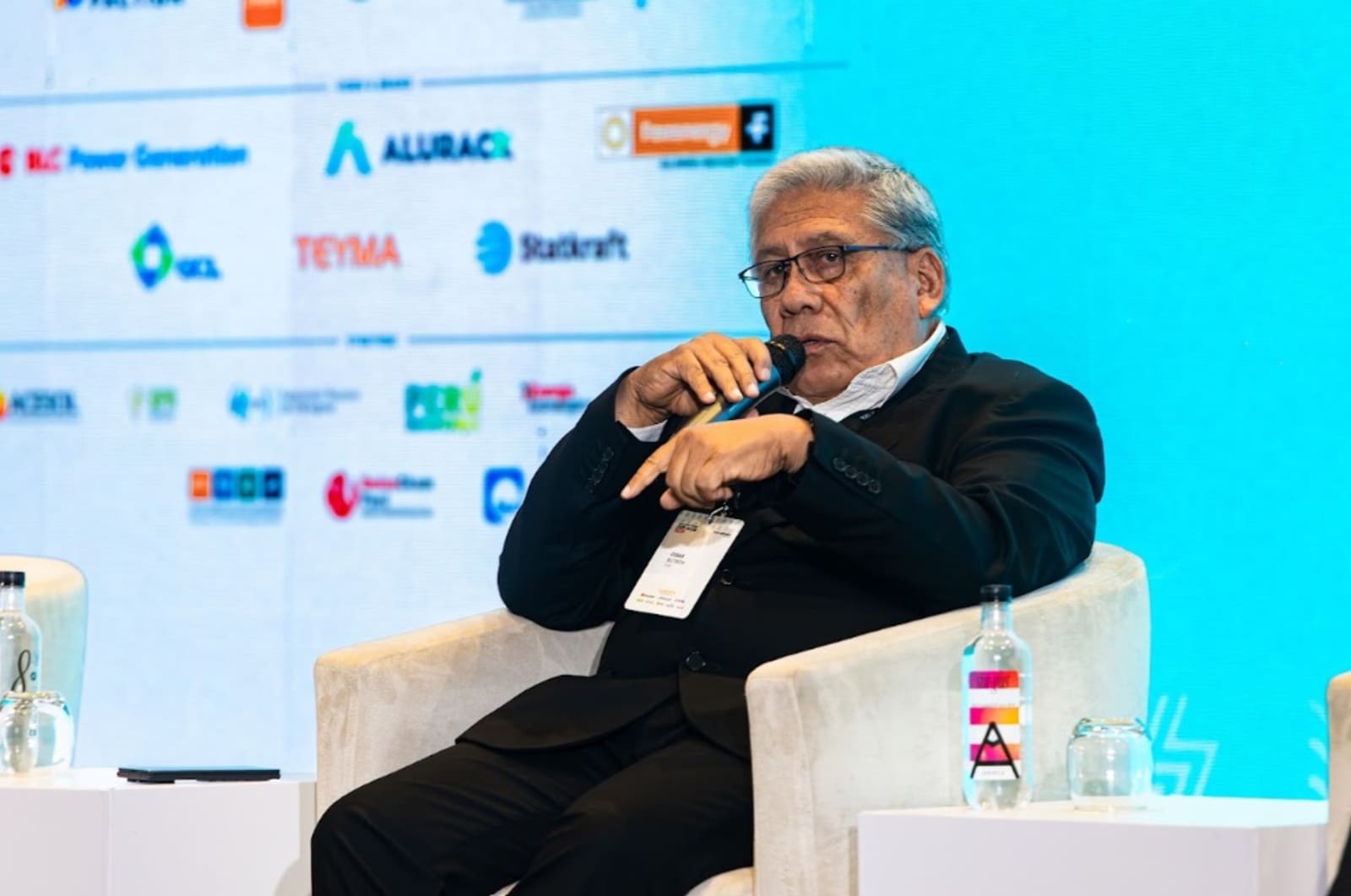
This was the warning issued by César Butrón, president of the Board of Directors of the Economic Operation Committee of the National Interconnected System (COES) , during his participation in the Future Energy Summit (FES) Peru 2026 , held in Lima.
“I am aware that private investors don't want to spend ten years fighting to develop a hydroelectric plant. Therefore, there is a problem there on which the government would have to take a position on energy policy,” he stated.
The warning is supported by the state of the portfolio. According to the latest available compendium of generation projects from Osinergmin , with information as of October 2025, there were 27 hydroelectric plants in the study phase, totaling 2,181 MW , representing planned investments of US$5,396.7 million. However, only two projects, totaling 43.7 MW, were listed as being under construction.

In addition, there were 14 stalled hydroelectric projects , totaling another 1,990.4 MW and involving investments of US$ 4,223.4 million.
The contrast is all the more striking given the still-available resource. The Ministry of Energy and Mines (MINEM) estimated in 2025 that Peru has approximately 70 GW of hydroelectric potential , of which only 8.3% is being utilized. At that time, 191 hydroelectric plants were operating, with a combined capacity of 5,749.9 MW.
Butrón, in turn, referred to the historic study evaluating the national hydroelectric potential, which identified approximately 58.4 GW of technical potential .
“I have always thought that hydroelectric power is a technology that Peru should not abandon,” said the head of COES.
The challenge of making renewables more stable
The proposal is not simply about recovering a source of generation with ample available potential. For Butrón, the discussion is directly related to the transformation that Peru's electricity matrix will undergo in the coming years.
“The only technologies that are going to grow in the coming years are wind and solar,” he noted, warning that this progress will require figuring out how to guarantee reliability when those resources are not available.
The market is already showing signs of this expansion. The portfolio of solar projects with definitive concessions, as recorded by the Ministry of Energy and Mines (MINEM) in April of this year, includes 13 plants and 2,402 MW of projected power , with estimated investments of US$1,805.9 million.
The Ministry also estimates that Peru has 20,493 MW of wind power potential , mainly concentrated on the north and south coasts.
The advancement of these technologies also poses challenges for the operation of the system. Butrón warned that the combination of reduced solar production due to cloud cover, drops in wind power generation, and periods of drought could decrease the availability of efficient generation and require other backup sources.
“We can have a lot of renewable energy, but it could lead to serious problems,” he noted. According to the head of COES, this scenario necessitates starting to define how to make the Peruvian electrical system more stable.
Continue reading
Butrón even cited recent incidents in the south of the country, where a drop in solar production forced the system to resort to diesel generation. He recounted that at one point, generation was down by approximately 400 MW due to cloud cover .
The challenge, therefore, is not solely about adding new megawatts. Simultaneously, it will be necessary to define which technologies will support that capacity when wind, solar, or hydroelectric production declines.
“The best battery is a large reservoir”
It is here that Butrón once again places hydroelectric plants at the center of the debate. In addition to generating renewable energy, he highlighted their capacity to provide security to the system and store the resource for use when needed.
“The best battery is a large reservoir,” he summarized.
He also pointed out additional benefits associated with this type of infrastructure, such as flood control, the availability of water for human consumption and agriculture, employment, and the use of locally produced inputs.
The problem lies in translating that potential into concrete projects. Butrón acknowledged the high costs and the social and environmental difficulties that these initiatives can face, in addition to lengthy development processes that reduce their attractiveness to private capital.
Hence his demand for a definition from the State: if the country considers that hydroelectricity should play a strategic role to guarantee the security of the system, he argues that energy policy will have to generate conditions that allow these investments to materialize.
Batteries appear as the other alternative
If hydroelectric development does not progress, battery storage emerges as one of the main tools to support solar and wind power growth.
But Butrón also doesn't expect Peru to immediately replicate the expansion seen in markets like Chile. He explained that currently there isn't a sufficiently marked difference between prices at different times of day to sustain the arbitrage business on a large scale.
“For now, in Peru, it will only have two possible revenue streams: the provision of synthetic inertia or the provision of primary frequency regulation,” he explained regarding storage.
The situation changes when considering systems capable of supporting large blocks of generation. For that segment, he deemed it necessary to create another remuneration scheme that recognizes the availability of installed capacity.
“That other storage, in my opinion, is going to need another mechanism,” he said, and raised the possibility of tendering capacity so that the systems are available and are remunerated for it.
The need to solve this equation is gaining importance in light of the behavior of demand. During the meeting, Butrón pointed out that electricity consumption was growing by slightly more than 5% , above the 4% previously considered in the COES baseline scenario, and stated that some areas in the north were registering increases of nearly 10%.
Official records also show greater demands on the system: the maximum monthly demand of the SEIN reached 8,084.5 MW in August 2026 , compared to 7,604.6 MW in the same month of the previous year, a difference of around 6.3%.
Thus, the debate raised by the head of COES goes beyond the choice between hydroelectric plants and batteries. With a new wave of solar and wind projects under development, Peru must define what investments and regulatory mechanisms will accompany this expansion to guarantee firmness and security of supply .
 By Emilia Lardizabal



 By Ailén Pedrotti

 By Florencia Guglielmetti