


The Chilean Renewable Energy and Storage Association (ACERA) projects that the Chilean electricity system will reach an installed capacity of 47.17 GW by the end of next year, primarily due to the construction of new non-conventional renewable energy (NCRE) and energy storage systems (ESS). "We foresee the addition of 8 GW more power during 2026 and 1,490 MW in 2027, considering projects that have been declared under construction, but also those committed to in regulated contracts," stated Ana Lía Rojas , executive director of ACERA. "Of that capacity, 95% is non-conventional renewable energy and storage systems."
“Although there are 3 GW that should be coming online between 2026 and 2027 that already have announced delays in their implementation schedule,” he added. Even so, the projection confirms the consolidation of renewable energy dominance in the national energy mix, where solar and wind power continue to gain ground against fossil fuels. During 2025, the system reached 38.6 GW of installed capacity, with almost 50% coming from non-conventional renewable energy sources , complemented by 31% from thermal and 17.8% from conventional hydroelectric. One of the milestones of 2025 was the consolidation of wind power as the country's second largest source of installed capacity, reaching 15.5% with almost 6,000 MW , surpassing natural gas.
Solar continues to lead with 30.4% (11.7 GW) of operating capacity. 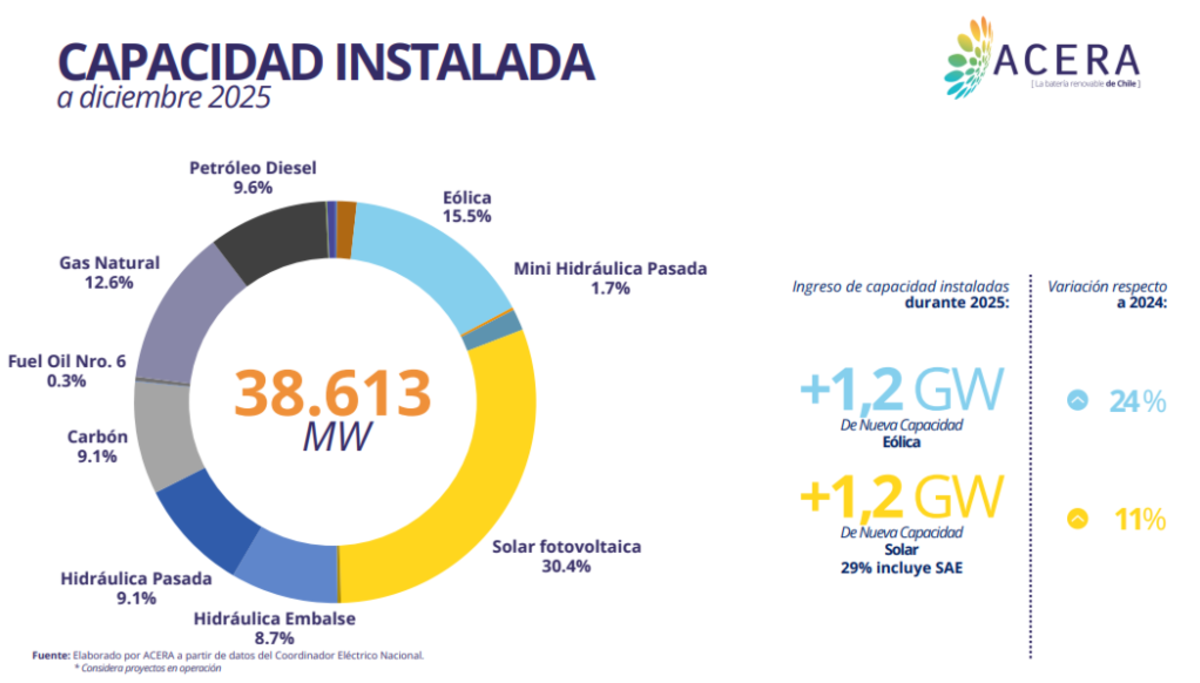
This progress was supported by record investment, as at the sector level they concentrated on solar, wind and storage projects, with a strong presence of hybrid developments.
In addition, 6,714 MW are formally declared under construction by the National Energy Commission, mostly corresponding to clean energy sources and storage . Furthermore, BESS systems have become a key component in addressing system constraints, so Chile has 9 GW of storage projects in operation, under construction, and undergoing testing; plus another 27 GW of storage in development .

- 28 projects in operation (1.6 GW - 4.1 hrs average duration).
- 6 projects in testing (0.7 GW - 3.6 hrs average duration).
- 68 projects under construction (6.8 GW - 4.4 hrs average duration).
- 14 GW of storage with a favorable environmental rating
- 13 GW of storage that are currently undergoing environmental assessment.

"We are optimistic about what we can see later with the fruit of this storage."
"We will see better system performance, less congestion, lower internal costs, and that will undoubtedly favor a more competitive electricity generation sector and better prices for the end customer," said Sergio Del Campo, president of ACERA, during the presentation.
However, spills remain one of the main threats to the efficiency of the electricity system, to the point that during 2025 they reached 6 TWh/year, which represented 8% more than in 2024.These losses are equivalent to the annual electricity consumption of 2,300,000 homes and are mainly concentrated in solar and wind energy in the northern part of the country.
"Despite the introduction of storage systems, the cuts increased, but without them, they would have been much greater," the union emphasized. Ancillary services: signals and necessary improvements. The evolution of the electricity market is also reflected in the introduction of clean technologies to ancillary services.During 2025, contributions began to be observed from
Solar, wind, and storage in primary, secondary, and tertiary frequency control mechanisms. "We are in an evolution of the ancillary services market that must be perfected," Rojas states.He warns that the current design still
It doesn't provide sufficient economic incentives to encourage participation , given that the volumes involved are still small. "For example, primary control mobilizes between 250 and 300 MW ," he explains. The current challenge isn't technological capabilities. "It's no longer a technological problem for storage systems," Rojas points out.Instead, what is needed is
Regulations are needed to capture the true value this technology delivers to the system. "Regulations must be established that recognize the contribution they make in terms of security, flexibility, and energy ," he concludes. The decarbonization process is also moving forward.In 2025, two coal-fired power plants (334 MW) were decommissioned and the conversion process began.
347 MW in Mejillones .By 2026, the launch of other companies is expected.
Three units for approximately 1 GW , although this will depend on the system's security conditions. "The rest committed to 2040 seems far off, but we believe this discussion will be brought forward," Rojas anticipates.In this context, Chile faces an energy transition that, beyond its operational and regulatory challenges, is moving forward strongly.
And, according to ACERA,
almost everything that's coming will be renewable or storage .