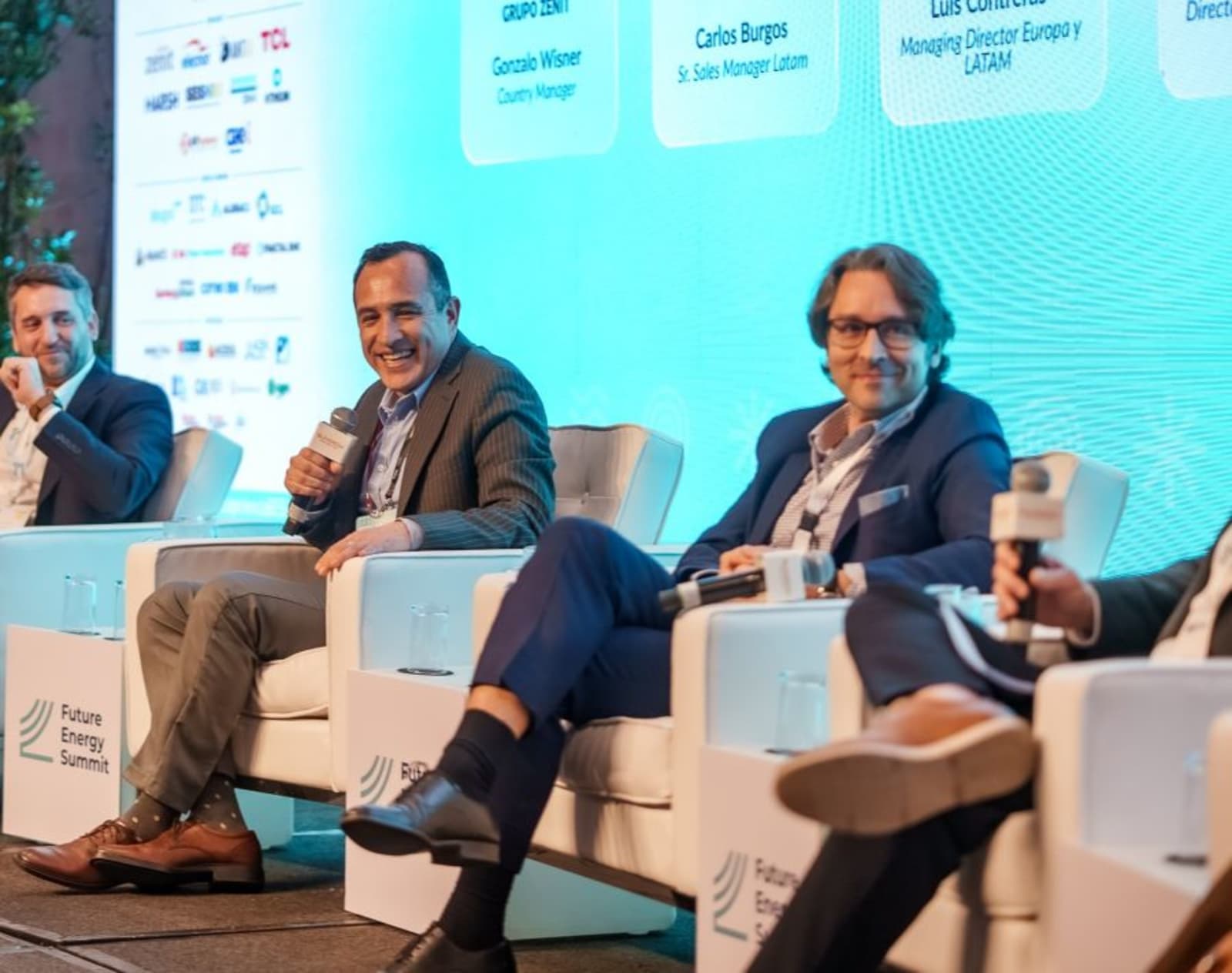
The pressure on solar panel prices opens a broader discussion for Latin America: how to sustain innovation, adapt equipment to each market, and accelerate projects without compromising long-term support . During FES Chile 2026 , Carlos Burgos , Senior Sales Manager LATAM at TCL Solar, explored these challenges with examples from Brazil, Chile, and Colombia.
“We definitely expect the trend to be somewhat upward,” he said regarding prices. However, his assessment wasn't limited to margin recovery: he also linked manufacturers' profitability to investments in technology and the ability to stand behind their products for 30 years.
The discussion about manufacturers' profitability is part of a shift in conditions for the Chinese photovoltaic industry, which, as of April 1, 2026, no longer receives VAT refunds on exports of these products. The measure, introduced by the Ministry of Finance as part of its efforts to curb excessive competition and promote industrial reorganization, altered the economic conditions for suppliers and provided a new framework for the debate on prices faced by international buyers.

Although Carlos Burgos did not specify percentages or dates for further increases, he linked the recovery of margins to the ability to finance technological development and fulfill obligations assumed with clients over decades. From this perspective, the supplier's financial strength emerges as a variable in the project evaluation , because warranties require a company capable of upholding them long after the modules are delivered. “The only way to maintain that presence and reliability in the market is definitely to have solid companies. And how is this achieved? With companies that are profitable enough to sustain themselves in the future,” he stated.
Brazil: competing on price and sustaining innovation
That discussion took on a concrete commercial dimension when Burgos reviewed TCL's entry into the Brazilian market, where, he indicated, the company sold more than 600 MW of panels during its first year of operation, which began in 2025. The executive presented the result as one of the main milestones of its regional expansion and attributed it to the manufacturer's vertical integration, which allowed it to adapt its supply to a demand that is particularly price-sensitive and concentrated, in the experience he described, in the residential, commercial, and industrial segments.
“We really managed to create a panel and a product that was a great fit for the Brazilian market,” he explained, noting that sales exceeded the initial target and fueled expansion into other Latin American countries. With a regional team that had been operating for just over a year, the company sought to broaden its presence based on an experience that tested both its sales capabilities and the product's adaptability to local conditions.
How can this competitiveness be sustained without sacrificing the investments required for technological development? Burgos explained that equipment upgrades respond to constant changes in facilities, networks, and energy consumption patterns, so manufacturers must maintain a pace of investment even when their margins are under pressure. “We cannot stop technology,” he stated, describing a requirement that affects the various components of energy projects.
In detailing TCL's offering, he mentioned half-cell modules, a stacked cell configuration, and back-contact technology, identified in his presentation as BC Contact, which he claimed would achieve close to 25% efficiency at the panel level . The distinction between this and measurements taken solely on the cell was part of his argument: evaluating a product requires observing the performance of the entire system and its contribution to the plant's production.
“It’s not just about having a panel with higher power output, but about ensuring that the energy I’m actually delivering from that panel is the maximum possible,” he explained. Based on this premise, he linked technological improvements to savings in surface area, structures, wiring, and labor, as well as the possibility of freeing up land for other installations. The comparison between alternatives thus encompasses the entire investment, because greater efficiency can modify both construction requirements and the energy the project delivers throughout its lifespan.
Chile: What happens when the module arrives on the ground?
Continue reading
The Atacama Desert was one of the examples Burgos used to explain why operating conditions must be a central consideration in equipment selection. When addressing the effect of temperature on production, the executive pointed out that the power output indicated in the technical specifications must be analyzed in conjunction with the panel's performance on-site, where environmental variables influence the actual energy generated.
This approach has a particular context in Chile, where solar and wind power generation contributed 38% of the system's electricity in 2025 , according to the National Electric Coordinator, while energy storage is gaining importance to shift surplus solar power to other times and reduce generation cuts. For new investments, this means evaluating equipment performance along with the conditions that allow for utilizing its production, from grid connection to the integration of batteries.
At that point, Luis Contreras, representative of Yingli Solar, agreed on the importance of considering high-temperature performance, degradation, and low-irradiance response, linking technological advancements with improvements in initial investment and levelized cost of energy. His presentation also addressed energy storage: he noted that the company had entered the battery business focusing on the commercial and industrial segments and expressed interest in participating in the Chilean market.
Colombia: Small facilities facing a national challenge
Burgos' presentation expanded the regional overview with the Colombian case, highlighting the deployment of small solar installations as a tool to complement hydroelectric generation in the face of El Niño. He explained that projects up to 1 MW have less stringent permitting requirements than larger-scale developments and can be operational within eight to ten months of submitting the application to the grid operator.
This speed of execution, he maintained, had facilitated accelerated implementation by developers and investors interested in incorporating solar power generation and reducing pressure on water resources. “We will be injecting energy into the grid and we will be able to save some of the water we have,” he stated, describing the complementarity between the two sources as one of the contributions of these projects to the response to climate risk.
Burgos estimated that hydroelectric sources account for approximately 67% of Colombia's energy mix and explained that increased solar power would allow for water conservation during periods of lower availability. He also mentioned thermal power plants as a backup, while cautioning about their operating costs, to illustrate why the integration of small photovoltaic plants can have a broader impact than any single installation.
The contrast with Brazil reveals the different factors driving regional activity: while in the Brazilian market the executive highlighted commercial adaptation to a highly price-sensitive demand, in Colombia he emphasized development timelines and the complementarity between technologies . In both cases, his presentation linked business expansion to the ability to respond to the specific needs of each electrical system.
30-year warranties and projects that have been waiting for years
The continuity of manufacturers was one of the points of agreement between Burgos and Contreras, who questioned the sustainability of prices in recent years and linked their evolution to capacity adjustments and the reorganization of the Chinese industry. “You have to maintain a 30-year warranty,” the Yingli representative pointed out, explaining why supplier reliability should be part of the purchasing decision along with price and performance.
Burgos steered the closing of the debate toward another factor affecting investment execution: regulatory timelines. Calling for greater flexibility, he advocated for increased input from the sector's technical expertise in defining operating conditions and argued that government guidelines must allow projects to move forward. "We know of projects that have been waiting, I don't know, six or seven years for even the smallest thing to get them started," he stated.
His argument introduced into the debate a difficulty that technological advances alone cannot resolve: having more efficient equipment and suppliers capable of supporting it is insufficient if investments remain delayed for years. According to the TCL executive, regional expansion requires that innovation and supply capacity find regulatory conditions that allow demand to be transformed into operational projects .
 By Ailén Pedrotti

 By Emilia Lardizabal
 By Energía Estratégica