

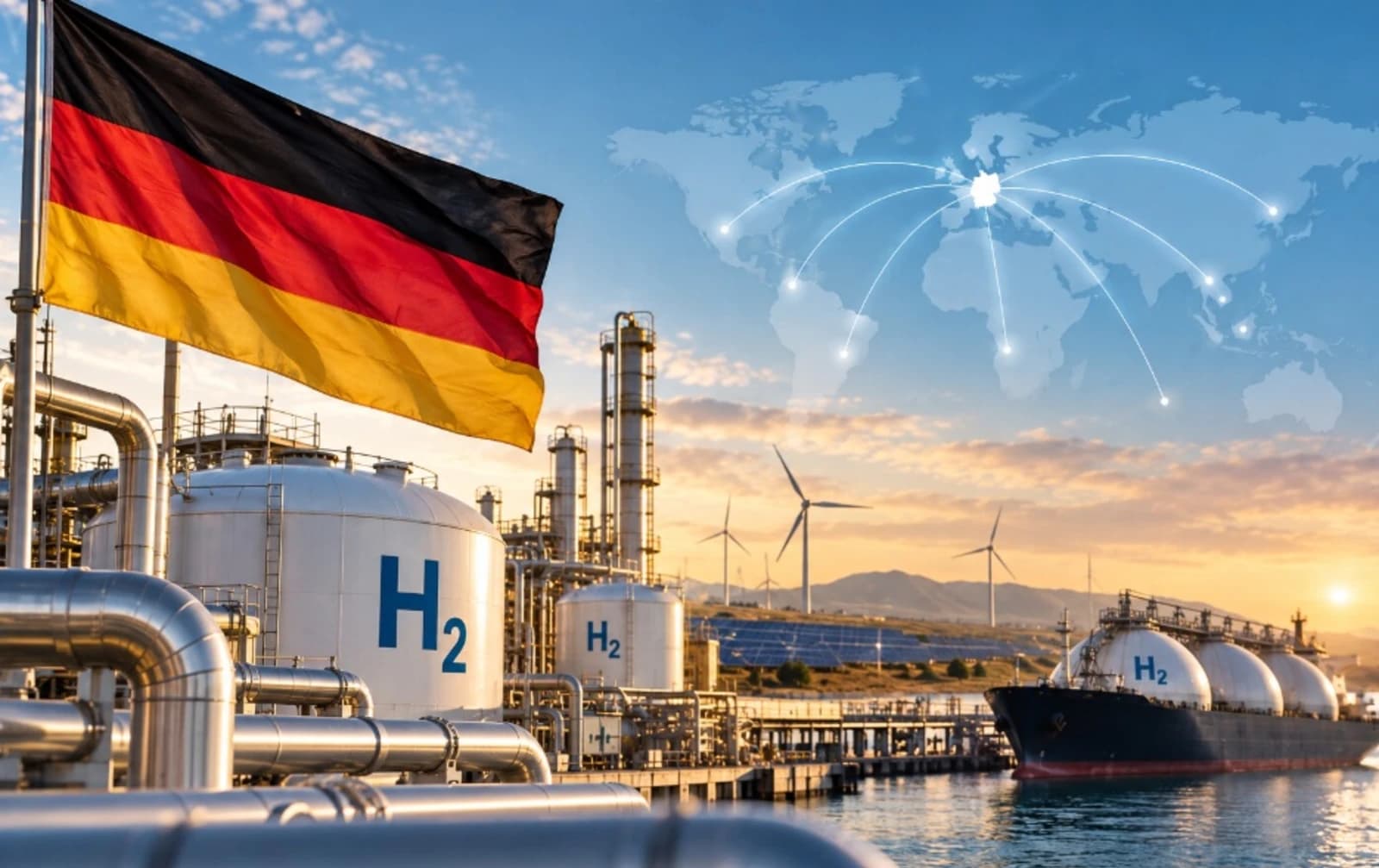
Germany has launched a new call for proposals to finance international renewable hydrogen projects and their derivatives , with aid that could reach €30 million and will be directed towards initiatives developed outside the European Economic Area (EEA) and Switzerland.
The call, published by the Federal Ministry for Economic Affairs and Energy (BMWE) on September 23, is part of the German program for financing international hydrogen projects and will remain open for proposals until December 17, 2026 .
The goal is to boost industrial capabilities on a global scale to produce renewable hydrogen and derived fuels, while Germany makes progress in building future supply chains to meet its own demand.
The call for proposals includes grants of up to €30 million for companies intended for both investments and feasibility studies related to the development of these initiatives.
To access the program, projects must generate significant added value for Germany or Europe and establish or prepare an import route for hydrogen products into Germany .
In this way, the scheme combines two objectives: to facilitate the international deployment of hydrogen-related technologies and to advance the supply chains that Germany will need to decarbonize sectors that are difficult to electrify directly.
Among them, the Government specifically identifies industry, aviation, maritime transport and heavy transport .
Which projects will be eligible for funding?
The so-called Module 1 of the call is mainly focused on the construction of innovative pilot plants to produce renewable hydrogen on an industrially relevant scale.
The funding aims to allow different technologies to be tested under different climatic conditions and usage scenarios.
Infrastructures intended for the storage and transport of renewable hydrogen may also receive support, provided they are part of an initiative that includes a production plant financed under the same program.
The scope also extends to facilities intended to transform renewable hydrogen into methane, ammonia, methanol or other renewable non-biological fuels (RNBF) .
Likewise, feasibility studies of initiatives that meet the conditions established in the call may be financed.
The projects must be structured in such a way that they can be completed before 2030 .
The plants must be located outside of Europe
One of the main characteristics of the program is its international orientation.
The financed facilities must be located outside the European Economic Area and Switzerland , which opens up the possibility of developing projects in different renewable hydrogen producing regions.
However, this does not mean that any foreign company can directly apply for the funds.
To access Module 1, companies must be headquartered in the European Economic Area or Switzerland and have a permanent establishment or branch in Germany . Applications must be submitted through the German representation in Germany.
The program especially encourages the participation of small and medium-sized enterprises.
Furthermore, universities and research institutions based in Germany will be able to obtain funding for scientific work that accompanies the projects.
Germany is looking to future imports
The design of the call for proposals is closely related to Germany's strategy to secure its future hydrogen supply.
Applicants must demonstrate that the initiatives contribute to the development of import structures to Germany and that the projects would not be economically viable without public support.
In addition, investments that receive funding must remain in operation for their intended purpose for at least three years after they become operational .
The program thus seeks not only to develop production plants in third countries, but also to facilitate trade relations with potential exporters and prepare the necessary infrastructure to supply the German market.
The Ministry itself points out that the global growth of industrial capacity to produce renewable hydrogen and its derivatives will be necessary to advance the decarbonization of strategic sectors of the economy.
The selected projects could begin in 2027
The process will take place in two stages.
Interested companies can submit their preliminary proposals until December 17, 2026. The initiatives will then be evaluated, and the selection process is expected to be completed during the second quarter of 2027 .
The selected projects will be invited to submit the complete documentation to apply for funding.
Provided they meet the technical, economic and budgetary requirements, the first initiatives could begin to be implemented during the second half of 2027 .
The call for proposals is administered by Projektträger Jülich (PtJ) , the organization responsible for managing the program.
The new call follows the one made in 2025, which, according to the German Ministry, sparked strong business interest and should result in around 20 funded projects by the end of 2026 .
With this new scheme, Germany is once again looking beyond its borders to develop part of the renewable hydrogen supply it will need over the next few decades, linking financial support for international projects with the construction of future supply routes to its market.