


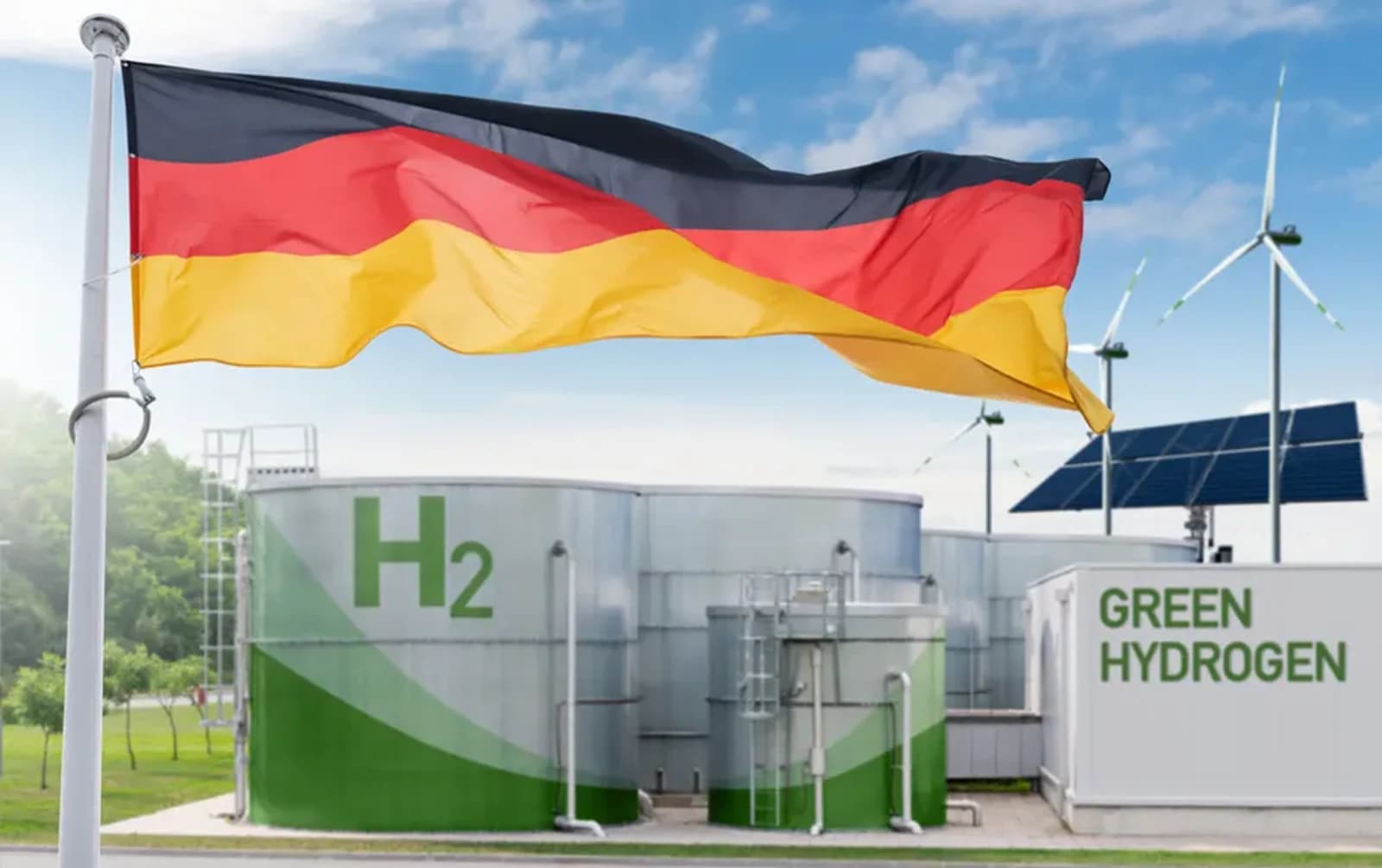
Germany launched a package of ten measures to try to unlock the development of the hydrogen market , in a context where production costs continue to be above the willingness to pay of a large part of industrial consumers and several projects are progressing more slowly than expected.
One of the main announcements is the creation of a specific window for hydrogen within the carbon contracts for difference (CCfD) program , with at least €1.5 billion earmarked for projects that use renewable or low-emission hydrogen.
That volume could be increased if demand exceeds initial forecasts. Furthermore, the overall CCfD scheme, with up to €8.7 billion available , will remain open to hydrogen-related projects.
The second major part of the package will be electricity generation.

The government plans to support the technical conversion of 4 GW of gas-fired power plants so that they can operate on hydrogen , through a phased auction process.
The first round would include 2 GW in 2027 , with an obligation to operate with H₂ from 2040, while another 2 GW would be contracted between 2030 and 2032 , with conversion planned for 2043.
The legal framework is still under development, but the goal is to create a concrete signal of future demand for the fuel.
More network, industrial demand and imports
The strategy also seeks to accelerate infrastructure deployment.
Germany already has more than 500 kilometers of hydrogen backbone network in operation , while another 2200 kilometers are under construction .
For the coming years, federal and regional authorities plan to contribute around €4.2 billion in public funding to continue expanding that infrastructure.
The package also includes import corridors, storage and transformation of distribution networks, with the intention of adapting the system to a greater availability of renewable and low-emission gases.
At the same time, Berlin wants to boost industrial demand.
One of the mechanisms will be the creation of a leading market for low-emission steel , using public procurement and sustainability requirements to generate buyers for products made with renewable or low-carbon hydrogen.
A green gas quota is also being evaluated to support the demand for renewable and low-emission gases.
On the supply side, the government seeks to reduce costs through a more pragmatic interpretation of European rules for renewable non-biological fuels (RNBF), maintain favorable tariff conditions for certain electrolyzers, and enable two 250 MW offshore electrolysis projects .
Germany also intends to rely on diversified corridors, H2Global, the European Hydrogen Bank and new risk reduction instruments for cross-border infrastructure.
The aim is to prevent the market from relying solely on domestic production and to expand supply options as demand grows. This measure also comes at a time when Berlin is seeking to translate its hydrogen strategy into concrete projects.
The problem is no longer just setting goals, but closing the cost gap, securing buyers, building infrastructure, and offering enough predictability to ensure that investments reach a final decision .
With at least €1.5 billion in specific support, 4 GW of convertible power plants and thousands of kilometers of grid under development , Germany is thus trying to move from planning to a more aggressive implementation phase in one of the key markets of its transition