


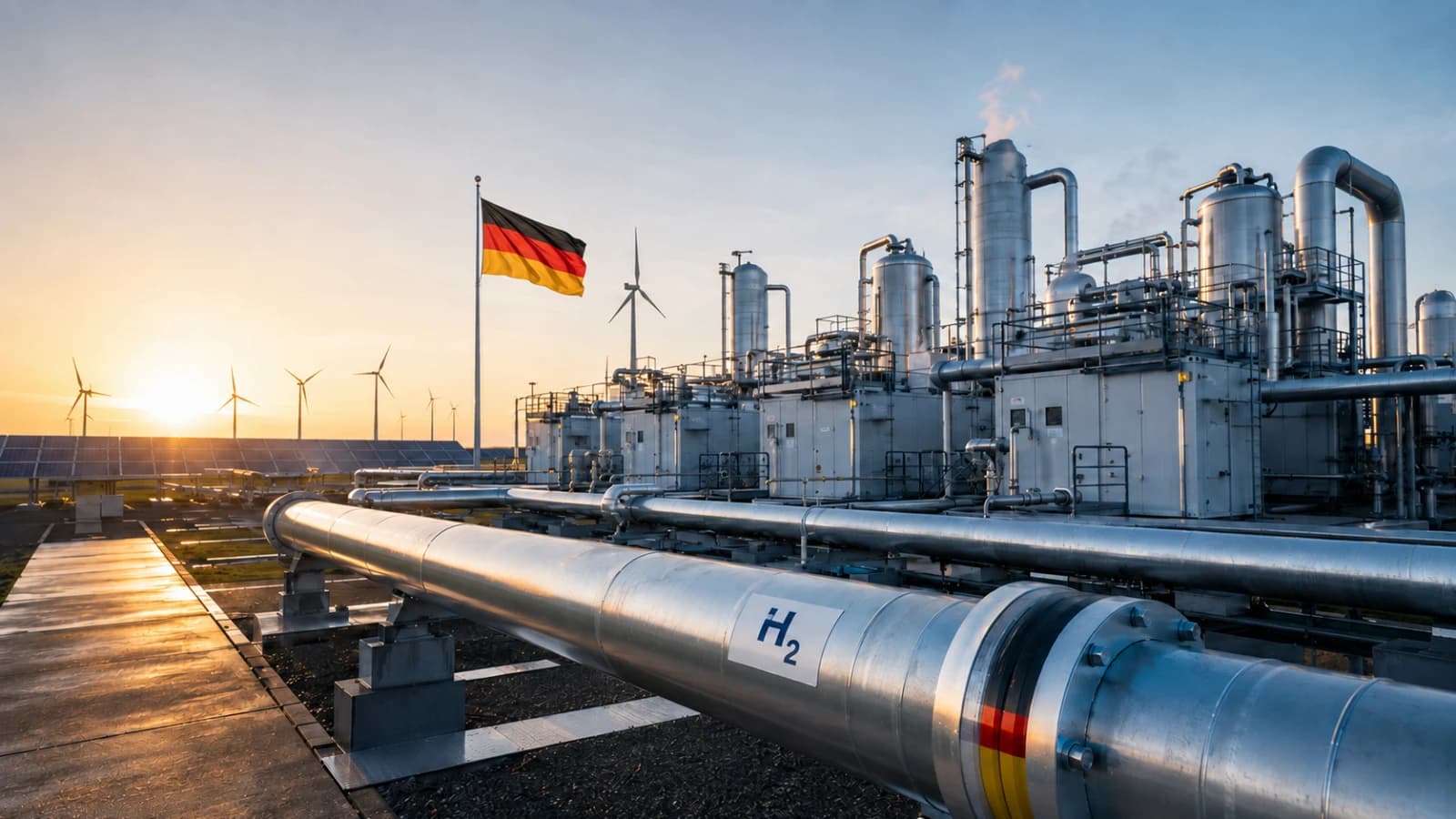
Germany has begun transforming its future hydrogen backbone network into a concrete market for transport capacity. As of July 23, 2026, operators had recorded paid inbound and outbound reservations of almost 6 GW, double the amount reported in the previous update, published on May 13.
To that volume were added approximately 0.6 GW contracted for inter-cluster transport and another 0.5 GW requested that remained under evaluation . Commercial commitments were made several years before all the infrastructure was operational.
“Germany’s hydrogen backbone network is beginning to move from planning to commercialization,” said Luis Ignacio Parada , EU Energy Policy & Regulation Director at Enagás, member of the boards of ENTSOG, ENNOH, GIE and EASEE-gas, and president of GLE.
The third package of market information thus signaled a shift in direction. The German backbone added contracts, bookings, and localized demand signals to the maps, timelines, and technical forecasts that had previously dominated its development.

The booking process began on March 19, 2026, to allow participants to secure transportation and support, among other things, future supply contracts. Since then, the managers have received further inquiries and finalized several agreements .
Input capacity triples by 2029
The infrastructure will initially offer 3,821 MWh of added capacity in 2026. The volume will increase to 5,175 MWh in 2027, 8,055 MWh in 2028, and reach 11,485 MWh in 2029 .
“The total available input capacity across all clusters will increase from 3821 MWh in 2026 to 11485 MWh in 2029,” Parada highlighted.
After that peak, availability will remain above 10400 MWh : it will reach 10708 MWh in 2030 and gradually decrease to 10465 MWh in 2034. Output capacity, in parallel, will decrease from 1977 MWh in 2026 to 8811 MWh from 2030 .
The values for the period 2031-2034 were calculated on the infrastructure of the commercial year 2030, the commissioning of which must be completed before December 31, 2029. Additional actions planned between 2030 and 2037 could increase the available supply.
The future Ost cluster will concentrate the largest volume of the system . From 2030 onwards, it will offer 4170 MWh of input and 2022 MWh of output, equivalent to around 4.2 GW and 2 GW , respectively.
“The largest concentration of available capacity is in the future Ost cluster,” said the Enagás executive, who placed its availability from 2030 at “around 4.2 GW equivalent of input capacity and 2 GW equivalent of output capacity.”
This zone will be formed by integrating Mitteldeutschland, Flow, and Flow 2. Its configuration will encompass corridors such as Rostock-Schönermark, Greifenhagen-Rückersdorf, Kulkwitz-Milzau, Milzau-Bad Lauchstädt, and Rückersdorf-Bad Lauchstädt-Ludwigshafen.
The territorial distribution aims to connect production areas, import terminals, storage facilities, and industrial centers . The maps in the report reflect a progressive expansion from the initial segments in 2025 and 2026 to an interconnected structure spanning northern, eastern, western, and southern Germany by 2029.
The Nord-West cluster will also occupy a strategic position. By 2030, it will reach 2,997 MWh of available input and 4,072 MWh of output, with connections to Oude, Friesland, Hamburg, Brunsbüttel, Ellund, Salzgitter, Bremen, and Huntorf.
Parada noted that “in the Nord-West cluster, the available input capacity reaches almost 3 GW in 2030” , due to “the importance of industrial demand centers and import corridors connected to the German hydrogen backbone network” .
The northwest region encompasses some of the country's main industrial hubs and key access points for future imports. The combination of high consumption, port infrastructure, and cross-border corridors explains why its export capacity is projected to exceed its import capacity by 2030.
Bavaria and mosaHYc expand the trade map
The grid will gradually incorporate new production and consumption hubs. HyPipe Bavaria will add more than 1.1 GW of feeder capacity in Burghausen , while Ingolstadt will have approximately 1.3 GW in both directions.
In Burghausen, availability will reach 1280 MWh between 2027 and 2029. From 2030 onwards, it will be 1123 MWh input and 298 MWh output.
Ingolstadt will be incorporated in 2029 with an input capacity of 1301 MWh and the same output capacity . From that year onwards, the mosaHYc cluster will contribute 1117 MWh in each direction.
“New supply and demand regions are gradually being incorporated into the system,” Parada noted, specifically mentioning HyPipe Bavaria, with more than 1.1 GW in Burghausen and 1.3 GW in Ingolstadt, as well as mosaHYc, also above 1.1 GW.
The phased implementation of these areas will allow for the identification of where the real transportation needs are concentrated . It will also provide guidance for producers, importers, and consumers who need to define the location and timing of their investments.
Continue reading
Applications already exceed the initial supply.
The main sign of commercial traction appeared in the areas where reservation requests exceeded the initially published capacity . Faced with this situation, operators implemented a specific procedure to explore alternatives before rejecting requests.
“Several reservation requests exceeded the initially available capacity, which triggered the specific process for excess demand,” Parada noted.
The process begins with optimization within each supply zone. When that proves insufficient, managers assess a reallocation between areas and clusters . The final stage involves physical interventions, including pressure adjustments or additional infrastructure incorporated into the development plan.
As of the reference date, all cases examined had concluded with a proposal for the applicant. “All cases analyzed so far have ended with a reserve offer,” Parada emphasized.
This result implies that the operators found options through optimization, redistribution, or adaptation of the system . In this way, additional demand began to guide investment decisions instead of being limited by the original configuration.
For this reason, the managers encouraged applications to be submitted even if the required volumes exceeded the published availability. Excess demand provides economic information for determining where infrastructure expansion is most advantageous , in addition to representing a technical constraint.
The report's charts showed a progressive increase in contracts during the subsequent years of development. Reserved capacity exceeded 3 GW equivalent in the last fiscal years represented , while other requests remained under review.
“The aggregated reserve charts already show reserved capacities exceeding 3 GW equivalent for the final years of network development,” the executive stated, adding that there were still additional applications under evaluation.
The grouped presentation protects the operational and commercial secrets of the participants. Even so, it reveals that procurement is distributed across Ost, Nord-West, Burghausen, Ingolstadt, mosaHYc, and interregional transport hubs , rather than being concentrated in a single corridor.
Contracts before the network is completed
The key data point goes beyond the volume reserved: participants began to make long-term transport commitments before the infrastructure was fully operational .
“Market participants are already willing to commit transport capacity several years before the complete network becomes operational,” said the Enagás representative.
This approach can reduce some of the uncertainty associated with a network still under construction. Advance contracts provide visibility into who needs capacity, where, for what period, and in which direction , while users gain a basis for negotiating future supplies.
Commercialization also allows for the detection of bottlenecks before commissioning. Congestion signals already respond to specific market demands , although the identity of the participants and their individual volumes remain protected.
The deployment of the transport system coincides with a broader transformation of the German energy sector. The country is moving forward with three processes aimed at adding more than 10 GW of dispatchable capacity by 2031 , within a framework that relaxes long-term requirements and improves storage options, although hydrogen-powered plants will retain a significant role.
Germany has also launched its first call for tenders for 4,500 MW . The Bundesnetzagentur will accept bids until September 8 and will award 15-year contracts to dispatchable power plants, storage systems, and projects ready to operate using hydrogen.
The connection between these two policies will be crucial. A grid with reserved capacity can facilitate the future supply of energy to industries and facilities , while new procurement mechanisms could create additional demand for hydrogen-compatible projects.
Meanwhile, the German government asked Brussels for greater flexibility in the European rules applicable to this sector in order to unlock investments and accelerate market development . The regulatory framework will determine how quickly producers and consumers can take advantage of the contracted infrastructure.
The convergence of transport, reserves, auctions, and regulation will set the pace of development. The grid needs sufficient production and demand to sustain its investments , while industrial projects require certainty regarding access, regulatory requirements, and future availability.
The operators plan to publish quarterly updates on capacity, clusters, and supply zones. They will also extend the data timeframe and adapt its presentation to comply with German regulatory requirements.
“The emergence of reservation contracts, signs of congestion, and capacity expansion mechanisms indicates that the European hydrogen market is gradually moving from concepts and forecasts toward tangible commercial commitments,” Parada concluded.
Germany still needs to complete a significant portion of its hydrogen infrastructure. However, future space is already being contracted, orders are forcing a review of capabilities, and market signals are beginning to define where infrastructure will need to be reinforced .