Europe is accelerating a new industrial race around batteries: it no longer only matters how many BESSs will be connected to the grid, but who will manufacture the cells, modules and systems that will support them.
According to Aurora Energy Research , installed capacity will exceed 80 GW in 2030 and four-hour configurations will concentrate investments of 24 billion euros.
This volume explains the arrival of a new wave of gigafactories , many with LFP chemistry, Asian capital and a direct link with renewables, networks, data centers and energy-intensive industry.
“As long as they arrive, set up and produce in Europe, it is already considered a battle won and a step closer to a certain degree of industrial autonomy,” warns Andrés Pinilla Antón , BESS Sales Director EU & LATAM of Risen Energy , in dialogue with Energía Estratégica .

Its reading encapsulates a central tension: Europe seeks industrial autonomy, but knows that technology and scale remain largely in Chinese hands . Unlike the United States, where industrial incentives are combined with stricter restrictions on Chinese capital, the European continent appears to be adopting a different strategy.
“Here, they are given the red carpet treatment: 'Come however you want, we'll do business and move forward',” Pinilla explains.
The map of BESS and industrial gigafactories shows that European energy sovereignty is also at stake in factories: there, the cells, modules and systems needed to store renewable surpluses, stabilize grids and electrify new consumption will be produced.
The central map: the gigafactories that are transforming Europe
The European BESS map is not limited to pure storage plants .
It also includes multipurpose gigafactories that produce LFP cells, anodes, cathodes, modules, or packs with potential applications in networks, industry, self-consumption, and data centers. The boundary between automotive and stationary storage is beginning to blur.

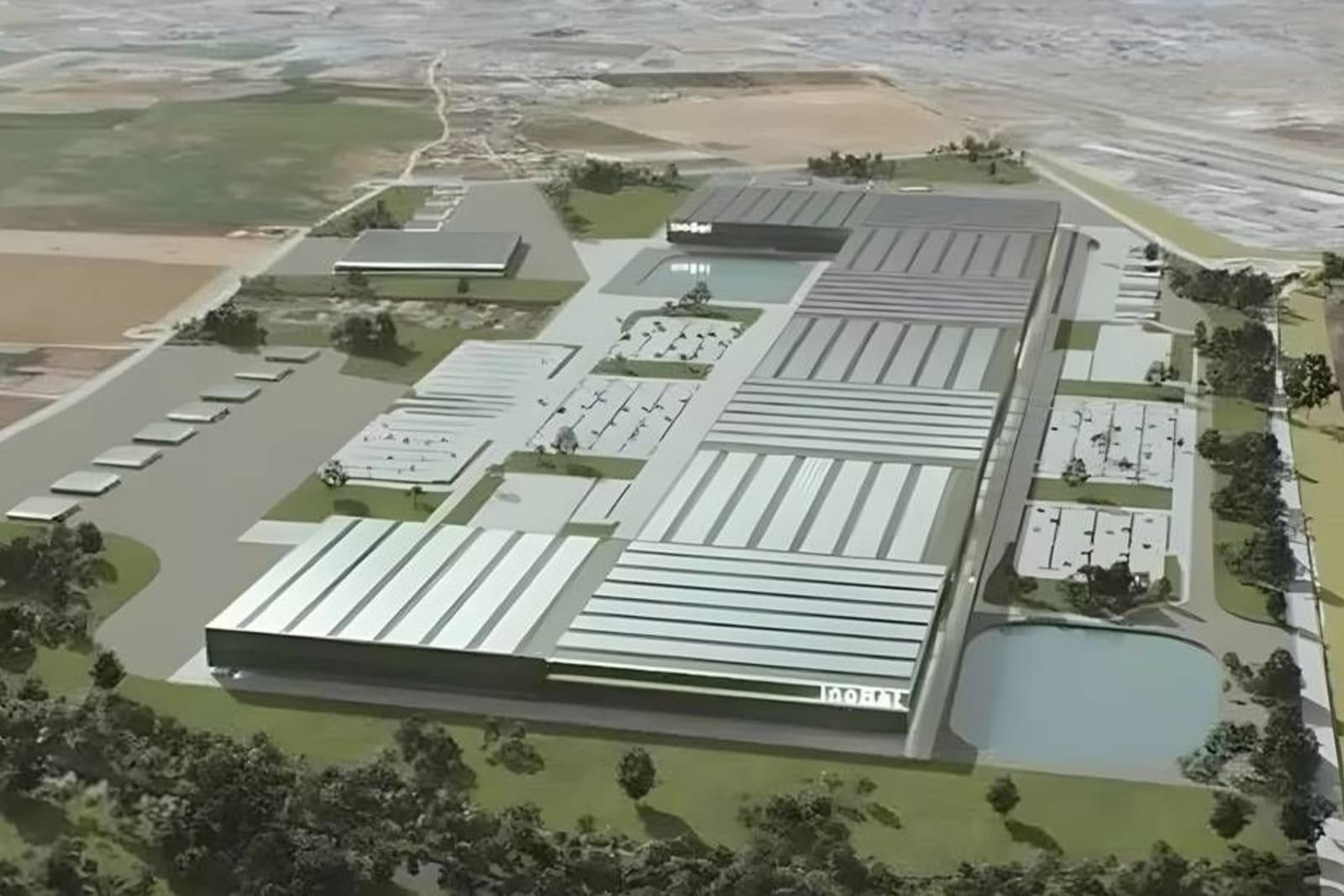
Gotion High-Tech , in Valladolid, represents the most ambitious project in terms of scale and energy integration . The project envisions an investment of around €5 billion and a surface area that could reach approximately 1,000 hectares , with an industrial plant linked to anodes and cathodes and an energy plant based on an associated mega-solar facility for self-consumption.
In Navalmoral de la Mata, AESC/Envision also embodies this new paradigm. The Extremadura gigafactory, designed with a target capacity of 30 GWh , is linked to electric vehicles, but its LFP chemistry and Envision's global position in stationary storage justify its inclusion in the BESS-industrial map. It is not a purely grid-connected plant, but neither can it be viewed solely as an automotive project.
The same nuance applies to Stellantis-CATL in Figueruelas , Zaragoza. The project, with a planned capacity of up to 50 GWh , originated in the electric vehicle sector, but introduces a continental-scale LFP capacity to Spain.
Joining this picture are Hithium in Navarre and TDG Ibernavitas in Zaragoza , which do appear to have a more direct focus on BESS systems. Cegasa , from Vitoria-Gasteiz, completes the Spanish map with its already operational activity in storage modules, while Basquevolt contributes the technological dimension of solid-state batteries with potential applications in both mobile and stationary applications.
Spain's internal war and solar weapon
Behind the map lies an internal economic war. Europe needs manufacturing capacity, but each country competes to attract investments that promise jobs, technology transfer, auxiliary suppliers, electricity demand, and industrial positioning.
Hungary, Poland and other Eastern markets have gained ground due to their cost structure, land availability, manufacturing tradition and a more pragmatic relationship with Asian capital .
CATL and EVE Energy in Debrecen show how Hungary got ahead of other countries by positioning itself as a European hub for Chinese battery manufacturers.
Continue reading
Poland , for its part, already has a powerful industrial base and includes cases like Lyten in Gdańsk, following the acquisition of the former Northvolt Dwa plant, with a focus on BESS, data centers and critical applications.
Spain competes with another argument: abundant renewable energy and competitive operating costs. In an electricity-intensive business, where the carbon footprint will become increasingly relevant, solar power generation can become a differentiating factor.
Pinilla summarizes it with a market analysis: Eastern European countries are "pushing hard" for cheaper labor, while Spain and Portugal may have an opportunity due to energy costs, provided that OPEX is as low as possible.
There appears the Spanish solar weapon.
Gotion encapsulates the new paradigm: a battery factory linked to a mega solar plant to reduce electricity costs and carbon footprint from the design stage. Envision is aiming in the same direction in Extremadura, where renewable resources, land, and access to the Iberian market outweigh the wage competition from Eastern Europe.
The red carpet for Asian capital
“We know the technology will be Chinese. They are light years ahead of us in technological advancements, so there isn't much room to hide in that regard,” Pinilla acknowledges.
CATL, Gotion, Envision, EVE Energy , and Hithium currently hold a significant portion of these capabilities. Therefore, Europe is moving towards partial autonomy: if it doesn't control all the technology, it at least seeks to locate production, employment, and suppliers within its borders.
“As long as they arrive, set up and produce in Europe, it is already considered a battle won and a step closer to a certain degree of industrial autonomy,” Pinilla points out.
The risk is that ownership, patents, critical machinery, and engineering will remain concentrated in Asia . The immediate benefit, however, is clear: investment, jobs, a support network, reduced logistical exposure, and better alignment with future EU regulations.
The automotive annex: noise in the general mapping
The European map of gigafactories cannot be read as a homogeneous block.
Although there are dozens of projects announced, under construction or operational, a significant portion responds almost exclusively to the electric vehicle chain and does not by itself define the strategic map of stationary storage.
This distinction matters because the automotive sector has undergone adjustments, delays, and restructurings. Projects announced years ago have yet to materialize, while BESS or multipurpose plants linked to renewables, grids, data centers, and energy-intensive industries are gaining prominence.
Furthermore, much of the existing European capacity is still focused on EVs and led by Asian manufacturers based in the east of the continent, such as LG Energy Solution in Wrocław, Poland, and Samsung SDI and SK On in Hungary.
In Spain , PowerCo, part of the Volkswagen Group, is building an initial 20 GWh plant in Sagunto. It is strategic for the local fuel cell supply chain, suppliers, and industrial employment, but its focus is entirely on the automotive sector.
The same applies to part of the AESC/Envision deployment: while Navalmoral de la Mata enters the BESS-industrial map due to its LFP chemical and its link with local renewable energy, Douai, in France , with 9 GWh for Renault, and Sunderland, in the United Kingdom, with 15.8 GWh for Nissan, respond to an EV logic.
The ACC consortium , backed by Stellantis and Mercedes, is also located in the industrial risk zone. Its Billy-Berclau plant in France is operational, but its projects in Kaiserslautern, Germany, and Termoli, Italy, have been delayed or temporarily suspended to concentrate resources and review strategy.
Verkor is making progress in Dunkirk with a gigafactory geared towards Renault, while Agratas/Tata is developing a 40 GWh project in Somerset, also associated with electric vehicles and affected by delays.
Morrow Batteries, in Arendal, Norway, offers another cautionary tale: its crisis and technical bankruptcy demonstrate that building gigafactories in Europe requires much more than mere announcements. It demands intensive capital, technology, guaranteed demand, permits, energy supply, raw materials, and the ability to scale without losing competitiveness to Asia.
 By Emilia Lardizabal


 By Ailén Pedrotti
 By Florencia Guglielmetti