


Yesterday, the results of the European Hydrogen Bank's third auction were published: nine projects were awarded across three categories for a total of €1.09 billion, with bid prices ranging from €0.57 to €3.49 per kg (€/kg). Collectively, these projects will provide nearly 1.1 GW of electrolyzer capacity and produce 1.3 million tons of RFNBO and low-carbon electrolytic hydrogen during the first 10 years of operation, with an estimated reduction in greenhouse gas emissions of 9 million tons of CO2 equivalent.
It is worth noting that the auction received demand more than seven times its offer.
The call for proposals awards successful projects a grant to help cover the price difference between their production costs and the market price. The aim is to incentivize the production and use of clean hydrogen. After signing their grant agreements, the nine selected projects will receive a fixed premium of between €0.44 and €3.49 per kilogram of certified and verified hydrogen produced, for a maximum period of ten years.
The selected projects

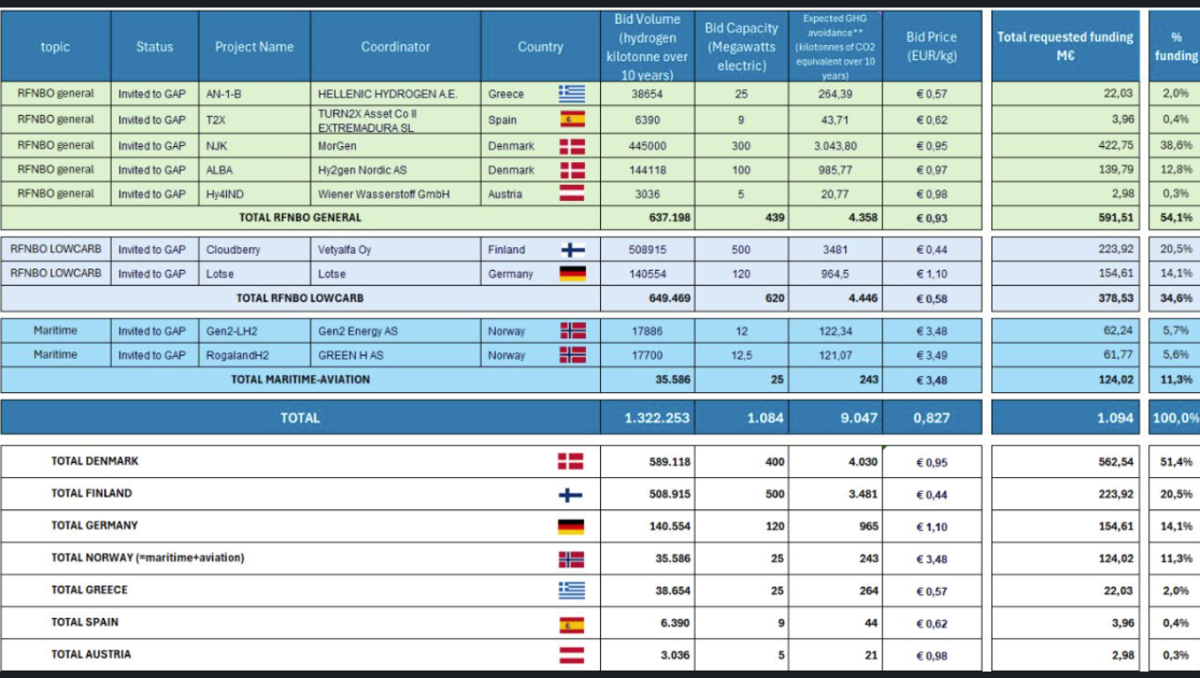
Hydrogen Europe celebrated the results of the third auction and congratulated its members Hellenic Hydrogen SA, MorGen Energy, Wiener Stadtwerke and Hy2gen for their success in this competitive auction, which had demand more than seven times the supply.
"It is positive to see countries like Greece and Austria represented for the first time on the list of winners, while the largest awarded contract went to a project in Finland, a country that has transposed its RED III Directive transport targets. Bid prices have remained surprisingly low, often below €1/kg of hydrogen produced. This demonstrates the continued high level of competition and confirms the expectation that low-carbon and low-carbon hydrogen will have to be sold at a higher price," the association stated.
Daniel Fraile, Director of Policy and Market at Hydrogen Europe, commented: “We are seeing continued strong interest in the auctions, with a similar number of applications to the previous round. Furthermore, we are noting how the adoption of the RED III transport directive in Germany is creating clear opportunities for the development of electrolytic hydrogen projects targeting the German market, including projects in Denmark thanks to the planned hydrogen interconnector. We strongly advocate for the continuation of the European Hydrogen Bank, building on the lessons learned, supporting the full implementation of RED III and transport regulations, and the rapid deployment of infrastructure.”
The auction was divided into three categories. The first, focused on RFNBO hydrogen production projects, saw strong demand, with 50 projects submitting bids totaling €7.3 billion, competing for a total EU fund of €600 million. Five projects, distributed among Greece, Spain, Denmark (two), and Austria, were awarded €592 million, with bids ranging from €0.57/kg to €0.98/kg.
The second basket included low-carbon electrolysis and RFNBO projects. It received five bids, with a funding request of €800 million for a total fund of €400 million. Two projects, one in Finland and one in Germany, were selected and invited to sign the grant agreement, for a total of €379 million in funding. The winning bids were €0.44/kg and €1.1/kg.
Continue reading
The third basket also included low-carbon electrolytic hydrogen and RFNBO projects, but specifically for buyers in the maritime and aerospace sectors. Three projects submitted bids, resulting in an oversubscription of €137 million. Two Norwegian projects were awarded contracts, with bids of €3.48/kg and €3.49/kg, respectively.
The projects governed by the Auction-as-a-Service (AaaS) mechanism are not yet publicly available. However, the Commission announced that three projects in Spain and three in Denmark will be invited to sign grant agreements under the AaaS framework in Spain and Germany, respectively. The German government will allocate €1.3 billion to RFNBO hydrogen projects linked to the Danish-German gas pipeline, with buyers in Germany. In addition, Spain has allocated €304 million to RFNBO for domestic projects, and €136 million for RFNBO and low-carbon electrolytic hydrogen, with buyers in the maritime and aerospace sectors.
Next steps
The European Union's Climate, Infrastructure and Environment Executive Agency (CINEA) will begin formally preparing grant agreements with the selected projects. This stage will confirm the final terms of the financial support, including the fixed premium per kilogram of hydrogen and the implementation schedule. The agreements are expected to be signed in the last quarter of 2026.
The selected projects must reach financial closure within two and a half years of the grant being signed and become operational within five years. These commitments are backed by a completion guarantee provided by the projects to the Commission.
CINEA will continue to monitor progress throughout implementation to ensure that projects are carried out as planned and that support is used in accordance with the agreed terms.
FES's next stops
The Future Energy Summit tour will continue with FES Guatemala on May 14 and FES Mexico on May 19, where key players from the public and private sectors will address the challenges and opportunities linked to the expansion of the energy system, new investment schemes and the execution of strategic projects.
To access the full FES 2026 tour schedule, learn more about it and be part of the meetings, the FES digital platform is available, while all events will have a live broadcast through the official Future Energy Summit YouTube channel.
For inquiries and more information, please contact info@futurenergysummit.com