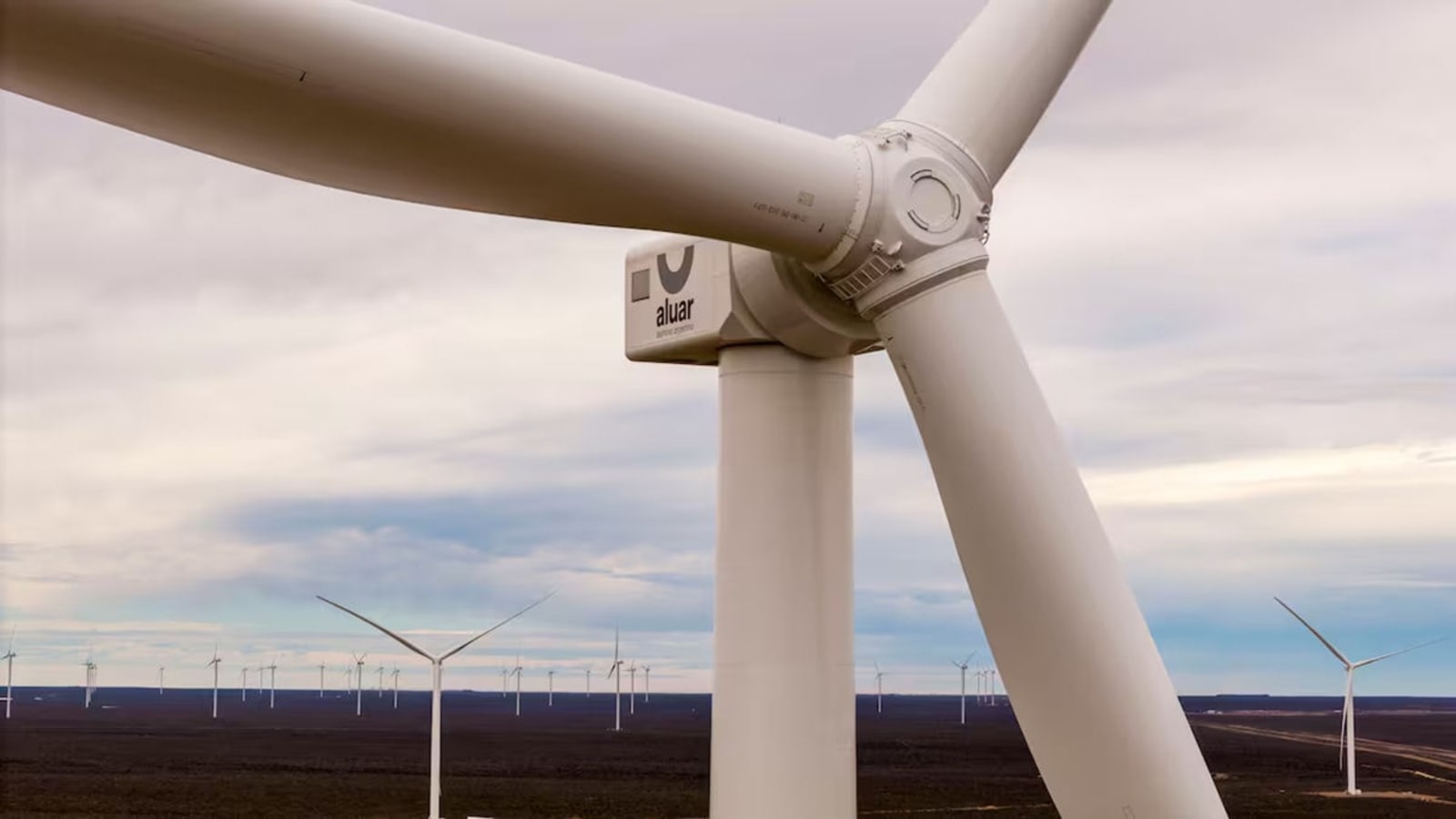
With the inauguration of At the end of October, Aluar increased its installed capacity to 582 MW with the La Flecha Wind Farm (336 MW) , and now accounts for nearly 12% of the operational wind power in Argentina 's Wholesale Electricity Market (MEM).
“Today, nearly one in eight megawatts of installed wind power in Argentina is produced at the Aluar Wind Farm,” the company highlighted on its social media channels.
Why is this? Currently, the country has 5107 MW of operational wind power in the MEM , of which 2203 MW are concentrated in Buenos Aires and Greater Buenos Aires, and 1,998 MW in Patagonia.
In this way, Aluar's facilities account for 29.1% of the operating capacity of this latter region, where some of the best capacity factors at the national and international level are recorded, with yields of around 50%.

The latest expansion represented a 136.6% increase over the accumulated power in the four previous stages and positioned the complex located in Puerto Madryn, Chubut, as the largest wind farm in the country.
After an accumulated investment of USD 743 million, it brings together 119 wind turbines distributed over approximately 200 square kilometers, an area similar to that of the Autonomous City of Buenos Aires.
Aluar's foray into this technology began in 2016, when it decided to incorporate wind power generation into its self-supply electricity scheme. Since the approximately 50 MW installed in 2019, the company has increased its capacity more than elevenfold.
In particular, La Flecha constitutes the largest individual project developed to date by the Argentine wind industry .
Its origin dates back to the end of 2023, when Goldwind Argentina signed a contract with the aluminum producer to supply 52 GW165 wind turbines with a unit power of 6 MW , equipped with permanent magnet direct drive (PMDD) technology.
In mid-2024, the addition of four more units was agreed upon, increasing the originally planned 312 MW by 24 MW.
The project took two years, covered a 10,000-hectare site, and required the laying of a 35-kilometer high-voltage power line to the industrial plant.
However, Aluar does not rule out further expansions, as it still has 37,400 hectares with the potential to incorporate another 1,500 MW , which would allow it to exceed 2 GW of wind power if these developments materialize.
The growth outlook is framed within a market where this technology represents 56.8% of the 8987 MW of renewable energy operating under the sources contemplated in Law No. 27,191.
But if large hydroelectric plants, exceeding 50 MW, are considered, the renewable capacity of the MEM amounts to 18,627 MW and the wind power share stands at 27.4%.
Aluar will triple the wind power contribution to its plant and add solar energy and batteries.
The primary aluminum plant in Puerto Madryn has a continuous demand of approximately 780 MW . At the close of its fiscal year in June 2026, the company reported that during the previous twelve months, 45% of its electricity supply came from thermal sources, 43% from the Futaleufú hydroelectric plant, and 12% from wind power generation.
With La Flecha operational, Aluar projects that the latter will increase to 36%, while thermal energy will decrease to 31% and hydroelectric energy will be at 33%.
“From now on, it is projected that approximately 70% of the electricity used by Aluar will come from renewable sources,” the company stated.
Modifying its supply matrix would allow it to avoid the emission of more than one million tons of carbon dioxide per year , according to corporate estimates.
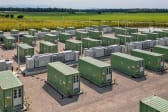
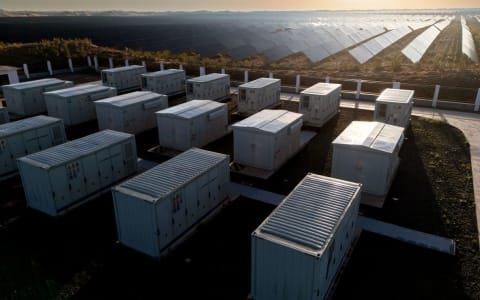
Meanwhile, Argentina's only primary aluminum producer is advancing the development of a solar park and BESS systems, which are scheduled to begin operations in 2027, after being awarded a 50 MW project in the AlmaSADI tender .
The initiatives are part of the company's reinvestment strategy, which has allocated USD 3.7 billion to investments in the country over the past 20 years .
 By Emilia Lardizabal
 By Energía Estratégica

 By Ailén Pedrotti

 By Matías Medinilla