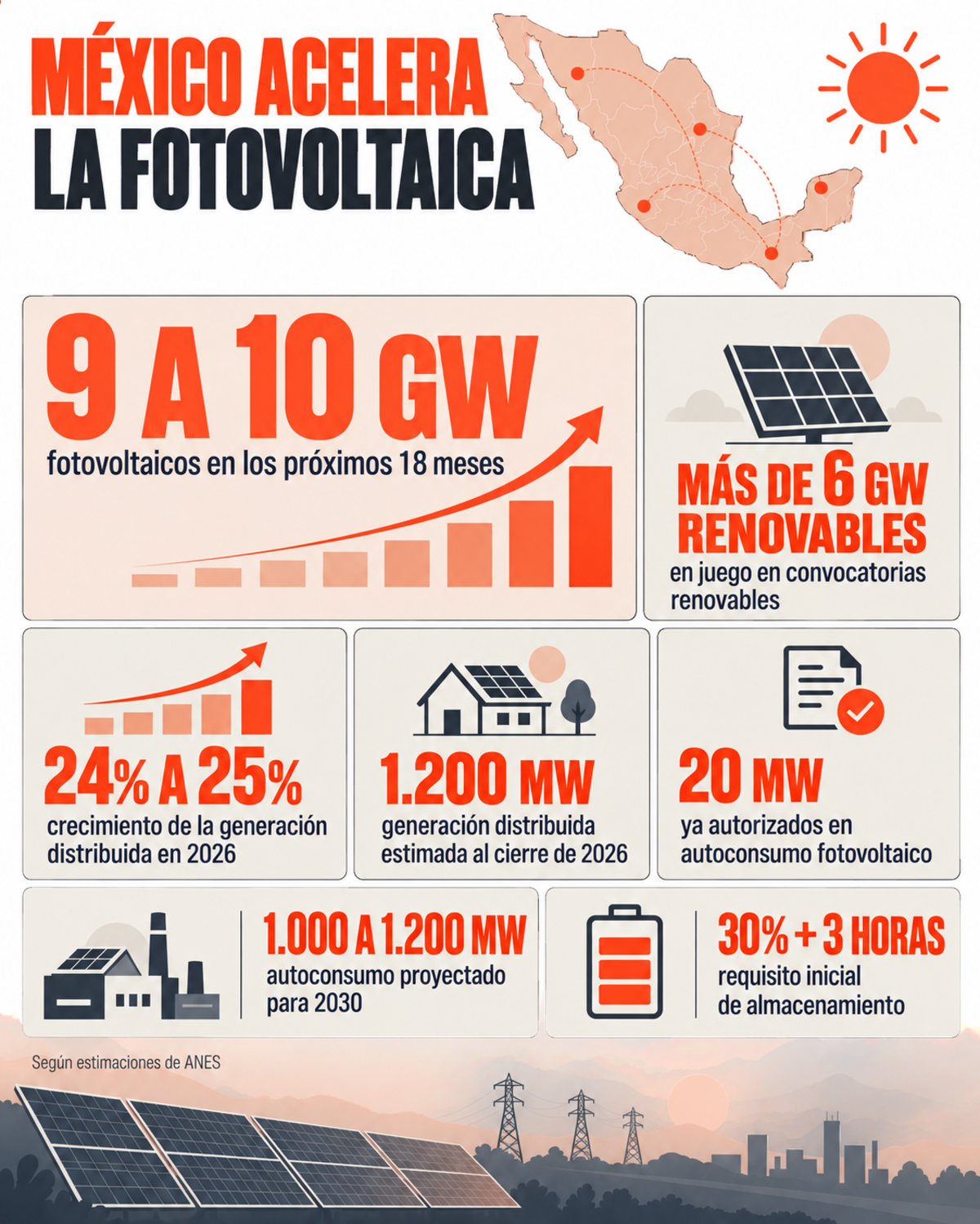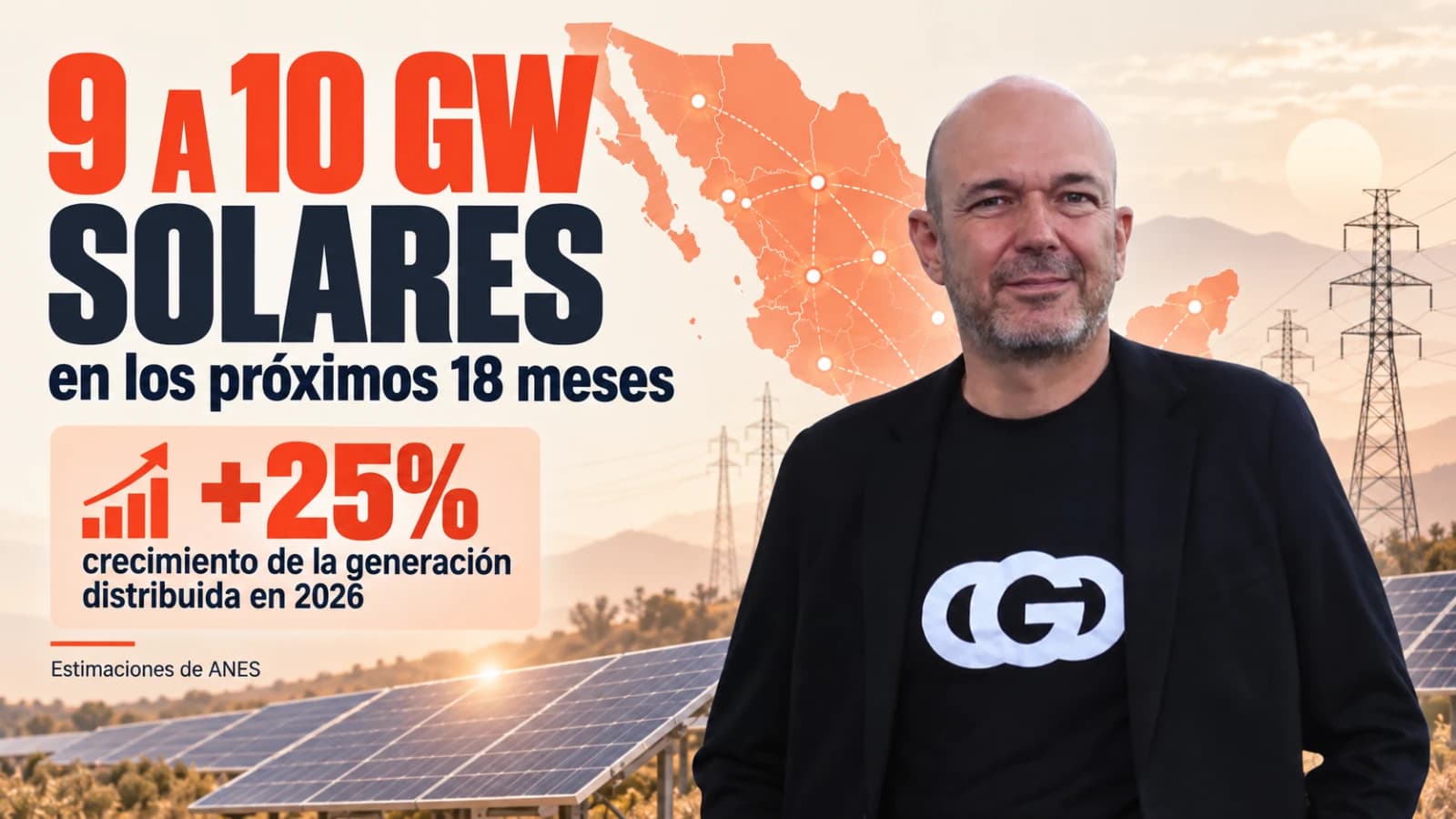
Mexico could incorporate between 9,000 and 10,000 MW of new photovoltaic generation during the next 18 months , in a stage marked by the reactivation of large-scale projects, new calls for tenders and a renewed interest from international developers in the market.
This was confirmed by Gilberto Sánchez, president of the National Solar Energy Association (ANES) , during an exclusive interview with Energía Estratégica at Intersolar México, where he simultaneously identified movements in three segments: utility scale power plants, self-consumption and distributed generation.
“ We see a very interesting interest from many companies worldwide that are turning their attention to Mexico again ,” the executive says.
According to the head of ANES, the change compared to previous years is already visible in the behavior of international capital. Companies from Europe, the United States, and South America are once again exploring opportunities in Mexico , in parallel with the progress of the initial processes.

This scenario coincides with a new round of competition for renewable energy capacity . Recent mixed and private calls for bids have closed their registration periods with over 6 GW of capacity at stake and portfolios submitted by international developers, while the technical process continues to determine which initiatives will move forward.
“ We see generators from Europe, we have seen them from South America and the United States. There are always players who are always present: Germans, Spaniards, Portuguese ,” the president of ANES stated.
From announced projects to construction
The central point for the market will now be to convert that interest into contracts, works and operational megawatts before 2030, the target date for commercial operation of the calls for tenders.
Sánchez explains that the process initiated with the calls for priority projects and mixed investment schemes is now going through a phase of greater concreteness.
“ We are in the phase of finalizing, signing contracts and starting construction ,” he said.
For Sánchez, the location of the plants is beginning to become a central component of planning , with a logic aimed at bringing generation closer to the centers where electricity is actually consumed.
“ Today we are focusing on where to generate energy . We don't have to go to the north of the country to generate energy in order to move it to the center of the country. That's a thing of the past ,” he explained.
The strategy would reduce additional pressure on the grid and allow for more efficient use of existing infrastructure. In this model, batteries take on a role that goes beyond traditional renewable energy backup.
“ Storage helps us optimize the use of infrastructure, and that's something that hasn't been seen as such ,” Sánchez warns.
The rules of recent calls already incorporate this variable: the new solar and wind power plants contemplated in these processes must integrate storage systems equivalent initially to 30% of their capacity, with three hours of discharge .
However, the leader clarifies that this parameter will not necessarily be definitive for each project. The industry is awaiting a variability analysis methodology that will determine the requirements based on the conditions of the power plant and the electrical grid.
“ It can be a higher percentage and more hours. Or it can be less ,” he explains.
Continue reading
The battery intended to compensate for variability could also open up other revenue streams. Capacity exceeding the technical requirements could be used for energy arbitrage and, eventually, for other services to the system.
Sánchez lists voltage regulation, frequency regulation and black start as possibilities, factors that could modify the economic equation of the projects and expand the monetization of the assets.
“ Photovoltaics will not grow without storage. Nowhere in the world. No matter what, ” the association president declared.
Distributed generation: 2026 could end with a jump of up to 25%
The expected expansion is not limited to large-scale power plants. Distributed generation could register another year of double-digit growth and accelerate to between 24% and 25% by 2025 , according to the association's projections.
“ This 2026 we must close with 1200 MW ,” Sánchez estimates regarding the new capacity that could be incorporated during the year.
One of the indicators ANES uses to anticipate this trend is the number of inspections related to medium-voltage contracts. According to the executive, these inspections are currently progressing at approximately twice the rate observed last year .
“ This indicator tells us that we need to grow at least 20% more than we have been. This would give us 24 or 25% growth compared to 2025 ,” he explained.
The sector's focus is now on the new administrative regulations for distributed generation. Among the changes ANES anticipates are those related to projects under 700 kW, energy storage, collective distributed generation, and potential schemes linked to communities and energy poverty .
The executive avoids interpreting the regulatory wait as a brake on investment. On the contrary, he asserts that activity continues to increase under the current rules and that companies are primarily inquiring about when they will be able to use the new mechanisms .
“ Some people say it’s uncertainty. No, we see it as an expectation ,” he stated.
In addition to this, there is self-consumption, where the recently implemented Single Window system aims to simplify and expedite procedures with various government agencies. According to Sánchez, there are already around 20 MW of photovoltaic projects with permits granted under this scheme , despite it still being a mechanism with a low level of awareness among potential users.
ANES projects that this market could reach between 1000 and 1200 MW of self-consumption by 2030, opening up a particularly relevant alternative for companies interested in producing electricity behind the meter.
This industrial interest also faces a financial challenge. The context recently analyzed by Energía Estratégica shows a greater search for shorter-term PPAs and structures where third parties assume part of the CAPEX , while private capital and fintechs begin to fill gaps that commercial banks do not yet fully cover in solar and BESS projects in the commercial and industrial segments.
In this way, Mexico is beginning to combine three different speeds of solar expansion : large power plants associated with calls for tenders and mixed schemes, distributed generation with growth exceeding 20% annually, and a self-consumption market that is beginning to be structured under a specific procedure.
For Sánchez, the key element will be energy storage. Not only as a requirement for managing photovoltaic variability, but also as a tool to bring generation and demand closer together, reduce congestion, and make better use of existing networks .