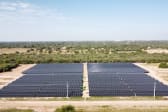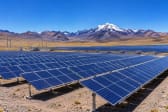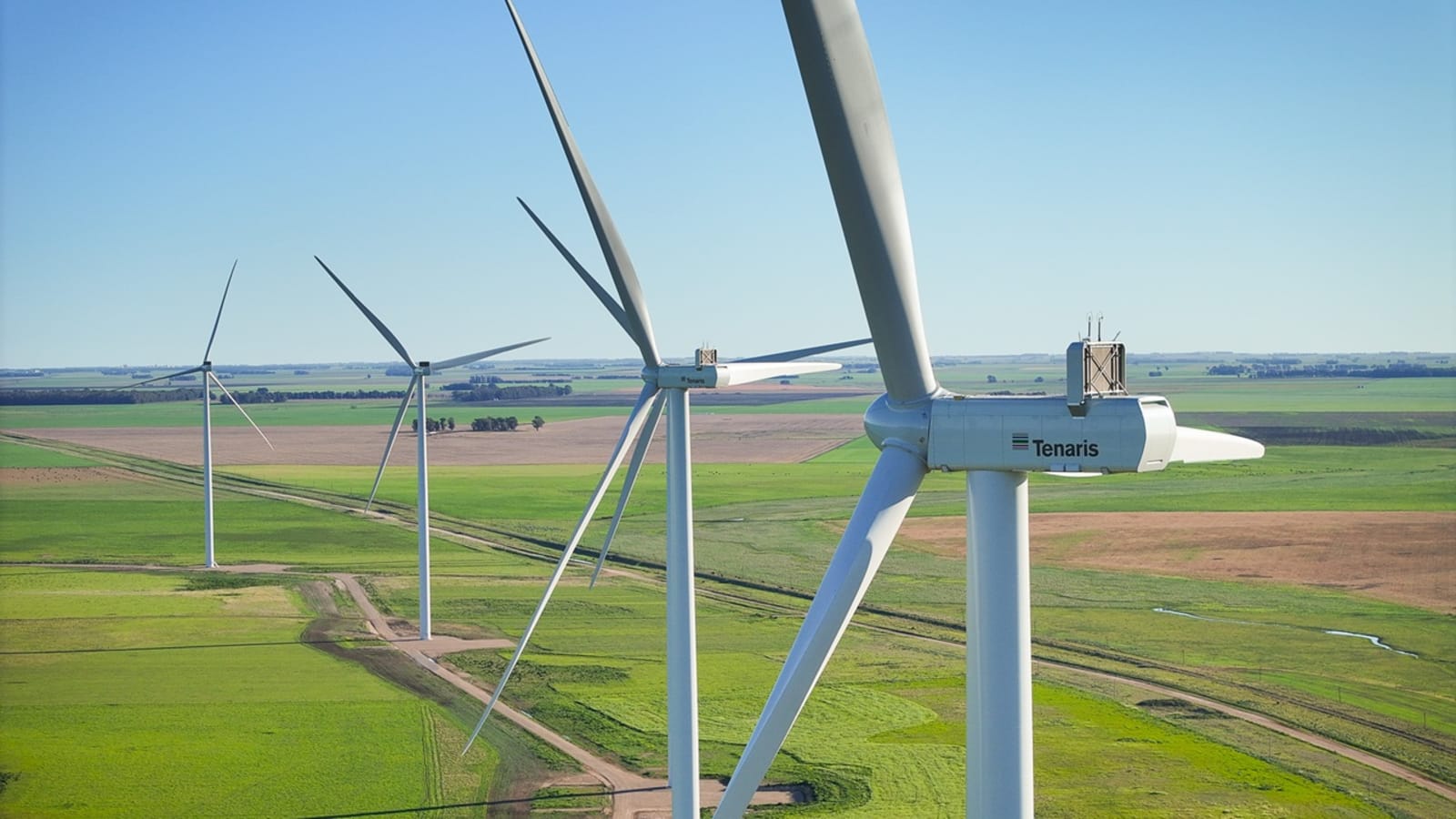
Argentina added a new renewable energy project to the Incentive Regime for Large Investments (RIGI) with the approval of the La Rinconada Wind Farm , promoted by Tenaris in the province of Buenos Aires.
The initiative becomes the third renewable project approved under this scheme , after the El Quemado solar park of YPF Luz and the wind farm of PCR and ArcelorMittal Acindar in Olavarría.
The authorization was formalized through Resolution 1983/2026 , published in the Official Gazette, and enables the project to access the tax, customs and exchange benefits provided by the regime.
La Rinconada will require a total investment of USD 230.75 million , of which approximately USD 218.3 million correspond to assets computable for the purposes of the RIGI.

The park will have an installed capacity of 94.5 MW and will consist of 21 wind turbines of 4.5 MW each .
Its location will be about 40 kilometers from Olavarría and the connection to the Argentine Interconnection System (SADI) will be made through the new La China transformer station, belonging to TRANSBA.
CAMMESA granted the project a dispatch priority of 91.5 MW .
Unlike other energy initiatives linked to RIGI that aim to generate exports, La Rinconada will primarily supply electricity to Siderca , the Tenaris plant located in Campana.
For this reason, the company did not declare exports associated with the project nor did it request the benefit of free availability of foreign currency provided for investments that generate external income.
The strategy aims to progressively cover the electricity demand of the industrial complex with renewable generation.
La Rinconada will be Tenaris' second wind farm in Argentina .
The first is Buenaventura , located in Adolfo Gonzales Chaves, which began operating in 2023 and allows supplying approximately half of the electricity consumption of the Campana Industrial Center.
With both projects, the company seeks to cover all of Siderca's electricity demand with wind power generation.
Tenaris estimates that La Rinconada will be able to produce approximately 400 GWh per year and reduce CO₂ emissions by around 100,000 tons annually .
“We estimate that the La Rinconada wind farm will allow us to reduce CO₂ emissions by about 100,000 tons per year,” said Andrea Previtali, president of Tenaris for the Southern Cone , when announcing the initiative.
The resolution establishes October 23, 2026 as the date for joining the regime and sets March 31, 2027 as the deadline for reaching the minimum required investment.
The project must demonstrate investments equivalent to at least 40% of the minimum amount established for the energy sector during the first years after notification of approval.
Upon entering the regime, ARCA must generate a special CUIT for the Single Project Vehicle (VPU) , while the Central Bank must implement the corresponding exchange benefits.
Construction is being handled by Techint Engineering and Construction , while Exiros is managing the supply of materials and equipment.
During the peak of construction, the project expects to employ around 400 people , with the participation of national suppliers and SMEs.
The third renewable energy approved under the regime
With La Rinconada, RIGI now has three approved renewable energy developments.
The first was the El Quemado Photovoltaic Solar Park , by YPF Luz, in Mendoza, with a total capacity of 305 MW developed in two stages of 200 MW and 105 MW.
The second was the Olavarría Wind Farm , promoted by PCR and ArcelorMittal Acindar, with approximately 185.6 MW , 30 wind turbines and an investment of over USD 250 million .
This project is also geared towards supplying industrial demand and includes associated works on high-voltage electrical infrastructure.
The addition of La Rinconada thus reinforces a trend within the regime: large industrial consumers using large-scale renewable projects to ensure long-term electricity supply and reduce the carbon intensity of their operations .
In the case of Tenaris, the new facility completes a strategy initiated with Buenaventura and brings Siderca closer to the goal of covering all of its electricity consumption with wind energy.

 By Emilia Lardizabal

 By Energía Estratégica
 By Ailén Pedrotti
 By Florencia Guglielmetti