


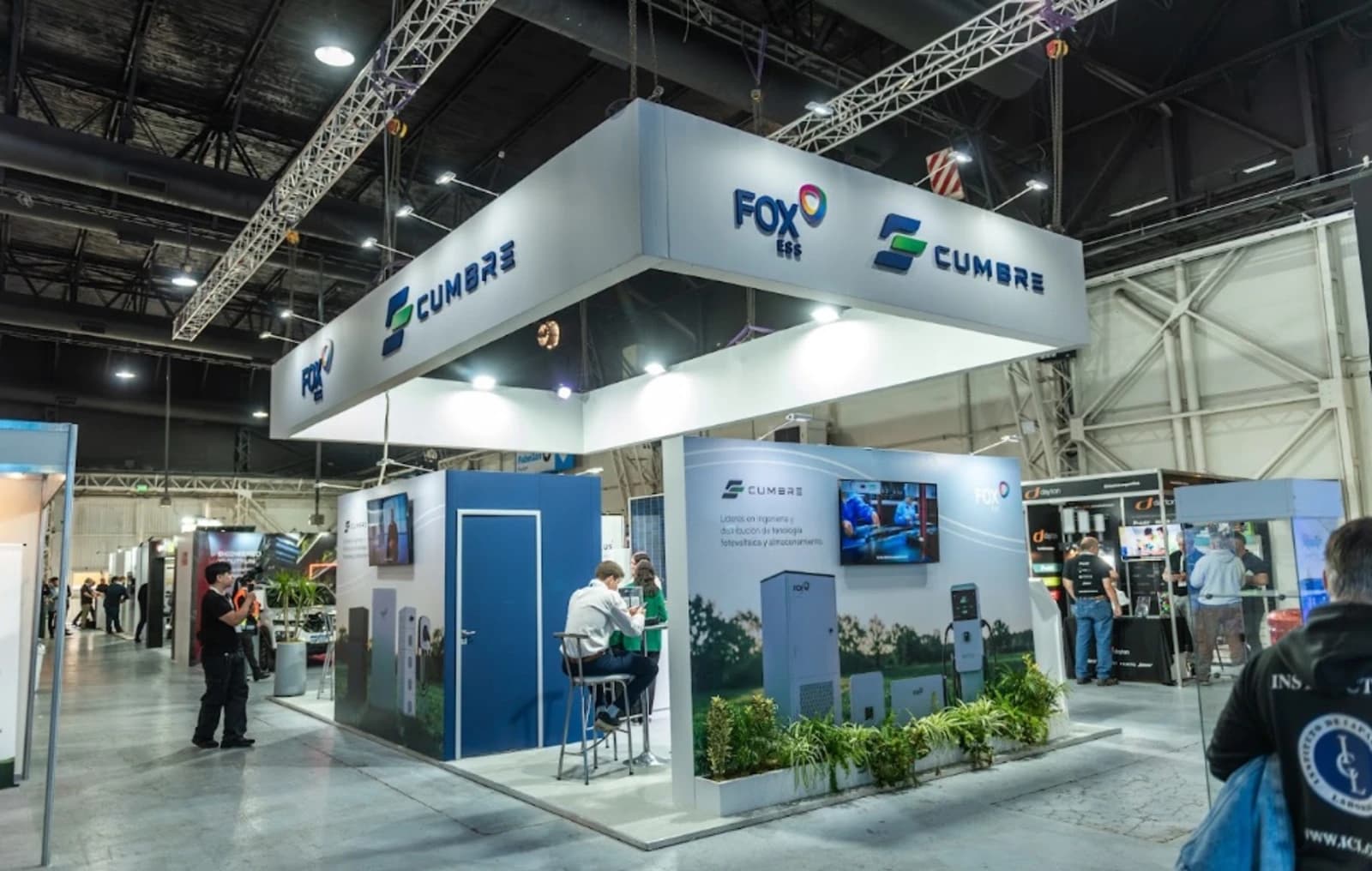
Fox ESS has identified Argentina as one of its next markets for expansion in storage , with Cumbre Energía as its exclusive representative and a long-term aspiration: to approach the market share it already achieves in mature markets.
“In Australia, we have about 25-30% of the market. Maybe even 30%. So that would be the goal,” said Jorge Visoso , sales manager for Fox ESS in Latin America, in a featured interview with Energía Estratégica during the Energy Efficiency Expo held in Buenos Aires.
Local entry will begin with the residential and commercial-industrial segments, featuring hybrid inverters, lithium batteries, and integrated BESS systems.
“Cumbre Energía aims to strengthen ties between Argentina and China to create a comprehensive bridge. We are the exclusive representatives in the country for Fox ESS and we visited the company in China this year,” said Juan Martín Colombres , vice president of Cumbre Energía .

“We have set ourselves a rather ambitious goal of being number one in energy and in residential BESS,” he added.
The range of solutions starts at 3 kW and goes up to 125 kW , with single-phase and three-phase configurations. The aim is to address needs related to self-consumption, backup power, power quality, and power constraints.
Fox ESS is arriving at scale. It has registered over 2,000,000 batteries and 1,500,000 inverters installed in the last three years and operates in more than 90 countries . InfoLink Consulting even ranked it first globally in shipments of residential energy storage systems during the first half of 2026 .
The market kept pace with this growth, as global shipments from the residential segment reached 39.07 GWh in the first six months of 2026 , a year-on-year jump of 137.67% , according to data from InfoLink.
Now the manufacturer is looking to transfer part of that market position to Argentina, although it acknowledges local competition from established brands. And the opportunity lies primarily in storage.
“We understand that Argentina is currently in a period of energy transition, a time when the grid is somewhat fragile in some regions. This is not so much due to generation issues, but rather years of insufficient investment in distribution,” Visoso stated.
This bottleneck is already impacting industrial consumers, so the manufacturer mentioned that there are companies that pay ARG $ 300 million monthly for electricity and still cannot get the necessary power to connect new equipment.
In some cases, the expansion also requires financing transformers and new connection infrastructure .
That's where the BESS equation comes in: reducing peaks, providing backup, improving quality of supply, and preventing the available network capacity from limiting new loads.
And for that segment, one of the core pieces of equipment will be the G-Max Plus , of which Fox ESS has already sold around 1500 units of this system worldwide, with deployments in Europe, Brazil and other markets.
“The G-Max Pls solution is an all-in-one BESS system, consisting of a cabinet with a 125 kW inverter and a 241 kWh battery bank. It is a solution that can be used both on-grid and off-grid and is ideal for commercial and industrial projects,” Visoso explained.
The company will also offer the H3 family, with different power outputs and configurations. The H3 Pro includes two battery slots.
But the leap in scale won't depend solely on the product. Financing appears to be the main obstacle to accelerating BESS in Argentina.
“It’s something everyone wants. It’s beyond question that we all want it. The question is whether it’s affordable or not. So, the key answer is financing. I think there could be lines of credit with more accessible rates, but the important thing is to understand that a large part of that payment will be self-subsidized by the user through the cost of energy,” Colombres emphasized.
The expectation is that credit lines will allow part of the initial investment to be paid in installments and offset by energy savings. Furthermore, under certain tariff and supply conditions, the payback period could be around four years or less, according to some more aggressive regional benchmarks.
“Regardless of the equipment costs, what drives the market are electricity rates. People need electricity, and if electricity rates keep rising, there are always ways to get the equipment,” both interviewees agreed.
From China to Argentina: logistics and next step in utility
The supply chain for Latin America still relies primarily on China, and an order for the region requires approximately 60 days between production and transportation.
“ Everything comes from China, although we have product stock in the Netherlands, the Middle East, Dubai, and also in the United States . We also have product stock in Brazil. However, for the moment, it's after-sales stock. But the trend is to modify all of that and expand its use for sales,” Visoso assured.
While the next step could be utility scale, although there is still no standardized offering from Fox ESS for that niche in the region , despite the fact that the group includes REPT, a lithium battery manufacturer with solutions for large-scale projects.
“We have been discussing and participating in developing solutions for some time, but it is mostly done on demand. In other words, at Fox ESS we don't yet have any solutions that we are commercially offering,” the specialist clarified.
The immediate impact is further down the line: households, businesses and industries with supply problems, lack of capacity or high electricity costs.
On this basis, Fox ESS will attempt to build a position in Argentina that already boasts double-digit market share globally, reaching up to 30% in some markets . The underlying principle is clear: if the grid is slow to keep pace with demand growth, energy storage can fill an increasingly larger portion of that gap.