


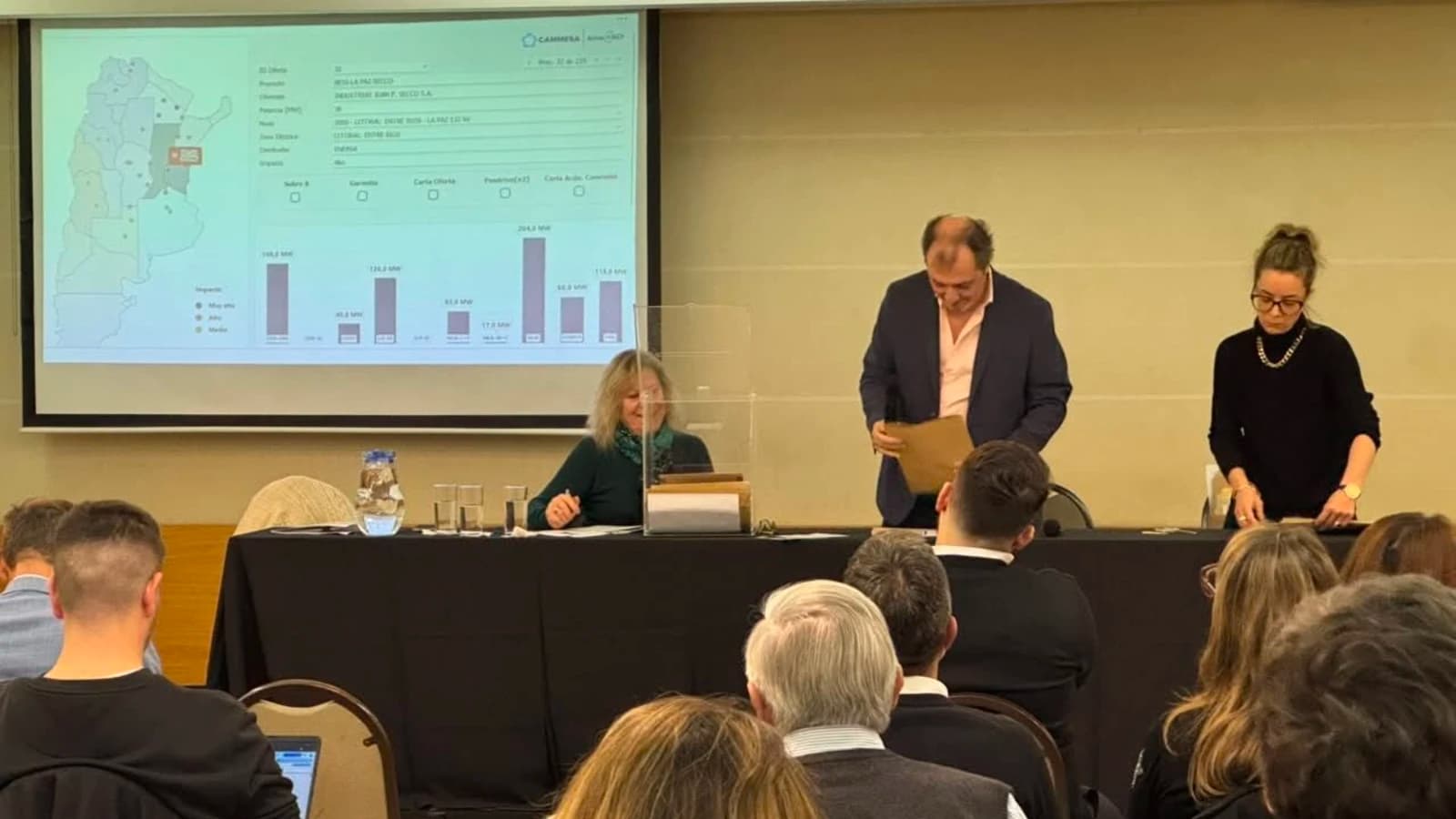
Argentina is beginning to define the future of its energy storage market after AlmaSADI. The national auction to incorporate batteries into the electrical system received bids for approximately 8,300 MW, compared to an original target of 700 MW, with a 10% tolerance.
This means that, if there is no decision to substantially increase the planned volume, more than 7000 MW of projects could be developed, submitted, and left out of the initial allocation.
In that context, the Additional Reliability Reserve Service appears as the next mechanism to release part of that pipeline and support new investments in storage, thermal generation and hybrids.
The instrument originates in article 11 of Resolution 400 of the Secretariat of Energy, which created the Additional Reliability Reserve Service —Additional SRC— applicable to thermal, hydroelectric, nuclear generation or storage units with commercial authorization from January 1, 2025.

Based on this regulatory framework, the Ministry of Energy requested CAMMESA to develop alternative selection mechanisms and general conditions for implementing calls for bids under the Additional SRC (Regulatory Service for the Energy Sector). In the technical work, this procedure was named SerCA.
“At the moment we are talking about fulfilling what the tender specifications say,” said Gustavo Báez, CAMMESA team leader, during the talk “Storage Opportunities in Argentina” , held within the framework of the diploma course organized by Regina Ranieri at UCEMA.
The phrase clarifies market expectations: AlmaSADI does not appear, for now, as a mass award tender, but as a first stage to incorporate batteries, test rules and measure investor appetite.
Continuity would be in SerCA.
“We are finalizing the details of the procedure, which must then be approved by the Energy Secretariat for its implementation,” Báez stated.
The mechanism had already been anticipated by Damián Sanfilippo , Undersecretary of Electric Energy, and that CAMMESA is working on the procedure at the request of the Energy Secretariat.
SerCA as continuity for more than 7000 MW outside of AlmaSADI
The key point for investors and developers is that AlmaSADI made it possible to identify a portfolio of projects far exceeding the volume that would be awarded in this first stage.
The tender received 235 projects totaling approximately 8,300 MW of power. If the allocation remains around the projected 700 MW, even with the 10% tolerance, over 7,000 MW would remain without a contract.
That universe would not necessarily be ruled out.
“Seven hundred will win, but there will be another number who won’t. And those will have the opportunity to enter through here, through this SerCA program, as a hybrid, or in various other ways,” Báez indicated.
The definition is key because it transforms AlmaSADI into more than just a one-off auction. The event allowed for gauging the real appetite of companies, developers, technologists, and investors for storage in Argentina.
It also generated knowledge about locations, project sizes, network constraints, connection letters, permits, engineering, and competitive conditions.
For projects that are not awarded funding, SerCA could open a second monetization process.
Quarterly or semi-annual calls to replenish reserves
The Additional Reliability Reserve Service is designed to incorporate power that helps rebuild reserves and strengthen the reliability of supply to the Argentine Interconnection System.
The instruction sent to CAMMESA suggests that the calls for tenders may be held quarterly or semi-annually, with defined power requirements for the system.
In the talk, Báez explained that one of the alternatives under analysis points to semi-annual rounds, associated with the times of greatest demand on the Argentine electrical system: summer and winter.
The logic responds to periods in which demand grows due to extreme temperatures and firm power, flexibility and operational reliability become more necessary.
“There will probably be a quota for thermal machines, a quota for storage, and also a quota for hybrids,” Báez anticipated.
In this way, the scheme would not be limited to stand-alone batteries. It could also include thermal generation, hybrid renewable projects with batteries, and other configurations capable of providing backup power to the system.
For the market, SerCA could function as a kind of "storage MATER," albeit with a different objective. The Renewable Energy Term Market allowed renewable generators to sell energy to large users through private contracts. SerCA, on the other hand, would aim to incorporate reliability and available power.
The parallel was drawn by Báez himself.
“Just as RenovAr was a prelude to what came later, which was MATER, storage is doing something very similar,” he said.
The interpretation is clear: AlmaSADI would be the first structuring tender for batteries, while SerCA could open a recurring dynamic of incorporating projects.
Free nodes and contracts with CAMMESA
One of the most important differences compared to AlmaSADI would be the location of the projects.
In AlmaSADI, nodes are predefined and receive rewards or penalties based on their expected contribution to the system. This means that location directly affects the ranking.
In SerCA, the logic could be more open.
“There won’t be a table of nodes, but rather presentations will be accepted wherever each person feels they should present themselves, and they will be analyzed and eventually accepted,” Báez explained.
This could broaden the map of opportunities for projects that do not fit into AlmaSADI's most competitive nodes, but that can provide reliability, backup, or specific solutions in other areas of the system.
It was also mentioned that the contracts would be with CAMMESA, the Wholesale Electricity Market Management Company, which manages the Argentine electricity market, coordinates dispatch and settles system transactions.
For investors, a counterparty like CAMMESA can be relevant for structuring financing, assessing collection risk, and providing greater predictability to project revenues.
Storage for mining, RIGI and large demands
The new scheme could also be linked to the growth of extra-trend demand, that is, new electricity consumption that grows above the normal evolution of the system.
This point is especially important for mining, energy-intensive industries, and projects associated with the Incentive Regime for Large Investments.
These large users don't just require energy. They also need backup power, reliability, and the ability to operate in areas where the grid may have limitations.
Continue reading
“Storage can appear as a power provider,” Báez acknowledged.
This opens up an additional opportunity for batteries: to participate as a backup for large consumers, a complement to renewable generation, a solution to transport restrictions, or as part of hybrid projects.
AlmaSADI: 235 projects and a sign of investor appetite
AlmaSADI received 235 projects totaling approximately 8,300 MW. This volume is 11 times the original target of the tender. For CAMMESA, this confirms that there is genuine market interest in investing in energy storage in Argentina.
“We received 235 projects and had planned for a room with 60 chairs. That speaks to the willingness of companies to participate, to do business, to get involved. And that is absolutely essential,” Báez said.
Báez recalled that in other calls for tenders in the Argentine electricity sector there were also more offers than power sought, such as RenovAr, RenMDI, TerCONF and the Renewable Energy Term Market.
The difference is that now that phenomenon is shifting to storage.
How AlmaSADI is awarded
The AlmaSADI process is divided into two stages. First, the technical and legal envelope is analyzed. This verifies whether the projects meet the requirements of the call for proposals. Only those that pass this filter proceed to the opening of the financial envelope.
“Envelope B will only be opened for bids that have passed the technical check,” Báez explained.
Bids that do not meet the technical or legal requirements are excluded without financial review. Furthermore, proposals exceeding the price ceiling are also rejected.
From there, a merit ranking is established. The basic rule is to order from lowest to highest price, but applying the nodal impact value.
Nodal impact: the lowest price doesn't win alone
AlmaSADI does not award contracts based solely on price. It also considers the project's location.
Purple nodes have a $750 per MW-month advantage in the economic comparison. Red nodes receive no adjustment. Yellow nodes receive a $750 per MW-month penalty.
This means that two projects with the same price can end up in different positions in the ranking depending on where they are connected.
The signal aims to direct the batteries towards areas where they provide the greatest value to the electrical system, whether due to reliability, network restrictions, or operational needs.
Regions, boundaries and competition
The tender also defines regional boundaries. Báez mentioned 130 MW in Córdoba, 70 MW in San Luis, 120 MW in Cuyo, 150 MW in Northwest Argentina, and 200 MW in Chaco and Formosa.
The sum of these limits exceeds the 700 MW sought, so these are not guaranteed quotas, but maximum ceilings.
“There is an incentive for competition between regions. It's not that a region is guaranteed a certain value; it's a limit that it cannot exceed,” he explained.
There is also a 10% flexibility, because the projects are presented in modules and it may happen that the last awardable offer slightly exceeds the available quota.
Remuneration: power, frequency and efficiency
AlmaSADI's main income comes from power remuneration.
The maximum price is $12,500 per MW-month. Each bidder competes below that value. This ceiling was defined based on the precedent of AlmaGBA, the previous storage tender for the Greater Buenos Aires area.
In AlmaGBA, the maximum price had been $15,000 per MW-month and the competition brought the awarded values to levels close to $11,620 per MW-month.
“In the previous one, we verified that the price was more or less around that. The price set here was a representative price from the previous tender, and we expect bidders to compete from there downwards,” Báez explained.
In addition to power, the contract includes remuneration for energy and frequency regulation. Energy is not the primary component because price arbitrage does not yet have a decisive impact in Argentina.
Frequency regulation, on the other hand, is gaining importance. In AlmaGBA, it could be provided outside the contract; in AlmaSADI, it is now part of the contractual framework.
Penalties are also foreseen for unavailability, non-compliance with primary frequency regulation, and equipment losses. In practice, this incentivizes efficient technology and actual availability when the system requires it.
Four hours of download and up to 180 cycles per year
AlmaSADI requires a four-hour discharge. That is, the battery must be able to deliver the promised power for that period.
The charging time is estimated at around six hours, although there is some flexibility. According to Báez, if the system takes longer to charge, it doesn't necessarily represent a critical problem.
The plan allows for up to 180 cycles per year because the system's needs are not uniform. The most critical months are summer and winter, when demand peaks.
That's why there's also a seasonal factor: January, February, March, June, July, and December have a greater impact on remuneration than the rest of the year.
Permissions, connection and environment: the real filters
Beyond price, projects must demonstrate viability.
Bidders must proceed with property availability, land use permits, registration as market agents, access to transport capacity, connection letters, and environmental certifications.
The connection will be one of the most critical points. CAMMESA is analyzing 132 kV nodes, but many batteries are connected at medium voltage. Between these two points, there may be distribution networks, cooperatives, or local transmission companies with physical constraints.
If CAMMESA's analysis identifies capacity at a node, but the intermediate network allows less power to be evacuated, the actual limit must be respected.
There are also environmental challenges, because battery storage is a new technology for many jurisdictions. Báez compared this process to what happened with RenovAr, where the difficulties were resolved over time.