


Argentina has reached 7,133 MW of installed renewable energy capacity in the Wholesale Electricity Market (MEM), under the framework of Law No. 27191, according to public information on the website of the Wholesale Electricity Market Management Company SA (CAMMESA). This figure marks a significant milestone for the sector, although a clear challenge remains: increasing the share of these sources in meeting demand, which is still below the targets established by law. Thus, renewables under Law No. 27161 increased their capacity by 463 MW during the first months of the year (2024 ended with 6670 MW operational), which already represents 50% of the increase given in 2024. Currently, the renewable capacity in operation is distributed as follows: 4,343 MW of wind energy, which represents 60.9% of the total, followed by 1,955 MW of solar photovoltaic (27.4%), 502 MW of hydroelectric plants less than 50 MW (7%) and 333 MW of bioenergy (4.7%). 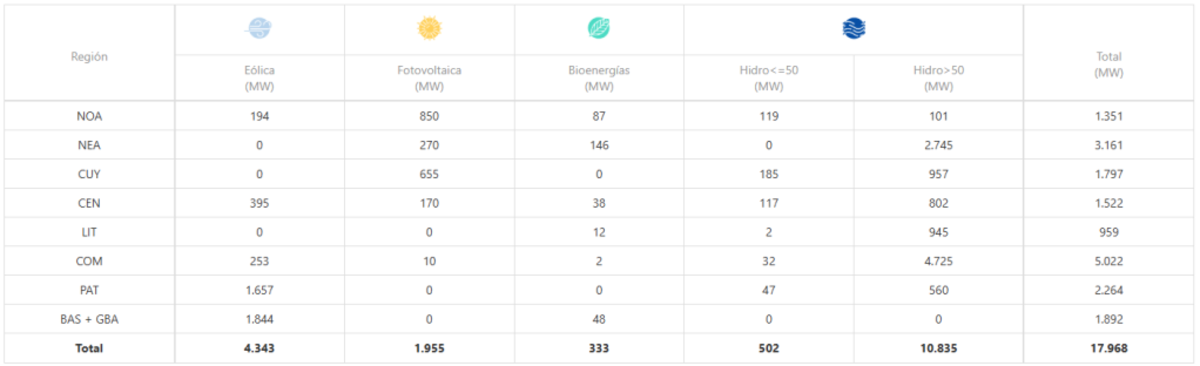
It should be clarified that if large hydroelectric plants (over 50 MW) are also included, the renewable capacity in operation in the MEM (Wholesale Electricity Market) reaches 17,968 MW. The prominence of the wind power segment is undeniable and is further boosted by the strong participation of the Renewable Energy Term Market (MATER), which already accounts for 45% of wind capacity and 39% of solar capacity, supplying large users of the system. MATER is consolidating its position as one of the main drivers of renewable growth in Argentina, facilitating contracts between generators and large consumers, which has expedited the addition of new capacity despite transmission bottlenecks. However, growth is expected to slow in the coming months until the commissioning of projects awarded in the latest MATER calls and the recent RenMDI tender. Why? Only 5 MW of wind power and an additional 30 MW of photovoltaic power are expected to be added to the system by June of this year, according to the latest reports from CAMMESA.
The average for all of 2024 was 16.3%, as was the case in the first three months of this year, far from the 20% that the regulations require to be reached before December 31, 2025.
Monthly data shows variable behavior, with records of 15.9% in January , 15.5% in February and a rebound to 17.6% in March .Therefore, with just under a year to go before the deadline, pressure is mounting to accelerate the implementation of projects and facilitate financing and infrastructure processes.
Achieving the goal depends not only on adding new megawatts, but also on ensuring that this capacity effectively translates into generation to meet the growing national electricity demand.