China's decline already has concrete figures: photovoltaic additions fell by almost 55% year-on-year during the first nine months of 2026 , after the country replaced its fixed-rate system with competitive auctions.
The regulatory change reduced developers' margins and led the International Energy Agency (IEA) to revise its forecasts for the Asian giant downwards.
The adjustment amounts to 116 GW, equivalent to 5% of the previous projection , according to the Renewables 2026 report.
Who gains and loses ground? China will retain its global leadership, but its share of new installations will fall from over 60% in 2025 to an average of 53% between 2026 and 2031.

While Latin America and the Caribbean project adding 165 GW of renewable energy by 2031 , with Brazil, Mexico, and Chile as the main expansion markets, the region received an upward revision of 12 GW (+9%) , driven primarily by distributed solar generation.
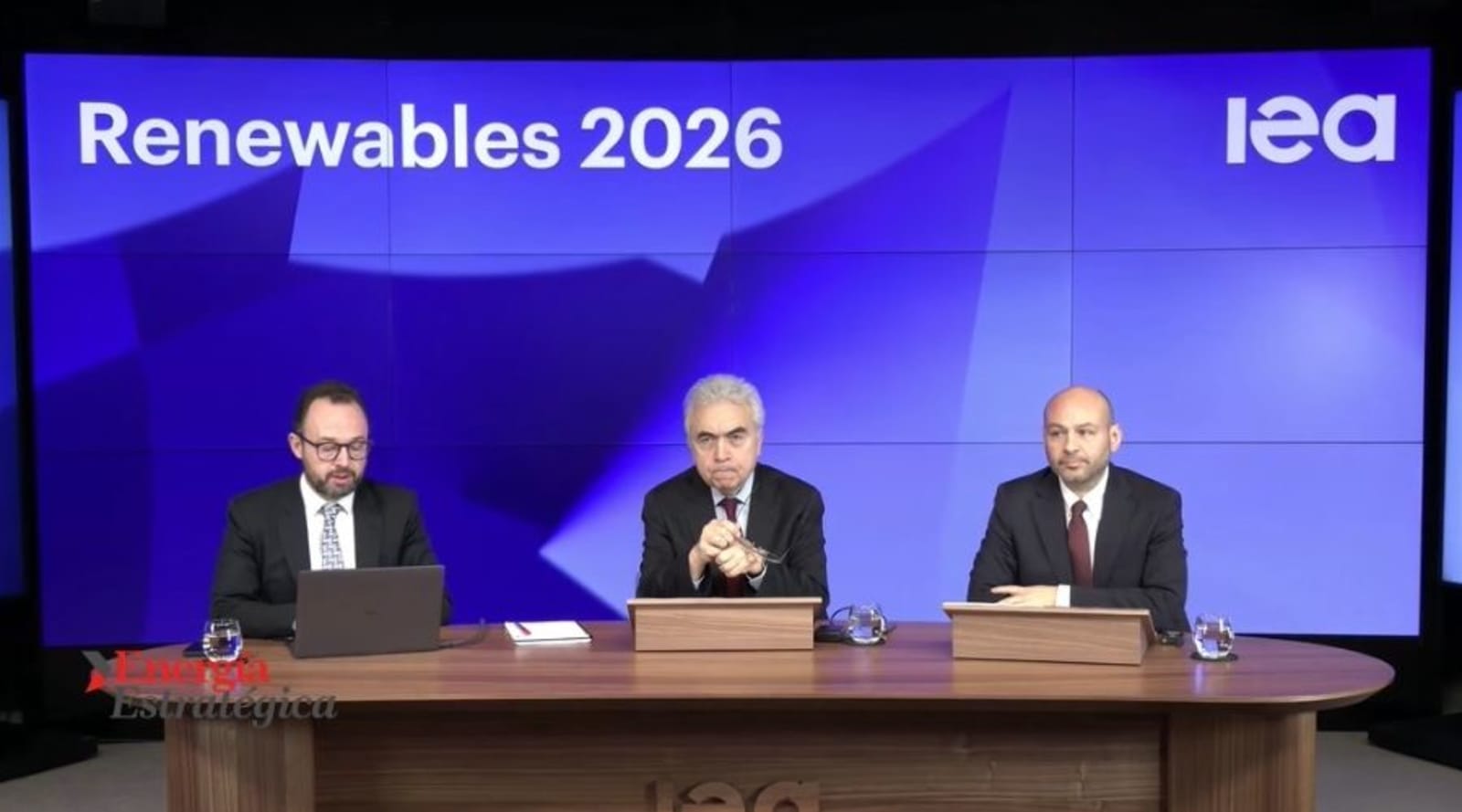
During the presentation of the report, Fatih Birol, executive director of the International Energy Agency , highlighted the growing prominence in various nations: “Renewables are no longer an issue exclusive to rich countries, but also to emerging and developing economies.”
The phenomenon transcends Latin America, given that the Agency raised its forecasts for sub-Saharan Africa by 54% and for the United States by almost 40% .
This means that these revisions compensate for the lower Chinese growth and support a global expansion of close to 4800 GW until 2031 , 57% higher than in the previous six-year period.
Brazil leads, Mexico rebounds, and Chile bets on flexibility
Latin America's transformation will also be technological: solar power will account for almost 80% of new capacity and will surpass hydroelectric power in installed capacity before the end of the decade . However, hydroelectric power will maintain its lead in generation, although its share will fall from 40% to 35%, while photovoltaics will advance from 8% to 15%. The region will reach 68% renewable electricity generation by 2031 .
Who will drive growth? Brazil will add almost 90 GW, equivalent to 55% of the regional total , with 86% of new solar installations. Distributed generation will be the main driver thanks to net metering, cost reductions, and private PPAs. In contrast, large-scale generation will lose momentum due to less auction activity, grid inflows, and transmission restrictions.
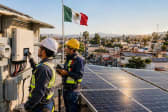
Mexico is projected to add approximately 22 GW of solar power, more than double the amount installed between 2020 and 2025 , with solar accounting for over 90% of the expansion. The reactivation of tenders led by the Federal Electricity Commission (CFE) and distributed generation will sustain this growth, although regulatory hurdles, permitting delays, and grid limitations persist.
Chile will add approximately 20 GW, two-thirds of which will be solar , but faces increasing curtailment, transmission congestion, and periods with zero electricity prices. These conditions reinforce the need for BESS storage and strategic infrastructure projects like the Kimal-Lo Aguirre transmission line to improve renewable energy integration.
Colombia and Argentina, for their part, would add around 10 GW and 6.5 GW , respectively. Colombia is seeking to accelerate the development of new projects, while Argentina is maintaining a more moderate expansion, supported by private renewable energy contracts.
The organization anticipates a moderation in annual additions after the peak projected for 2026, primarily due to Brazil's slowdown. In contrast, Mexico, Chile, and Colombia are expected to maintain relatively stable growth levels until 2031.
The silent integration crisis: 4,500 GW on hold and unmet global targets
The renewable energy expansion faces a bottleneck: nearly 4,500 GW of generation and storage projects are awaiting grid connection , compared to the 3,500 GW previously recorded. Batteries already exceed 1,500 GW on standby , while hybrid projects reach 600 GW.
The impact? Solar and wind energy spills could increase from 200 TWh in 2025 to 850 TWh in 2031 , exacerbating the hours with negative prices and reducing the profitability of projects.
The agency also warns about missed targets: global renewable capacity is projected to reach 9,710 GW in 2030, just 2.6 times the 2022 level , falling short of the COP28 tripling target. This target would only be met in 2032, or in 2031 under an accelerated scenario.
Europe will also fall short of its targets: renewables will cover 60% of the EU's electricity generation in 2030, compared to the 72% projected in REPowerEU. Even with accelerated investments, biomethane production will only reach 67% of its European target .
China's solar paradox versus India's industrial takeoff
The slowdown in the Chinese market coincides with a profitability crisis among its photovoltaic manufacturers. According to the report, more than 90% of China's leading solar producers reported losses in 2026, and more than 70 companies have filed for bankruptcy since 2024 , as a result of industrial overcapacity and falling prices.
Although China maintains its dominance in all stages of manufacturing, India could reach 17% of global solar module production by 2031 and become the only country, besides China, capable of manufacturing all the main components of the photovoltaic chain on a large scale.
During the question and answer session, Heymi Bahar, senior analyst at the IEA and lead author of the report , acknowledged the difficulties for the European market.
“We do not expect significant growth in solar photovoltaic manufacturing in Europe,” Bahar explained during the presentation, warning that high industrial costs make it difficult to compete with China and India.
India is also projected to account for 17% of global solar module manufacturing by 2031 , while China will maintain its dominance over all stages of the supply chain.
The organization thus identifies two simultaneous transformations: a greater geographical distribution of renewable energy expansion and a still incipient industrial diversification. For Latin America, the challenge will be to convert its projected 165 GW into operational capacity , in a scenario where network availability, storage, and project profitability will be as crucial as the cost of the technology.


 By Emilia Lardizabal


 By Energía Estratégica
 By Ailén Pedrotti