


Colombia holds its presidential runoff election this Sunday, and the energy sector finds itself with a relatively unified view on one point: renewable energy will continue to advance regardless of who wins the second round. However, when the discussion shifts to investor confidence, energy security, the future of Air-e, and hydrocarbon policy, differences begin to emerge that tip the scales toward one of the candidates.
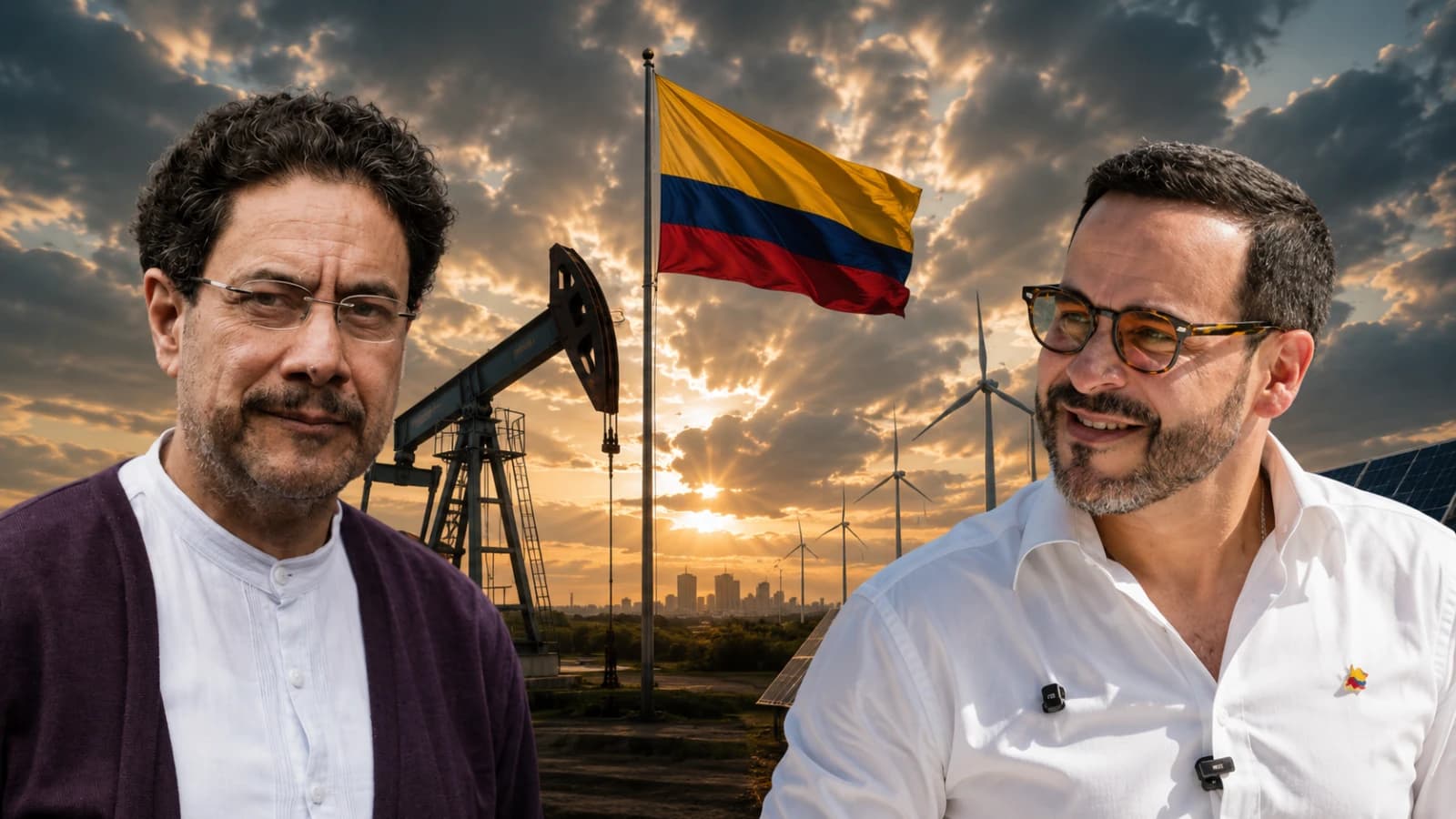
The market is closely watching the contest between Iván Cepeda , seen as the continuation of Gustavo Petro's political project, and Abelardo de la Espriella , who proposes a shift in economic and energy policy. After a very close first round , the right-wing candidate obtained 43.73% of the votes compared to his rival's 40.91% . With the election just days away, much of the industry believes that the next administration will inherit an electricity system under pressure, with a firm energy deficit, financing challenges, and strategic projects still pending implementation.
Industry sources consulted by Energía Estratégica agree that, from a purely electrical perspective, there are no radical differences between the two programs. Solar and wind energy are already part of Colombia's energy mix, and their development responds to both energy transition objectives and supply needs.
However, the scenario changes when analyzing the overall context that the next president will inherit.

The truth is that the discussion is no longer solely about renewables. The latest Reliability Charge auction highlighted both the interest in continuing to incorporate clean energy generation and the difficulties the system faces in guaranteeing firm energy for the future.
The tender resulted in the allocation of approximately 1.8 GW of new renewable capacity , with significant participation from companies such as Enel, AES, and Celsia. However, the outcome raised questions about whether the new supply will be sufficient to meet future system requirements and prevent deficits toward the end of the decade.
Specifically, a potential Cepeda administration is associated by the market with the continuation of long-term tenders and the mechanisms promoted during the Petro administration to accelerate the incorporation of renewables and storage.
This expectation has gained relevance following the recent publication by the national government of the terms for a new long-term auction for renewable energy projects and BESS systems , considered a key initiative to strengthen the system's reliability in the coming years. The process will be one of the first tests the incoming administration will face and will serve to gauge the appetite of buyers and developers in a context marked by regulatory uncertainty.
However, doubts also persist about the ability to sustain these policies without resolving the financial and regulatory problems that the sector faces today.
Added to this is the controversy generated after the recent Reliability Charge auction. Despite the awarding of nearly 1.8 GW of renewable energy capacity, President Gustavo Petro himself publicly questioned the results and opened a debate about the mechanism's design and the participation of certain technologies. These statements also exposed internal divisions within the government and raised new concerns in the market regarding the stability of the rules of the game.
Meanwhile, De la Espriella's candidacy is seen as an alternative that could offer greater openness to different technologies and a higher priority to energy security, although without substantially modifying the trajectory that renewables are already following within the energy mix.
Energy deficit, the main challenge the next president will inherit
Beyond the electoral differences, there is a consensus that the next administration will receive an energy system under pressure.
Former Minister of Mines and Energy, Amylkar D. Acosta, warns that Colombia faces increasing vulnerability in both electricity and natural gas. He points out that demand growth is outpacing the expansion of available supply, and the situation could worsen due to delays in strategic generation and transmission projects.
In one of his most recent analyses, Acosta argues that "the specter of blackout is haunting us again," referring to the tight balance between energy supply and demand that the country faces.
The politician also warns of the need to unblock infrastructure projects and preserve the economic conditions that will allow the system's reliability to be maintained. Among the main risks, he identifies delays in gas generation, transmission, and transportation projects, as well as the sustained growth in electricity demand.
Continue reading
Acosta also points out that Colombia currently has a firm energy deficit for the coming years and warns that thousands of additional megawatts are needed to keep up with growing demand.
According to the leader, one of the priorities of the next government should be to unblock the execution of renewable and transmission projects, particularly the wind power developments in La Guajira, considered strategic to diversify the electricity matrix.
Investor confidence and Petro's continuity
Although the energy transition appears to be consolidated as a state policy, the debate on investor confidence remains one of the main differentiating factors between the two candidates.
Part of the sector associates a possible victory for Cepeda with the continuation of the energy agenda promoted by Petro, including the deepening of the energy transition and the maintenance of the current strategy regarding hydrocarbons.
In this context, one of the questions the industry is closely following is the composition of the next energy team. Various sources believe Edwin Palma could remain in his post under a potential Cepeda administration, although there is no official decision yet, and the controversy generated by Petro's criticisms of the last auction has somewhat weakened that possibility. Meanwhile, on De la Espriella's side, no concrete names have yet been circulated for the Ministry of Mines and Energy.
However, there is also concern regarding the financial situation of the electricity system, the regulatory signals sent during the last few years, and the difficulties in advancing projects considered strategic.
Conversely, De la Espriella is perceived by various stakeholders as a more favorable candidate to restore investor confidence and provide greater regulatory guarantees to the energy sector.
This view aligns with Acosta's analysis, who believes Colombia needs to restore legal certainty and confidence to attract the necessary investments in energy generation, transmission, and infrastructure. The former official maintains that the electricity sector will require investments of around $10 trillion annually , and that restoring stable conditions for investors is essential to achieving this.
Air-e and the crisis that is affecting the campaign
If there is one issue that crept into the final stretch of the presidential campaign, it is the situation of Air-e, an energy marketing and distribution company.
President Gustavo Petro's recent announcement regarding the potential liquidation of the company has set off alarm bells throughout the energy sector. In response, ANDESCO, ACOLGEN, ANDEG, ASOCODIS, SER Colombia, Naturgas, and ACP issued a joint statement warning that any decision concerning the company must first guarantee the continuity of service and the stability of the national electricity grid.
The organizations noted that Air-e serves approximately 11.3% of the national energy demand and has obligations of around $2.7 trillion with various market participants, a situation that could have effects on the liquidity of the entire chain.
This is a significant issue for investors. The financial situation of the intervened company has become one of the main symbols of the structural problems currently facing the Colombian electricity sector.
Similarly, Acosta believes that a potential liquidation could deepen existing financial risks and affect the continuity of service, especially in a context of energy scarcity and increasing dependence on imported gas.
Indeed, a large part of the industry believes that the choice transcends the debate between renewables and fossil fuels. The discussion hinges on the next government's ability to execute projects, guarantee legal certainty, stabilize the sector's finances, and restore the necessary confidence to mobilize the investments required by the Colombian electricity system.
Looking ahead to Sunday, the prevailing perception within the sector seems to be leaning towards the need to regain signs of confidence and resolve the structural problems that currently condition the country's energy development.
However, regardless of the election results, there is a shared conviction: the next administration will have little room to postpone decisions. Between the need to incorporate new, reliable energy, resolve the Air-e crisis, guarantee gas supplies, and accelerate the implementation of renewable energy projects, the future president will inherit one of the most complex energy challenges of recent decades.