Banco Sabadell México finalized two structured financing transactions totaling up to $56 million to support wind and solar power generation projects in three Mexican states. The transactions encompass both the development of new infrastructure and the acquisition of existing photovoltaic plants.
The resources are earmarked for initiatives located in Yucatán, Zacatecas and Nuevo León , which represent a reported joint capacity of approximately 132 MW and an estimated annual electricity production of 382.5 GWh.
The financial institution's participation involves two distinct business structures. While the wind project will market its production on the open market, the solar assets have long-term supply contracts with the Federal Electricity Commission (CFE).
This difference is relevant from a financial perspective, because electricity marketing mechanisms determine different risk and income profiles for generation projects.

A 75 MW wind farm is the main hub of operations
The main transaction corresponds to the Tizimín II Wind Farm, with a capacity of 75 MW , located on the Yucatán Peninsula and developed by the company Smartener, SL
For this initiative, Banco Sabadell México is participating as the structurer and coordinator of a financial package of up to $41 million , which includes the intervention of other financial entities with a participation equivalent to 50% of the debt.
The scheme incorporates a senior credit facility, lines of credit, and financial hedging mechanisms, instruments designed to support financing needs and manage certain risks associated with the operation.
One of the central aspects of Tizimín II is its fully merchant marketing model, which involves selling electricity without depending on a long-term power purchase agreement that covers all of its production.
Under this model, the park's revenues are exposed to the conditions of the electricity market, which introduces variables linked to the evolution of prices and effective generation.
The plant has an estimated annual production of 262.5 GWh , equivalent to approximately 68.6% of the electricity that would be generated jointly by the three assets included in the operations.
According to the reported figures, the project registers a relationship between planned annual generation and nominal capacity equivalent to an approximate capacity factor of 40%, subject to compliance with production estimates.
Solar financing with long-term contracts
The second operation amounts to $15 million and is intended to support Riverstone Holdings LLC in the acquisition of two photovoltaic solar facilities.
Continue reading
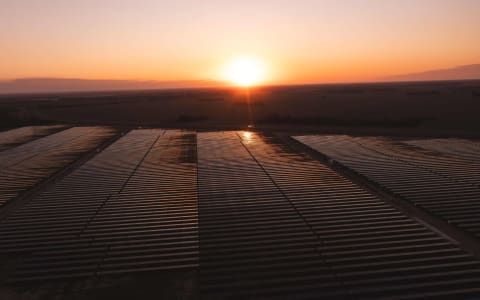
These are the Aldebarán parks, located in Zacatecas, and Pollux, located in Nuevo León , whose combined capacity amounts to approximately 57 MWp.
Unlike the wind farm project in Yucatán, both power plants operate under long-term contracts with the Federal Electricity Commission, under the Small Producer modality.
This contractual structure provides a different marketing scheme than that of a merchant facility, since the supply conditions are established through electricity purchase agreements.
The two photovoltaic complexes have a combined generation of over 120 GWh per year , according to information released about the transaction.
The operation also presents a difference with respect to the financing of Tizimín II: while in Yucatán the resources support the development of a project, in Zacatecas and Nuevo León they are linked to the acquisition of generation assets.
In this way, the transactions reflect the participation of banks in different stages of investment within the renewable energy sector, from infrastructure financing to the transfer of ownership of existing facilities.
Gustavo Martínez Baca Anaya , Deputy General Director of Corporate Investment Banking at Banco Sabadell México, highlights the importance of certainty, financial discipline, and technical industry knowledge to structure operations tailored to the characteristics of each project.
In this regard, the entity focuses on collaboration between financial institutions, development banks, and international promoters as a mechanism to channel private resources toward energy infrastructure.
The operations are also part of Mexico's efforts to increase the share of clean energy sources in its electricity mix.
The country has set a goal of 38.5% clean electricity generation by 2030 , an objective that requires incorporating production capacity and maintaining conditions that favor investment in the sector.
In this context, structured financing is a tool to support the development and operation of renewable energy facilities with different technological and commercial characteristics.
The two agreements announced by Banco Sabadell México represent, together, up to $56 million in financing for wind and photovoltaic infrastructure , with an estimated production exceeding 380 GWh per year.
Its scope includes three states, two generation technologies, and different marketing schemes, which demonstrates the diversity of financial structures used to support renewable assets in the Mexican market.
 By Matías Medinilla

 By Emilia Lardizabal
 By Energía Estratégica