


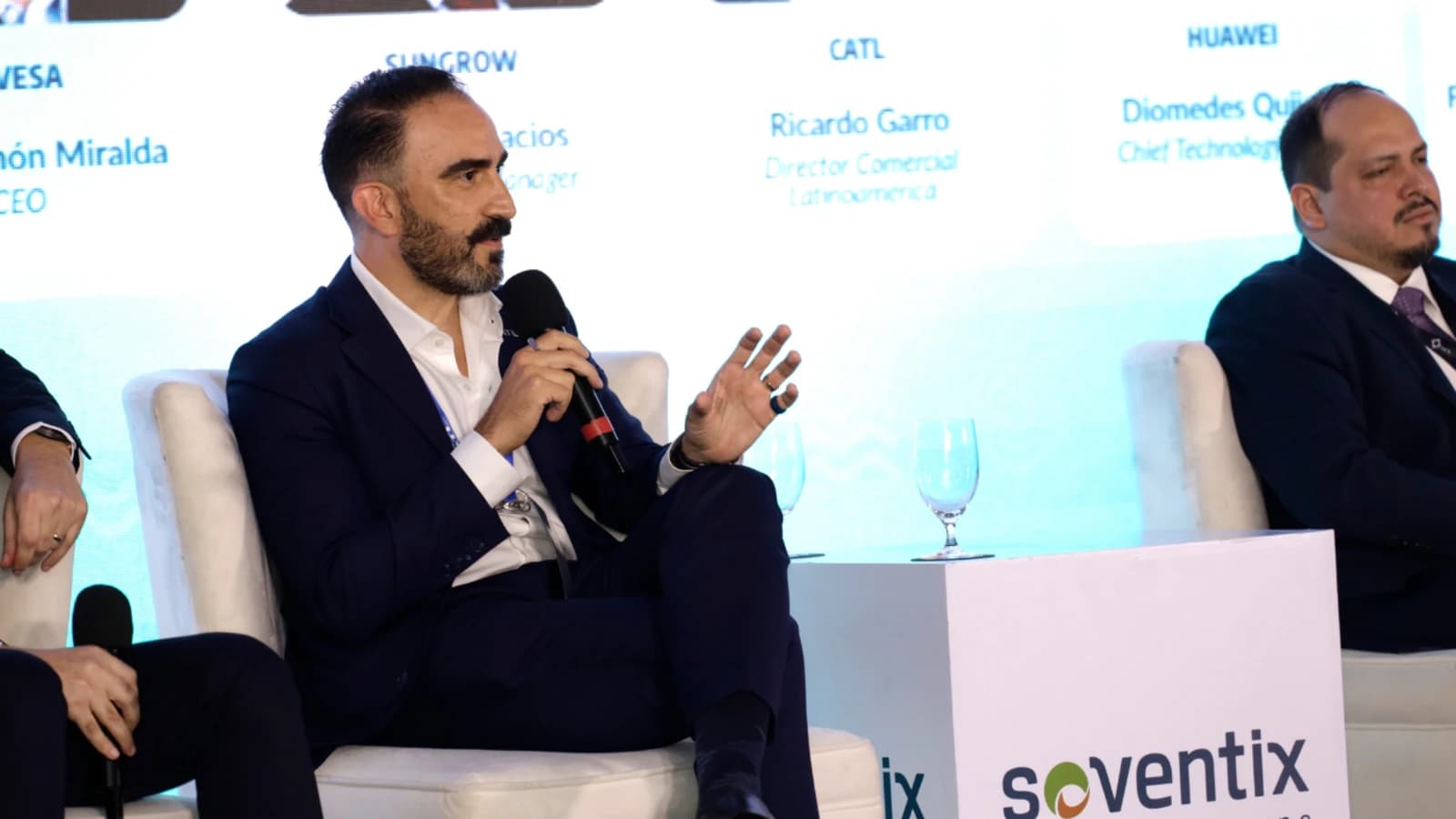
For Ricardo Garro , Commercial Director for Latin America at CATL, the PEG-5 " will mark a turning point, not only for Guatemala, but for the entire region ." During the panel "Solar Energy and Storage: PEG-5 Vector of Transformation for the Central American Energy Sector," held within the framework of FES Guatemala , the executive positively assessed the outcome of the bidding process.
“ I would rate it between an 8 and a 9 overall. I think it was a very successful tender in terms of its implementation and the results for solar with batteries, which was the big winner with nearly 26 projects ,” he said.
The bidding process concluded with 73 rounds of negotiations and 93 offers , resulting in an estimated allocation of 1258 MW , with renewable energy participation close to 73% and single-unit prices around USD 101/MWh . Within that volume, solar plus storage projects account for approximately 671 MW , equivalent to about 53% of the total allocated capacity .
Relive the event: https://www.youtube.com/watch?v=-fQIrVqwZYk

According to Garro, one of the main messages that the process leaves is the consolidation of hybrid systems as an alternative capable of providing firm energy to electrical systems.
“ Solar plus battery was the big winner. It sends a message to the entire region that storage technology is now a reality for building solid renewable energy projects to meet a country's energy needs ,” he said.
The executive considered one of the main achievements of the bidding process to be demonstrating that a single technology can simultaneously provide energy and power to the system. In his view, Guatemala is moving beyond a system where both requirements had to be met through separate processes.
This interpretation aligns with that of various market players, who see PEG-5 as a benchmark for future procurement processes in the region. In fact, the National Electric Energy Commission (CNEE) announced during the meeting that it had begun analyzing new tenders, including PEG-6 and PET-4 .
However, Garro warned that the planning does not reflect the speed at which these types of initiatives can be developed today.
“ Our criticism is that the timeline was too far off. I think it doesn't take into account that these projects can now be done very quickly, and this could lead to another process in the short term for those more distant years ,” he argued.
He explained that the maturity of storage solutions allows for a significant acceleration of construction and commissioning timelines. Consequently, he believes the market could absorb new tenders ahead of schedule to meet future demand.
Even with that observation, he highlighted the message that the tender leaves for developers and investors.
“ It sends a clear signal that there is an appetite for investment, there are projects that are ready and the technology can be implemented very quickly ,” he remarked.
Continue reading
The CNEE attributed the result to a correct definition of the distributors' contracting needs and the high level of competition achieved during the process. According to the regulator, the objective of PEG-5 was to replace contracts expiring between 2030 and 2033, guaranteeing supply under criteria of efficiency and lower cost for users.
From the United Arab Emirates to Central America
Technological evolution is also reflected in projects on a global scale. As an example, Garro mentioned one of the largest initiatives currently in operation.
“ We have one of the world’s largest projects of this kind, which is a 24-hour firm gigabyte in Abu Dhabi, it’s 19 GWh ,” he noted.
The executive stated that just a few years ago, this type of development seemed reserved for highly advanced markets. Today, however, it is beginning to be replicated in Latin America.
“ Seeing that projects of this kind are now starting to be carried out in our countries is truly amazing ,” he concluded.
According to Garro, this evolution is due to an accelerated maturation of storage technologies, which now allow the development of renewable projects capable of supplying energy continuously.
In that context, he highlighted the experience accumulated by CATL in the segment.
“ We have more than 2,300 storage projects and, fortunately, without incident ,” he remarked.
Added to this was the company's financial strength.
“ We have a market capitalization of almost $300 billion, we had the biggest IPO of 2025, and we have very strong financial statements ,” he said.
As he explained, these factors are key to guaranteeing long-term service contracts and supporting the performance of the systems throughout their useful life.
The executive also addressed some concepts that still raise questions among developers and investors. One of these is system degradation, which depends on variables such as the number of daily cycles, ambient temperature, depth of discharge, and the type of cell used.
He also warned that the market still tends to analyze these solutions as if they were a commodity similar to the photovoltaic panel, when the technological differences between manufacturers continue to be decisive for performance, warranties and long-term operation.
The combination of high renewable energy participation, the prominence of hybrid systems, and the interest shown by developers reinforces Garro's interpretation of PEG-5. While he believes the timelines could have been adjusted to the speed at which technology now advances, he understands that the tender sent a clear signal to the market: projects with energy storage are now ready to assume a central role in the electrical expansion of Guatemala and the rest of Central America.