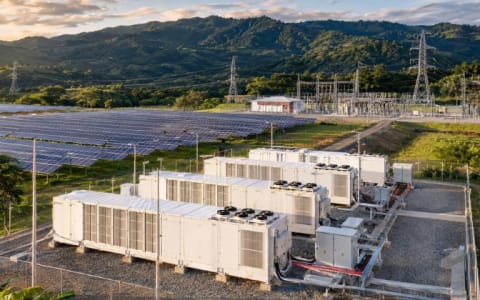
Restoring power to an electrical grid doesn't always require starting up a conventional power plant. In the Dominican Republic, a 36 MW and 40 MWh battery system successfully energized up to 70 kilometers of 138 kV and 69 kV transmission lines without initially needing an external source to establish the electrical conditions for the operation.
The unique aspect of the operation was that the storage system itself was able to establish the voltage and frequency references necessary to power the infrastructure. This capability, known as a black start , allows a grid to begin recovery without relying on an external power source.
The experience illustrates one of the applications of grid-forming technology, which allows inverters to behave as voltage sources and assume functions traditionally associated with synchronous machines in conventional power plants.
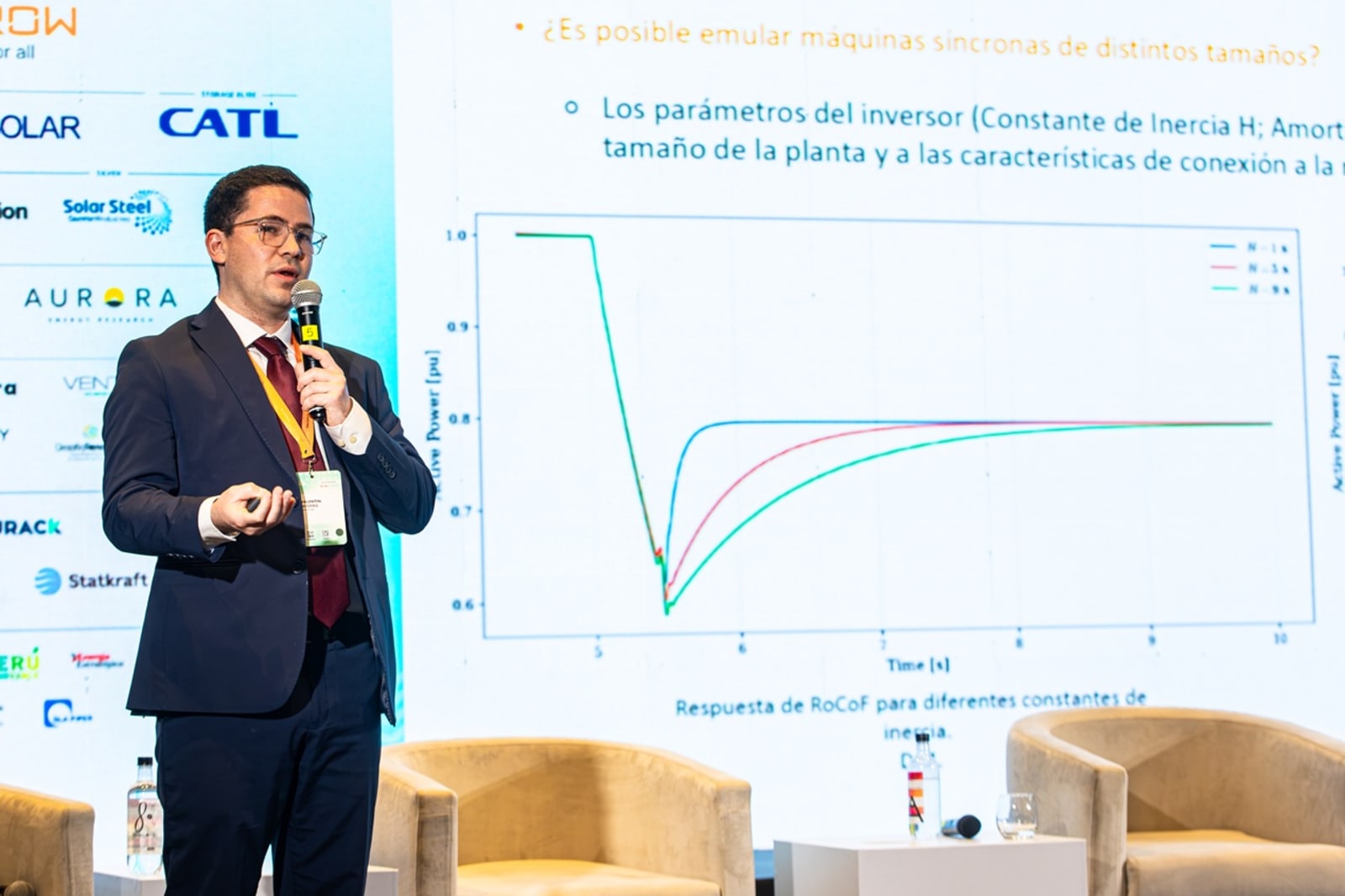
“It’s not that grid-following is bad, but it has given us the stability to reach the current operation of the system, but as the penetration of renewable energy increases we would have to start operating mostly with grid-forming,” said Valentín Romero , Application Engineer ESS Latam of Sungrow, duringFuture Energy Summit (FES) Peru 2026 .

While grid-following inverters need to follow an existing electrical reference, grid-forming inverters can establish one using their own control algorithms. This difference becomes relevant given the growth of solar and wind power generation, whose integration can reduce the relative share of conventional synchronous machines and, consequently, the available inertia in electrical systems.
Lower inertia can accelerate frequency variations in response to disturbances and reduce the time available for control mechanisms to respond, increasing the need for technologies capable of contributing to grid stability.
Dominican Republic adds requirements for storage
According to the National Energy Commission (CNE), the Dominican Republic ended 2025 with 25% renewable energy participation in its electricity generation , while maintaining the goal of reaching 30% by 2030. The advancement of these sources introduces new needs for flexibility and support to sustain the operation of the National Interconnected Electric System (SENI).
In parallel, the Superintendency of Electricity approved resolutions SIE-164-2025-MEM and SIE-178-2025-MEM , which establish authorization procedures and technical requirements for storage systems, especially those associated with variable renewable generation projects.
The regulatory framework addresses aspects related to electrical stability, frequency and voltage regulation, and the response of installations to disturbances. These conditions broaden the criteria that developers must consider when designing projects and selecting equipment.
The change coincides with a new contracting phase. The Dominican Republic opened a tender on November 2 for up to 200 MW and 800 MWh of batteries , exclusively for existing solar and wind farms that have long-term supply contracts with distributors.
The tender, with the award scheduled for February 25, 2027 , calls for systems with a four-hour operating time, 15-year supply contracts, and a 12-month implementation period. Furthermore, the storage capacity cannot exceed 50% of the nominal capacity of the associated renewable energy park.
The country is also preparing another call for projects with definitive concession, comprising between 600 and 900 MW of new renewable generation , accompanied by storage equivalent to 50% of the generation capacity and a duration of four hours.
The planned expansion of installed capacity brings to the forefront a technical question: what services the batteries will have to provide and how their performance will be verified in networks with an increasing share of inverter-connected generation.
Continue reading
From synthetic inertia to oscillation control
Romero presented simulations in which Sungrow inverters recovered stable conditions in response to changes in the short-circuit ratio ( SCR ), from a value of 40 to 1. This latter scenario represents a considerably weaker network, where maintaining stability requires more demanding control responses.
The technology also allows for adjusting the behavior of the equipment in response to disturbances and modifying the speed at which they respond to frequency changes.
“Through different configurations of the inertia constant, we can have a behavior in which the system simulates being a machine with greater or lesser inertia,” the specialist explained.
This feature is known as synthetic inertia and allows for the reproduction of certain responses of synchronous machines. In operational terms, it offers the ability to configure how the storage delivers or absorbs power in response to system variations.
Inverters can also control power fluctuations and supply reactive current to maintain voltage. These functions can be maintained both during energy injection and absorption, taking advantage of the bidirectional nature of BESS.
“It is important to mention that this is a capability of the technology; not every system to be installed necessarily needs to meet these capabilities,” Romero warned.
The distinction is relevant for developers and operators, since the selection of features must respond to the conditions of the connection point and the specific requirements of the electrical system, rather than applying a uniform configuration to all installations.
The tests that will need to support the new features
Before connecting a BESS equipped with advanced controls, developers must verify that its dynamic response is compatible with network conditions. To do this, Romero identified three stages: dynamic modeling, field testing, and certification.
The first step may include hardware-in-the-loop testing, which uses real-time digital simulators to reproduce the behavior of the electrical system and evaluate the responses of the converters before their installation.
Field tests verify performance during commissioning, while certification confirms compliance with the corresponding technical requirements. The process may also include subsequent verifications to ensure that the conditions are maintained throughout the installation's operational life.
As background, in April 2026, Sungrow completed a grid-forming validation campaign of 14 scenarios over 138 hours , verified by TÜV Rheinland. The tests used a 30 MW grid simulation platform to reproduce disturbances and demanding operating conditions.
The company also reported that its teams were able to establish a voltage reference using blackout starting in less than 20 seconds, a result obtained under test conditions and different from the experience presented in the Dominican Republic.
For the Dominican market, where new storage projects must meet specific technical and operational requirements, these features incorporate new variables in technology selection and certification processes.
The experience presented by Sungrow reflects how BESS systems can move from managing energy to performing active functions in the stability and recovery of electrical networks , a transformation that is beginning to gain importance in markets with greater renewable penetration.

 By Emilia Lardizabal
 By Florencia Guglielmetti