


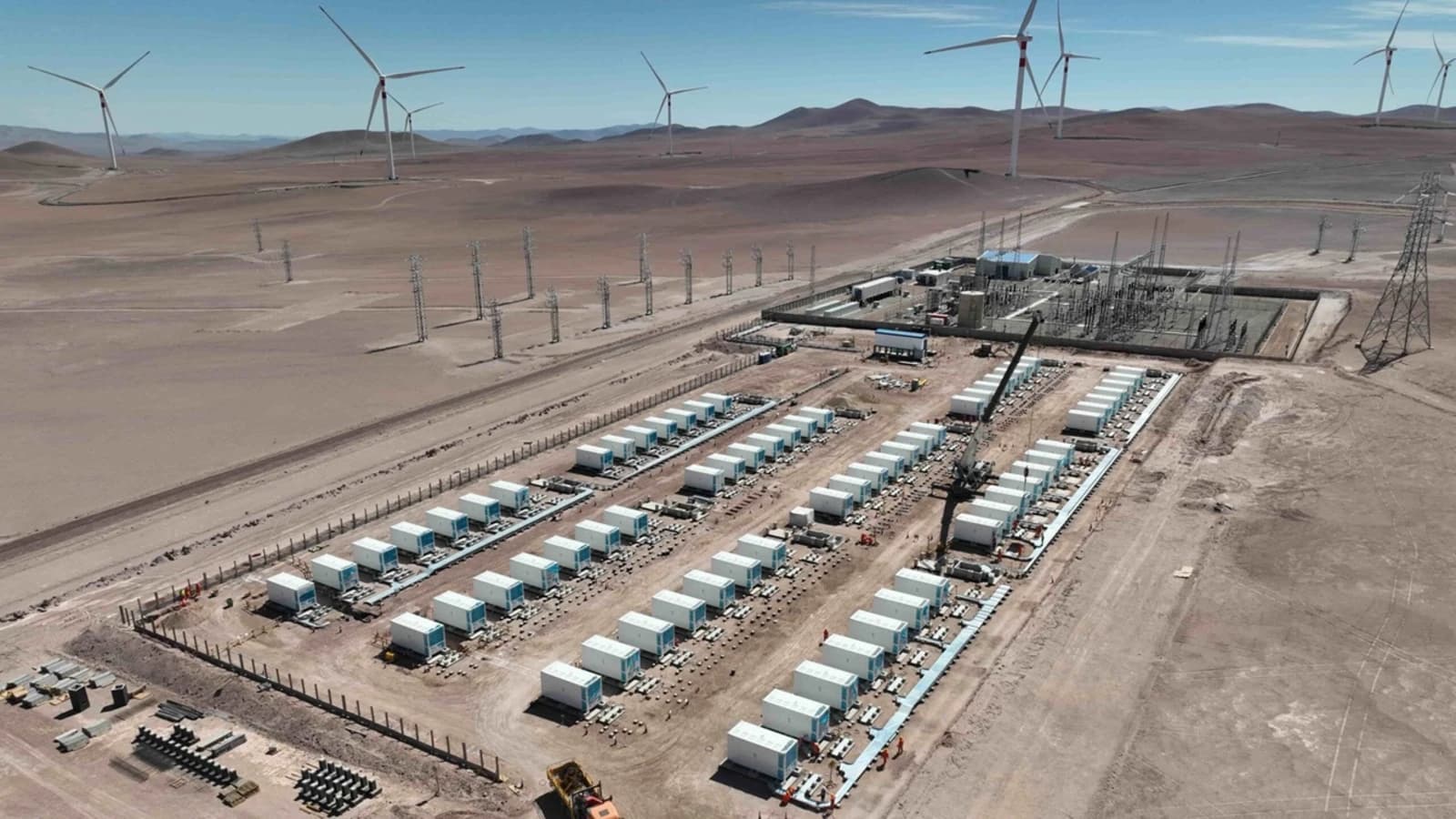
Chile's National Energy Commission (CNE) revealed that developing a four-hour BESS storage system requires an average investment of US$722/kW , a figure that increases to US$805/kW for five-hour projects and US$935/kW for six-hour configurations.
The upgrade comes at a time when Chile already has 2063 MW of operational battery storage systems, consolidating itself as the most advanced market in Latin America.
In addition, there are 2124 MW in testing and another 5977 MW under construction , while the portfolio of environmentally approved initiatives exceeds 16 GW and another 12.6 GW are progressing through different stages of evaluation.
The data compiled by the CNE also shows a significant dispersion in investment costs. For four-hour projects, values between US$616 and US$879/kW are reported, while five-hour configurations register ranges between US$723 and US$987/kW , depending on the technical characteristics and specific conditions of each development.

The report identifies four- and five-hour systems as the predominant configurations in the market, mainly due to the energy arbitrage opportunities they offer and the expected revenues associated with this type of asset.
It is worth remembering that, according to ACERA data, by the end of 2025 storage systems made it possible to reduce projected renewable energy discharges by about 10% .
Hybrid systems exceed US$1400/kW
The CNE update also provides new benchmarks for projects that combine renewable generation and storage. For solar power plants with four to five hours of battery storage, the average cost reaches US$1,404/kW , while for wind power installations with storage, the benchmark rises to US$1,610/kW .
The difference compared to stand-alone systems lies in the fact that these configurations simultaneously incorporate the investment in the generating plant and the storage equipment. Photovoltaic projects include solar modules, inverters, trackers, and civil works, while wind power developments add wind turbines, towers, foundations, and associated infrastructure.
Despite the difference in investment amounts, fixed operating and maintenance costs remain relatively low. The CNE estimates expenses equivalent to between 1% and 2% of the total investment value for both stand-alone systems and hybrid configurations.
Development timelines also differ, with stand-alone projects typically taking two years to complete construction, assembly, and commissioning. Meanwhile, hybrid solar or wind power plants with storage require approximately three years to complete their development.