


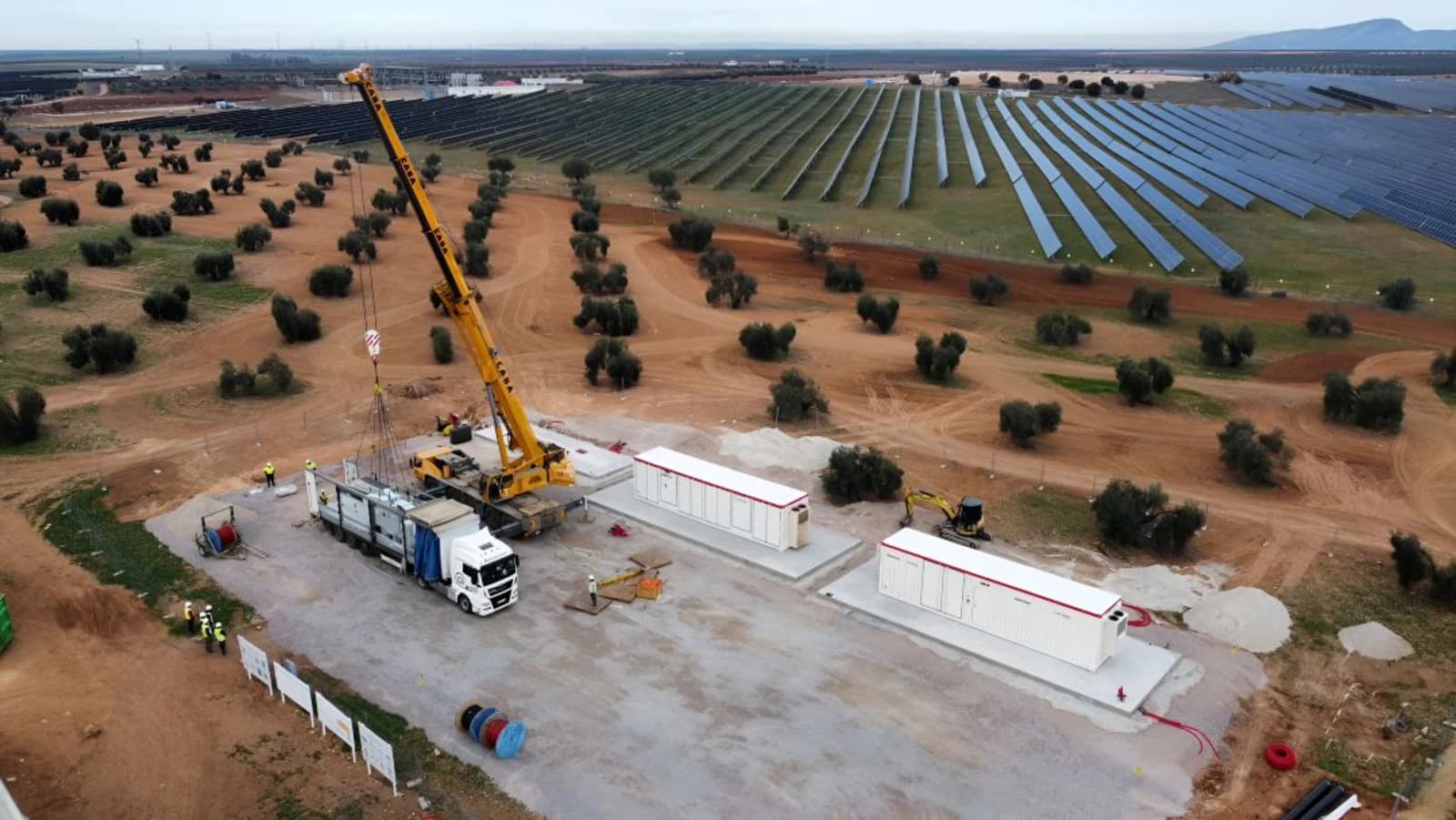
The Official State Gazette (BOE) in July drew an energy map marked by hybridization, the advance of large renewable installations and particularly intense administrative activity in southern Spain.
The monthly survey includes 55 projects, with photovoltaic presence in 45, storage in 23, and wind power technology in 10. It should be noted that the categories overlap because a considerable part of the initiatives combine different sources of generation.
The balance also shows that the sector is going through very different stages .
Ten projects involving batteries and renewable energy generation were put out to public consultation to obtain prior administrative and construction authorizations, while eight received both permits.

In parallel, seven withdrawals were recorded and the procedures associated with declarations of public utility, environmental assessments and land occupation continued.
Among the larger-scale developments are Navabuena Solar , with 424.71 MW, which obtained the declaration of public utility in Castilla y León; the Moralets II hydroelectric expansion , with 420 MW of turbine capacity in Aragón; and the Paucali, Arlo and Céfiro wind farms, which together comprise 239.15 MW between Aragón and Catalonia.
Batteries will no longer be allowed to travel in the back seat in July.
Storage appears in approximately 42% of the reviewed files . The most visible change is not in independent installations, but in the proliferation of plants incorporating batteries into existing or planned photovoltaic projects.
The combination of both technologies dominates with 17 entries. These are joined by four exclusively BESS developments and two schemes that integrate storage with more than one renewable source.
The result extends the trend observed in June, when the batteries had already gained their own volume within the BOE , although at that time they intervened in 18 of the 63 actions identified.
Among the proposals submitted in July is La Atalaya, in Villena, with 96.88 MW of solar power and 83.71 MW of storage. Ignis is processing the BESS Azor Solar 1 and 2 systems in Madrid, associated with a 64.02 MW plant and 68.51 MW of battery storage. Opdenergy is promoting OPDE Miramundo in Puerto Real, which combines 49.99 MW of photovoltaics with an additional 24.04 MW of flexible storage.
Independent solutions also progressed. PB Babor 7, a 66 MW project, obtained preliminary administrative authorization in Tarifa, while Solaben ST1 and ST6, each with 50 MW, began the permitting process in Logrosán. The contrasting development came from Huesca, where the withdrawal of Visenta, a 100 MW project, was accepted.
Continue reading
This regulatory rollout coincides with a still-moderate economic outlook. ENTSO-E estimates a theoretical gross arbitrage value for Spain of €552 per MW per day, 31% lower than that of Hungary, the European leader. Spain ranks 18th out of the 24 markets examined, meaning that the viability of batteries will not depend solely on buying cheap electricity and selling it during peak hours. Balancing services, congestion management, and other revenue streams will be key to sustaining investment.
Andalusia steps on the gas and focuses on the new map
The territorial distribution shows a clear leader in July. Andalusia accounts for 20 of the 55 registered projects, followed by Catalonia with eight . Extremadura, Castilla-La Mancha, the Valencian Community, and Castilla y León each have five projects. Aragon completes the main group with three, in addition to a wind farm project shared with Catalonia.
The Andalusian epicenter is in Alcalá de Guadaíra. There, six plants totaling 278.4 MW of photovoltaic capacity and 237.6 MW of storage—Artemisa, Elvisa, SES, Jade, Esmeralda, and Heracles—obtained prior and construction authorizations. The concentration of applications with nearly identical capacities reveals a development strategy based on blocks, capable of bringing together more than 500 MW of generation and battery storage in a single area.
The province of Seville also incorporates Freya, in Carmona, with 44 MW of solar and 39.6 MW of BESS. Cádiz adds PB Babor 7 and OPDE Miramundo, while Huelva maintains activity with La Puebla 1 and 2, from Jinko Greenfield Spain 1, which together comprise 139.2 MW of photovoltaic capacity.
Outside of Andalusia, Extremadura stands out for its series of energy storage systems in Badajoz and Cáceres . Castile and León combines Naturgy's Torozos B and C wind-solar hybrid projects with the ongoing development of Navabuena Solar. The Valencian Community presents a more contrasting picture: the La Atalaya project is currently being processed there, while four Acciona facilities in Ayora have been abandoned.
The withdrawals from Rincón del Cabello, La Solana, Bodeguillas, and Mulatón represent 181.21 MW. These are in addition to the Arrebol and Lagunillas wind farms, owned by Statkraft, which total 123.8 MW in Andalusia. Together with Visenta, the identified cancellations amount to just over 405 MW.
A small plant peeks out from the large agrovoltaic showcase
Amidst the megaprojects, the Official State Gazette (BOE) in July opened the comprehensive processing of the L'Arrendament agrivoltaic plant , with a capacity of 0.86 MW, in Botarell, Tarragona. The file was released for public comment to obtain the necessary prior and construction authorizations, the declaration of public utility, and the environmental assessment.
Its scale is minimal compared to the large-scale installations of the month, but its interest lies in the production model. The proposal seeks to combine solar power generation and agricultural activity on the same plot of land, a formula that aims to reduce competition for land and evaluate how the modules coexist with the crops.
The Catalan project comes at a time of increased institutional support for this technology . The second call for proposals under the IDAE's Innovative Renewable Energy Program subsequently awarded grants to 118 agrivoltaic initiatives totaling 882.43 MW and expected to mobilize nearly €748 million. All of these projects incorporate energy storage and, collectively, are projected to have a capacity of 1,733.82 MWh.
The lease agreement should not be confused with that portfolio of successful bidders, nor does the Official State Gazette (BOE) file identify an associated set of agreements. However, its appearance anticipates a trend that is beginning to shift from innovation calls for proposals to the specific processing of installations.
July thus sends a double signal. Batteries are becoming commonplace in solar developments, while configurations that seek to share the space with other activities are beginning to emerge. The volume of applications confirms investor appetite; the real test will come when permits translate into construction, connection, and commercial operation.