


Brazil is entering a new phase for energy storage, and Growatt projects that the commercial and industrial (C&I) segment will accelerate in 2027 , after a year in which customer interest grew, although a large part of the inquiries and quotes have not yet turned into sales.
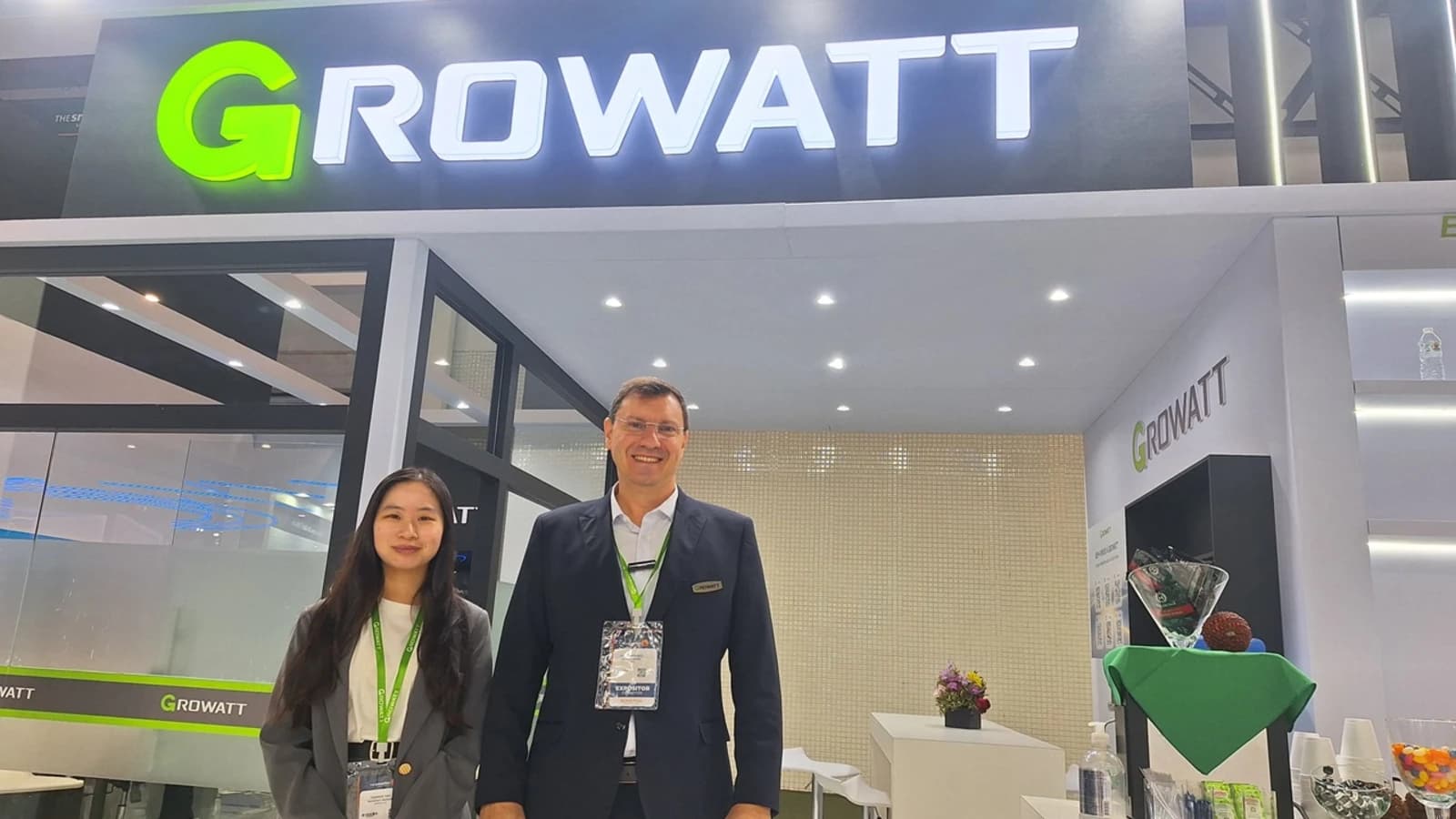
“We anticipate significant growth next year because customers are beginning to understand the solution,” said Silvio Robusti , Product Marketing Manager of Growatt Brazil , in an interview with Energía Estratégica during The Smarter E South America 2026 .
The expectation coincides with a change that the company has already identified in the market: while the on-grid business remains stable, battery solutions are gaining ground, first in the residential sector and with prospects of expanding more strongly towards businesses and industries.
The movement occurs on a photovoltaic industry that already exceeds 74.3 GW of operational capacity , of which 51.69 GW correspond to distributed generation in more than 4.71 million solar systems connected to the grid .

These dimensions expand the base of installations on which batteries can be incorporated, both in new projects and through retrofitting.
“The transition to storage is just beginning. We are moving towards storage; while the on-grid market is relatively stable, storage is growing,” Robusti noted.
Currently, residential storage is showing greater dynamism than C&I for Growatt in Brazil , mainly due to power supply interruptions and the need for energy backup in homes.
Data on distributed generation allows us to understand the importance of this segment. The residential sector accounts for 26,564.1 MW, equivalent to 51.39% of distributed photovoltaic capacity , while commerce and services represent 14,102.2 MW, or 27.28% .
Regarding that market, Growatt presented in Brazil a residential storage offer of between 3 kW and 12 kW , accompanied by low voltage lithium iron phosphate (LFP) batteries.
For businesses and industries, the manufacturer offers an all-in-one solution with 125 kW of power and 261 kWh of capacity , integrated into a single unit. The portfolio showcased at Intersolar South America thus reflects the increased emphasis the company intends to place on batteries within its Brazilian business.
“In the future, we expect C&I to grow because many commercial and industrial customers currently use diesel generators, and for those types of users, the solar solution with batteries is much better,” Robusti stated.
The effect of that curve is reflected in the sales pipeline. Growatt receives numerous requests for quotes and inquiries that have not yet converted into sales , a situation that Robusti linked to customers who are still learning about the technology and its applications.
For this reason, the company is developing training programs to expand the technical and commercial knowledge of a market that is still in its adoption phase. Therefore , 2026 serves as a period of demand maturation , while suppliers and solutions begin to consolidate.
The company expects that a greater understanding of the technology will allow some of those opportunities to be transformed into installations during 2027.
Retrofit, microinverters and diesel replacement
The transition is already visible in existing installations. Growatt is registering retrofit projects in homes that previously had solar power generation and subsequently decided to incorporate batteries , a path that expands the market beyond new systems.
Added to that demand is the off-grid segment, where the company has been selling storage equipment in Brazil for five years.
One of their cases corresponds to a restaurant located in Ilhabela, São Paulo state , whose operation needed to resort to a generator on a recurring basis.
Initially, the facility had a Growatt inverter and two battery modules totaling 10 kWh . This configuration required the use of the diesel generator almost every day during operating hours.
After installing a new inverter and expanding the storage bank, the use of fossil fuel equipment dropped to one or two days per month , mainly during rainy periods. The facility is already considering doubling the system with the goal of completely eliminating the generator.
The project showcases one of the applications that Growatt intends to bring more forcefully to the C&I: combining photovoltaics and batteries to reduce dependence on diesel backup , particularly for consumers who require continuity of supply.
Meanwhile, the company is identifying another transformation within the Brazilian residential market. Microinverters are gaining market share compared to string inverters , and Growatt is registering a year-on-year increase in sales of this technology.
The strategy is part of a broader push following the company's 10-year presence in Brazil , where, according to Robusti, Growatt leads in the number of installed inverters. Now, the firm seeks to maintain that position while shifting a greater focus to batteries.
“Our goal is to continue being market leaders while we focus more on storage,” the executive stated, clarifying that, for the moment, that roadmap does not include utility-scale storage in the Brazilian market.
“Globally, our parent company has the solution, but we are not yet deploying it in Brazil. High-voltage substations and utility-scale storage are not part of our current objective for Brazil,” he emphasized.
Therefore, residential and C&I are Growatt's immediate focus , within a distributed generation market that exceeds 51 GW and where photovoltaics represent 99.40% of the installed capacity of micro and mini distributed generation , according to ABSOLAR.
Growatt's commitment to Brazil is also reflected in its infrastructure. The company is investing in a new, larger, and more modern warehouse in Santo André , within the São Paulo metropolitan area.
Given this scenario, the company sees 2027 as a year of potential acceleration for Brazilian commercial and industrial storage , once part of the learning curve that still hinders the conversion of inquiries and quotes into new installations has been overcome.