


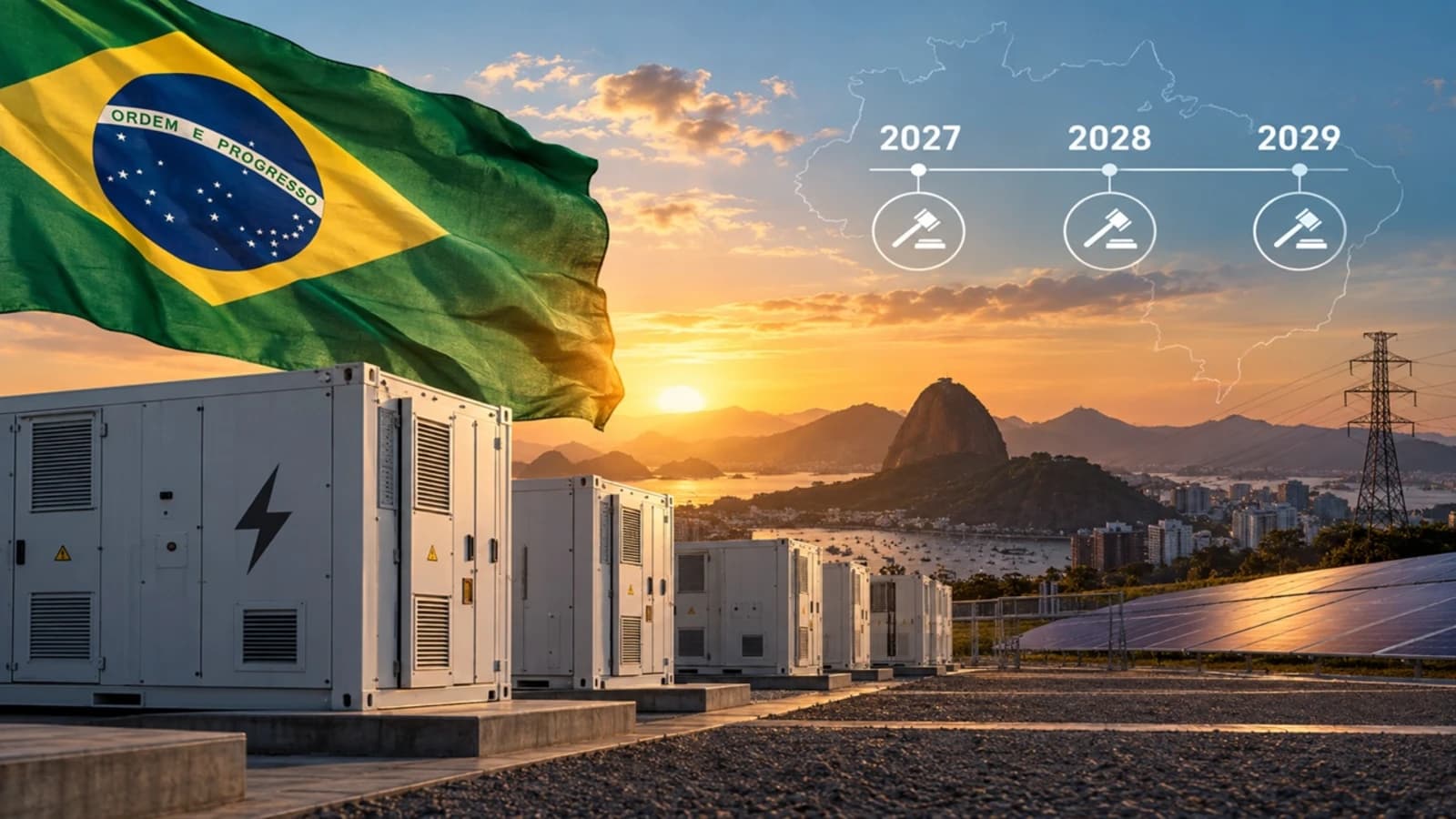
The Ministry of Mines and Energy (MME) established an estimated schedule of electricity tenders for the period 2027-2029 that includes the holding of a Capacity Reserve in the form of Power (LRCAP) in the second half of each of those three years, with battery systems among the technologies that may be considered.
The schedule was organized as follows:
- 2027: During the first half of the year, tenders are planned for reserved capacity for hydroelectric plants up to 50 MW and for supplying isolated systems. The second half of the year will see the LRCAP (Local Renewable Energy Capacity Purchase Agreement) , with BESS (Bulk Energy Storage Systems) among the technologies that may be considered, in addition to processes for contracting energy from new projects and existing plants.
- 2028: The first half of the year will again include a capacity reserve tender for hydroelectric plants up to 50 MW. The second half of the year will see another capacity reserve tender , along with tenders for energy from new projects and existing plants.
- 2029: The same scheme will be repeated, with a tender for hydroelectric plants up to 50 MW during the first half of the year and a new LRCAP (Local Revenue and Certification Program) for power and processes for new and existing energy in the second half. The schedule also includes a new procurement process for isolated systems.
The schedule was established through MME Regulatory Order No. 143. In addition to electrochemical systems, future LRCAPs may include hydraulic storage —including reversible power plants—, hydroelectric plants and thermal power plants, including facilities powered by biomethane, biogas, biofuels and waste.
The timeline does not, however, imply that Brazil will automatically hold three new auctions specifically for BESS. The implementation of the LRCAPs will depend on studies prepared by the Energy Research Company (EPE) and the National Electric System Operator (ONS), which must determine the system's power requirements and submit their findings to the Ministry before April 30th of each year . The schedule itself is an estimate and may be modified according to planning needs.

Even with that caveat, the inclusion of an annual contracting window until 2029 represents a new signal for an industry that has been demanding greater predictability to develop projects and, especially, to justify investments in local manufacturing.
As Energía Estratégica previously reported, industry representatives warned that a single tender was not enough to support long-term industrial decisions and demanded consistency in the contracted volumes.
The new schedule does not yet determine how many MW of storage will be demanded each year, but it extends the possibility of BESS's participation in capacity processes beyond the first experience planned for 2026.
A market that already has almost 300 GW of projects
The starting point will be December. Brazil is preparing its first two processes, specifically dedicated to contracting power through new battery storage systems, for the 2nd and 4th of that month.
MME Regulatory Order No. 136/2026 established two separate tenders: LRCAP 2026 – National Stockpile , for projects meeting minimum national content requirements, and LRCAP 2026 – Stockpile , open to all other eligible systems. Both will contract power availability with supply commencing on August 1, 2028.
The market response far exceeded previous Brazilian electricity tenders. EPE received 6,091 projects totaling 296,807 MW , a record number of entries for national electricity sector tenders.
The registered volume does not equate to available capacity, much less to the power that will ultimately be contracted. Projects must undergo analysis and technical approval by EPE, so only once that stage is completed will the bids that can actually compete be known.
Continue reading
The magnitude of the interest also led to strengthening the mechanisms designed to separate mature projects from speculative initiatives, with greater technical requirements and guarantees to participate, in a market where the number of proposals far exceeds the foreseeable needs for contracting.
In parallel, the government began linking storage development to an industrial strategy. The process, reserved for domestically produced content, requires that systems meet the criteria of the BNDES accreditation scheme . Currently, companies such as BYD, Gotion, Moura, TBEA, Trina, SecPower, WEG, and You.On are among the suppliers progressing through this process, although the BNDES itself clarifies that the list may expand as new production facilities are evaluated.
The final contracting scale has not yet been established. However, the market is working with a reference point of between 2 and 5 GW , equivalent to 8 and 20 GWh for systems with a four-hour operating time. Compared to the 296.8 GW registered, the difference between submitted projects and final demanded capacity anticipates strong competition in the initial tenders.
This new storage scenario will be one of the main focuses of FES Brazil , which will be held on November 5 and will mark both the first edition of the Future Energy Summit in that market and the closing of its 2026 tour.
The meeting will discuss the opportunities presented by the transformation of the Brazilian electricity system, with an agenda that will include storage, investment, solar and wind projects, hybridization, technological innovation and sustainable financing , as well as public-private partnerships and business leadership.
The meeting will take place just one month before the country's first stand-alone BESS auctions, in a market that combines a record number of registered storage projects with 74.3 GW of solar power in operation and a technical potential for offshore wind exceeding 900 GW .
Batteries also reach the transmission
Brazilian energy storage will face another test in 2027. The Agência Nacional de Energia Elétrica (ANEEL) is preparing for April 30th the Leilão de Transmissão Nº 01/2027, which incorporates for the first time a batch intended to contract batteries as part of the transmission infrastructure of the National Interlinked System.
The project, included in Lot 5, aims to strengthen the reliability of the water supply to Cruzeiro do Sul and Feijó, in Acre. Unlike the other transmission lots, whose contracts will last 30 years, the BESS system will have a contractual term of 18 years due to the technology's lifespan.
The complete project includes 12 lots, approximately 3,245 kilometers of new lines and 1,386 MVA of transformation, with investments estimated by ANEEL at R$12.9 billion .
Brazil thus enters a stage in which storage begins to occupy different spaces within electricity planning: first through the specific LRCAPs of December, then as transmission infrastructure and, from the second half of 2027, as one of the eligible technologies within the new annual capacity tenders planned until 2029.
The question now is how much storage EPE and ONS will determine is necessary for each exercise and what portion of the windows foreseen by the new calendar will actually end up becoming BESS contracts.