


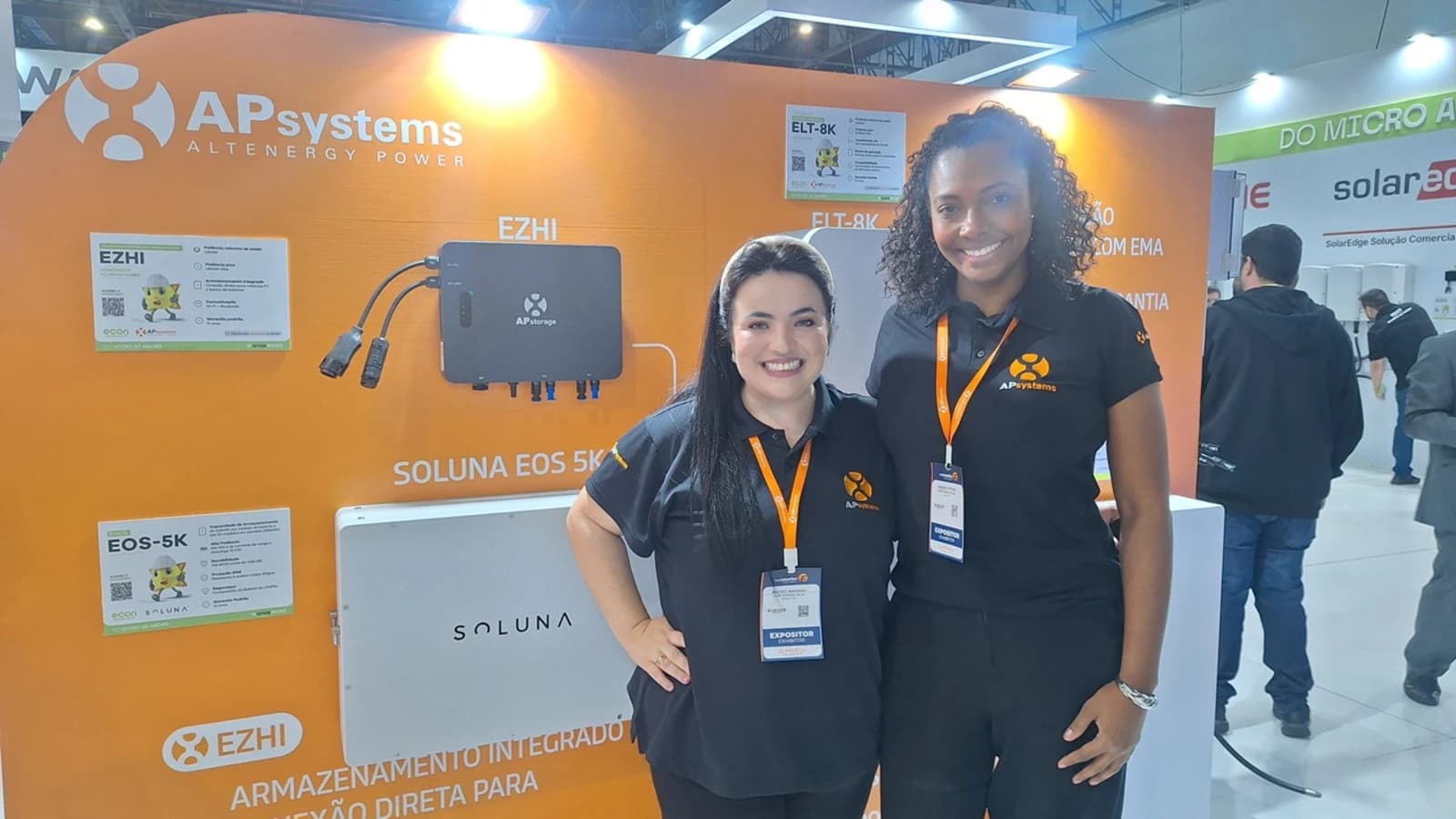
Commercial and industrial energy storage is emerging as one of the next growth segments of the Brazilian energy market , according to APsystems' vision.
“C&I projects will be the big trend towards 2027 and next year,” predicted Mariani Pereira , Country Manager of APsystems in Brazil , in an interview with Energía Estratégica during The smarter E South America .
Pereira linked that expectation with concrete signs that the company is collecting among installers and end users, and it is being developed on a large-scale photovoltaic base: the country already has more than 74.3 GW of solar in operation , equivalent to 27.4% of the capacity of its electricity matrix, according to data from the Brazilian Photovoltaic Solar Energy Association (ABSOLAR) updated to July 20, 2026.
Within that volume, distributed photovoltaic generation reaches 51,693.1 MW . The commercial and services segment accounts for 14,102.2 MW , while industry adds 3,612.5 MW , two categories directly linked to the target market for C&I solutions.

The growth of this capacity is beginning to coexist with greater production management needs, especially among users who seek to expand their systems but find limitations in feeding energy into the electrical infrastructure.
“Distribution companies are placing restrictions on projects, while customers continue to need more power,” Pereira noted.
According to the executive, some consumers can no longer inject energy into the grid , increasing the need to manage a larger proportion of the electricity produced by larger photovoltaic systems locally.
“To have these larger systems and produce your own energy, batteries are becoming increasingly necessary,” the Country Manager stated.
For APsystems, the main driver is not simply the behavior of electricity prices. The ability to meet growing demand and manage its own production appears to be a determining factor in the decision to incorporate storage .
The market is also finding impetus in problems of continuity and quality of supply , a condition that is beginning to modify the economic evaluation of storage among certain commercial and industrial consumers.
“Most of the customers I’ve been talking to in the last couple of days are looking for backups ,” Pereira explained.
The directive linked this behavior to situations detected in different areas of Brazil, where supply conditions affect both the continuity of operations and the integrity of the equipment.
“The electricity grid of the distributors and the quality of the energy in different areas of Brazil are worsening. That is the main concern,” he stated.
For this reason, APsystems is working on systems that provide backup and stabilization to C&I facilities , while some of its clients report problems associated with poor power quality and seek to reduce their exposure to outages.
Among the segments where Pereira detects the greatest need are supermarkets and other establishments that handle refrigerated products , due to the cost that a prolonged blackout can generate.
The executive mentioned that some regions of São Paulo remained without electricity from the grid for up to seven days , a situation that increased interest in solutions capable of maintaining critical loads.
The same logic applies to businesses linked to food and temperature-sensitive products, including vaccines , where continuity of supply can become a central component of the business case .
Storage is now finding applications beyond backup. APsystems identifies its most significant project in Brazil as a hospital that acquired around 100 APstorage ELS-5K 5 kW units for peak shaving .
“This project is the largest APstorage project we have had in Brazil: 100 5 kW battery units used for peak shaving in a hospital ,” Pereira highlighted.
The transaction took place during the initial product launch period in 2024, the interviewee recalled. The client used the batteries to reduce peak demand and take advantage of features beyond conventional backup power.
Pereira explained that the investment was justified by the benefits of peak shaving and the additional features of the system.
At the same time, the company is supporting this growth outlook with the APstorage 261L , a solution that it already has in stock in Brazil and that is aimed at larger commercial and industrial facilities.
The response received during The Smarter E South America surprised Pereira. The executive expected possible objections related to the size or investment required, but instead found integrators who already associated the equipment with specific needs.
The country manager revealed that the product generated great interest among its customers, thus reinforcing APsystems' perception that installers are beginning to identify more clearly where there is a business case for larger storage systems.
The modular architecture presented by the manufacturer allows up to ten units to be connected in parallel . Its global portfolio includes higher-end models, although the introduction of these options to the Brazilian market will depend on the requirements identified in specific projects.
For larger-scale installations, APsystems chooses to work directly with customers and design configurations tailored to each need, rather than automatically transferring solutions available in other markets.
“For these larger projects, we work directly with clients to design solutions tailored to their specific needs,” Pereira explained.
The company's participation in the trade show also had this objective: to gather requirements in person and evaluate which configurations can best respond to the evolution of the Brazilian market . For the moment, the company believes that the APstorage 261L meets a large part of the identified demand.
Another area of focus is the training of installers , with the aim of enabling them to acquire technical knowledge and identify consumers with potential for C&I projects.
The initial investment for a storage solution remains higher than that of an installation composed solely of photovoltaic panels. However, for APsystems, the emergence of use cases related to backup power, power quality, energy management, and peak surge mitigation expands the variables that justify the investment .
The growth in photovoltaics further strengthens the potential market for this technology. Brazil has more than 4.7 million distributed solar systems connected to the grid and 8.2 million consumer units receiving credits through the compensation scheme , according to ABSOLAR.
Photovoltaics also reached new generation peaks. On December 26, 2025, it registered an hourly record of 42,552 MW , equivalent to 48.37% of the national electricity demand at that time, while during December it contributed 15.23% of all electricity supplied in Brazil.
Microinverters: the other front of APsystems
Although storage is gaining importance in its strategy, microinverters continue to be APsystems' main product in Brazil , a market in which the company has been operating since 2013 and has accumulated more than 12 years of activity.
“When we started, nobody was talking about micro-inverters, and now all the brands are bringing them to the Brazilian market,” Pereira pointed out.
For C&I projects, the manufacturer presents a new generation of microinverters with flexible DC cables , developed after gathering needs from customers and installers in different regions of the country.
The modification responds to the increased size of photovoltaic modules , which increased the demand for greater flexibility during the installation of the direct current side.
Regarding microinverters, APsystems offers three-phase models for both 380V and 220V, as well as single-phase models for 127V and 220V, covering all major grid configurations in Brazil.
Brazil's regional diversity also influences portfolio development. Pereira noted that needs vary by region , which is why the company travels the country gathering requirements before introducing new configurations.
The strategy thus combines the evolution of its historical microinverter business with a greater presence in storage , at a time when users are beginning to demand solutions that integrate generation, backup and energy management.
Regarding APsystems' presence in Brazil, it has officially operated in the Brazilian market since 2014. And in 2026, it will celebrate 12 years in that market.
“Our DNA is focused on preparing our portfolio to meet the needs of all projects,” the Country Manager concluded.
With 74.3 GW of operational photovoltaics and more than 51.6 GW of distributed generation , Brazil has an ever-increasing solar base on which to develop new energy applications.
For APsystems, the next step within C&I will be to incorporate more management capacity , and the signals gathered from customers and installers lead the company to project that storage will gain prominence during the next year and towards 2027 .