


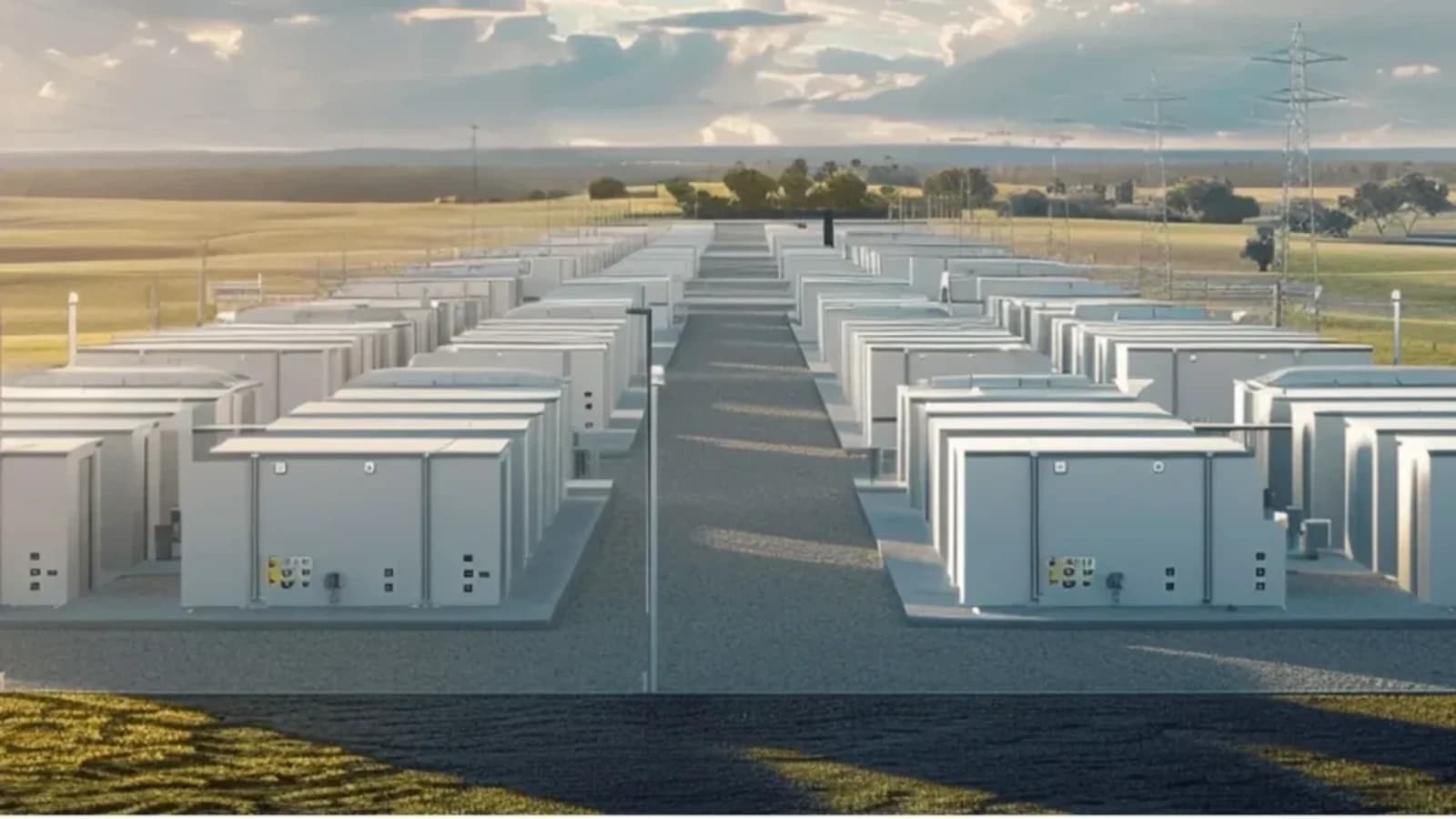
The Province of Buenos Aires has taken the first step to transform its system for meeting peak summer demand. Through Buenos Aires Energía SA (BAESA), it awarded a 25 MW project with 125 MWh of storage capacity, which will become operational in January 2027 and will replace the forced generation that was previously carried out using diesel generators during the Summer Plan.
The project will require an estimated investment of $31.2 billion and will install BESS systems in Mar del Tuyú, Carmen de Areco, Arrecifes and Capitán Sarmiento , four nodes where storage will allow for reinforcing the electricity supply during periods of higher consumption caused by high temperatures.
"We had already set it as a goal for next year, the summer plan, to replace it. Not having to keep hiring small diesel engines, but batteries," confirmed Gastón Ghioni , Undersecretary of Energy for the province of Buenos Aires, in an interview with Energía Estratégica .
"Every summer, for several years now, we have been implementing the Buenos Aires province summer plan, which we have been doing with diesel, where we put in forced generation every year between December, January and February to make up for the electricity transport deficit in the network," he said.

The initiative, spearheaded by the Undersecretariat of Energy of the Ministry of Infrastructure and Public Services, will be financed through the Distributed Generation Cost Surcharge (ACGD) via FITBA , while BAESA will be responsible for implementing the program. For the Province, the project represents the beginning of a long-term energy storage strategy that extends beyond this initial phase.
The change in technology is supported by the experience gained with PROINGED 's projects in Saladillo, where the combination of solar generation and storage allowed the performance of batteries for this type of application to be validated.
In addition to providing backup power during peak demand periods, the Province aims to improve the performance of the distribution network, and has already identified dozens of locations where new BESS systems could be installed.
"The grid is quite dynamic, but we have 80 more nodes where battery systems can be installed, for around 200 MW of capacity," the undersecretary assured, although he clarified that this planning will depend on the evolution of the transport works and the needs presented by the electrical system.
The relationship with AlmaSADI and the next step in storage
The project's definition was also linked to the national tender for 700 MW BESS stand-alone power generation, called AlmaSADI and promoted by CAMMESA. Therefore, Buenos Aires decided to partially await the results of this tender before awarding the contract, as it had submitted four projects through BAESA.
With this, he sought to find out what solutions the market offered, but he was not among the possible winners (the official award will be on July 8).
"We delayed because of the AlmaSADI battery tender at the national level, since we wanted to participate as BAESA and see what other companies were presenting, given that there could be offers that might resolve to some extent what we were seeing," Ghioni explained.
However, the Province believes that the design of the national tender left out applications that would have allowed for the resolution of restrictions on distribution networks.
"One of the questions we asked CAMMESA during the bidding process was whether we could submit a bid for 10 MW across the entire corridor, in the distribution network, instead of a single point at 132 kV. This would have solved the problems we were having with the network, but it wasn't possible, and I think CAMMESA's bidding process didn't consider what was happening downstream," he remarked.
Meanwhile, the Province is analyzing how to adapt the program to the national regulatory framework established by Resolution 400/2025 to support the planned expansion of storage in the Buenos Aires electricity system.