

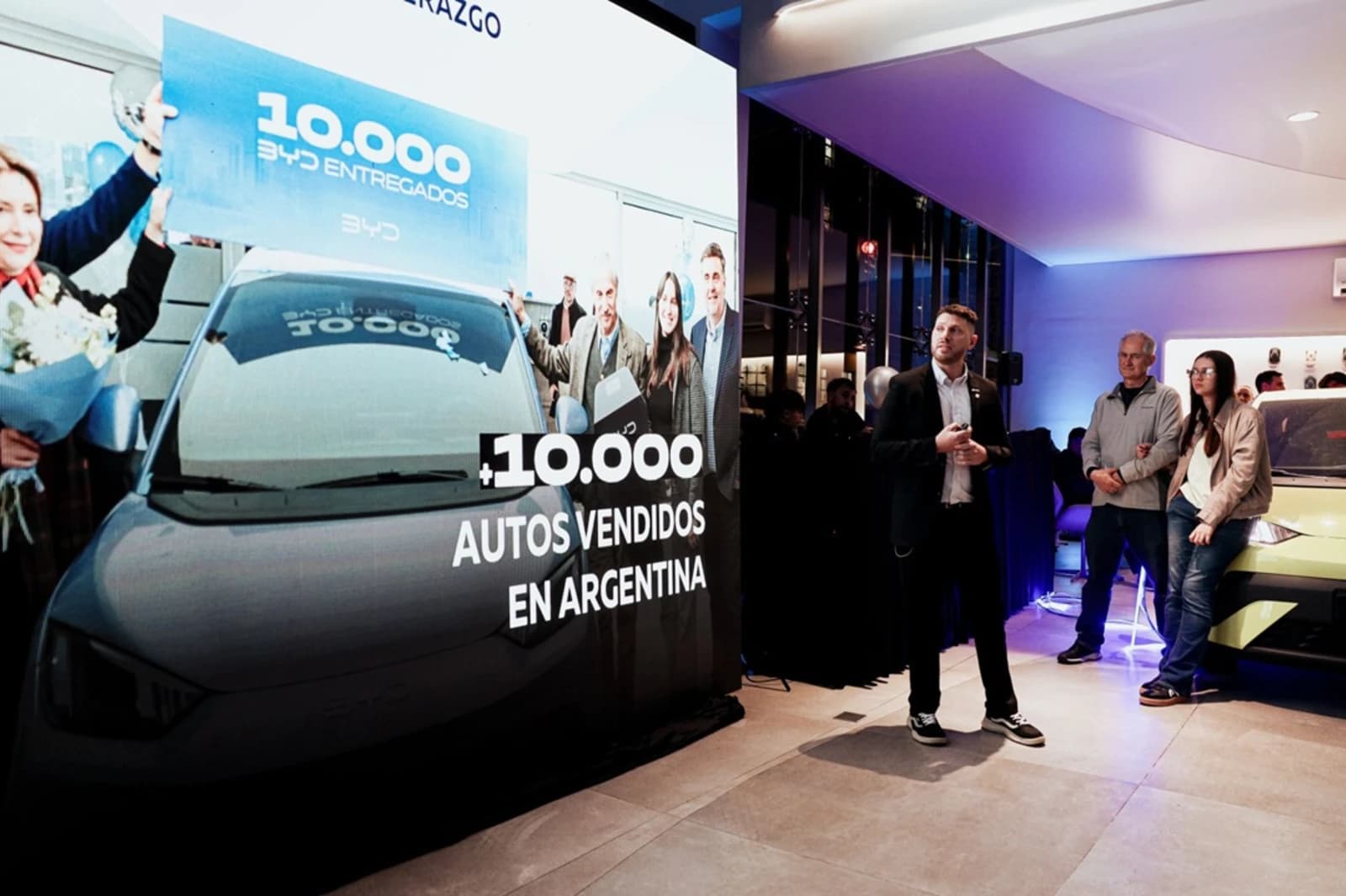
The BYD Seal 5 DM-i was presented practically at the same time in the 18 official dealerships that the automaker already has in Argentina , a picture that allows us to measure the structure that the brand built in less than a year.
In fact, the launch finds the company at a different stage than when it first arrived: it has already surpassed 10,000 units sold and now seeks to expand its presence into more segments, gain volume and add Brazil as a supply platform along with China.
“We want to offer a high-quality electromobility proposal, with advanced equipment and electrification in every segment. There’s much more to come,” anticipates Christian González Albinati , Product Manager of BYD Argentina , in an interview with Mobility Portal .
The company has not yet revealed what its next models will be for 2027, but the speed with which it expanded its local offering allows us to identify its direction.
BYD officially began sales in October 2025 with the Dolphin Mini, Yuan Pro, and Song Pro . Since then, it has expanded its offerings to seven models, strengthened its presence in the electrified SUV segment, entered the pickup truck market with the Shark, and now launched its first sedan lineup with the Seal 5 DM-i.
More than a succession of launches, the move aims to increase the number of segments in which BYD can compete for customers and stop depending solely on the buyer who comes to the dealership specifically looking for an electric vehicle.
BYD raises the stakes against its competitors
The numbers are starting to give the brand a scale that exceeds the electrified niche.
During August, BYD registered 1,389 new car and light commercial vehicle registrations , achieving a 3.3% market share and ranking ninth overall among brands , according to ACARA data. It also accumulated 10,663 units between January and August 2016 .
The result also marked a milestone for Chinese automakers: BYD became the first brand of this origin to enter the monthly top 10 of light vehicle registrations in Argentina .
In that context, González Albinati compares: “That’s where the 120,000 engineers working in the development centers demonstrate the difference in technology, quality, and performance. The other brands are years behind with their electrified offerings.”
BYD is not just looking to present itself as a new Chinese alternative, but to put into discussion the electrified proposals of manufacturers that have been established in Argentina for years.
The executive is equally emphatic when referring to the new sedan: “We are revolutionizing this segment in Argentina. There is nothing like it.”
Beyond that assessment, the price helps to understand why BYD considers the product a tool to compete for volume.
The Seal 5 DM-i has an official price of US$31,990 , a range of up to 50 kilometers in 100% electric mode , a claimed fuel consumption of 3.7 liters per 100 kilometers , and a combined range of up to 1,600 kilometers , both measured under the NEDC cycle. During September, the brand is also offering a US$1,000 discount off the purchase price.
The strategy, then, is not solely about offering electrification. BYD aims to make it a direct competitor to conventional vehicles through a combination of price, equipment, range, and running costs.
Continue reading
González Albinati asserts: "We have a winning proposition in terms of equipment, Super Hybrid technology, and price, both for the vehicle and its maintenance. The TCO of this sedan makes a significant difference: you can save 60% on fuel alone and more than 80% on maintenance compared to its competitors."
He then points out: “We believe it will be a great solution for rental companies and fleet businesses.”
Why can Brazil change the price equation?
The next step could occur not only in the catalog, but also in the origin of the vehicles.
“BYD Brazil, as has already been explained by the brand, will supply the region along with China,” confirms González Albinati.
He adds: “With the integration of auto parts, we position ourselves not only with a direct channel from Mercosur, which marks a great difference between us and any importer, but also with a tax benefit that will allow access to top-level vehicles at affordable prices.”
But where exactly does that advantage come from?
One of the key factors is the import tariff . Automobiles from China are considered non-regional goods, and outside of special regimes, vehicles classified under these categories face a 35% non-regional import duty . In contrast, vehicles produced in Brazil that meet the origin requirements of Economic Complementation Agreement No. 14 (ACE 14) can access a 100% tariff preference, meaning they can enter Argentina with a 0% intra-regional tariff .
However, the condition of origin does not arise simply from assembling a vehicle in Brazilian territory.
As a general rule, the agreement requires a Regional Content Index (RCI) of 50% for finished vehicles. However, there is a condition that is particularly relevant for BYD: Argentina and Brazil established a specific scheme for vehicles with new powertrains, including electric and hybrid vehicles , which allows access to preferential treatment with a minimum RCI of 35% within a growing bilateral quota . By 2026, this quota reaches 36,000 units and will continue to increase to 50,000 in 2029.
Therefore, BYD's growing industrial integration in Brazil is relevant for Argentina. The company announced its intention to exceed 50% nationalization of parts and components in Camaçari by 2027 , while expanding its supplier network and moving towards more comprehensive production processes. This objective should not be automatically confused with the Regional Competitiveness Index (RCI) required by the trade agreement, but it does demonstrate a direction compatible with greater utilization of regional preferences.
The benefit is not identical for all models. Argentina also maintains a parallel system that allows the import of up to 50,000 electrified vehicles per year with a 0% import duty , provided their FOB value does not exceed US$16,000 . This scheme is expected to be in effect for five years, and BYD is among the brands that have already used this mechanism to source their vehicles from China.
Therefore, producing in Brazil does not automatically eliminate the 35-point tariff on all BYD vehicles sold in Argentina . Some models from China can already enter with zero tariffs through the national quota.
Camaçari's advantage may become more relevant for vehicles that do not fall under that regime because they exceed the FOB limit, are outside the Argentine quota, or need to sustain larger volumes without depending on an annual allocation .
Added to this is the logistical factor. A production source in Brazil significantly shortens the supply chain compared to China and can reduce replenishment times, transportation costs, and inventory needs, although the final impact will depend on the company's business model and structure.
This doesn't mean that all of those savings will be passed on to the selling price. But it would give BYD a second way to improve costs, gain supply flexibility, or pursue a more aggressive sales strategy in Argentina .
