The energy required by an ice cream factory to maintain its cold storage facilities, a pharmaceutical warehouse to preserve medications, or a logistics center to distribute perishable goods cannot be treated as just another industrial consumption. In these operations, refrigeration must be maintained within specific operating conditions, even when production decreases or the electrical grid experiences difficulties.
This characteristic makes the cold chain a segment of particular interest for the development of industrial solar solutions. Unlike other activities that can shift part of their consumption to specific times, refrigeration systems require continuous operation and can represent a significant energy load for much of the day.
Among companies involved in food production, logistics, and pharmaceutical warehousing, the interest in these solutions stems from various factors. The motivation is not limited to the cost of electricity: it also includes the need to protect merchandise, reduce exposure to supply problems, and prevent power outages from disrupting operations.
“Companies continue to look for ways to reduce costs and generate their own energy. But energy storage is also starting to gain traction, due to power restrictions from distributors, isolated locations, and grid quality problems that affect production processes,” explains Marcos Feroce, director of Sunrise Solar Energy.

An electricity demand that cannot be stopped
In a facility with cold storage chambers, electricity consumption is conditioned by the need to maintain controlled temperatures, regardless of whether the plant is producing, preparing orders or outside of its usual operating hours.
This presents two distinct challenges for designing a solar solution. The first is leveraging photovoltaic generation to reduce the electricity the company purchases from the utility. The second is determining how to respond to outages, fluctuations, or power limitations that could compromise critical systems.
The first need can be met with grid-connected photovoltaic systems, sized according to the consumption profile and self-consumption capacity of the establishment. The second may require a hybrid architecture, with batteries capable of powering priority loads when the grid fails.
The choice is not arbitrary. A self-consumption system can offer significant economic benefits without providing backup power in the event of a power outage. For a solar installation to maintain certain loads during an interruption, it must be specifically designed to operate under those conditions.
This distinction is especially important in activities where a loss of refrigeration can compromise perishable products, high-value merchandise, or storage conditions subject to regulatory requirements.
From cost savings to operational protection: projects in the ice cream industry
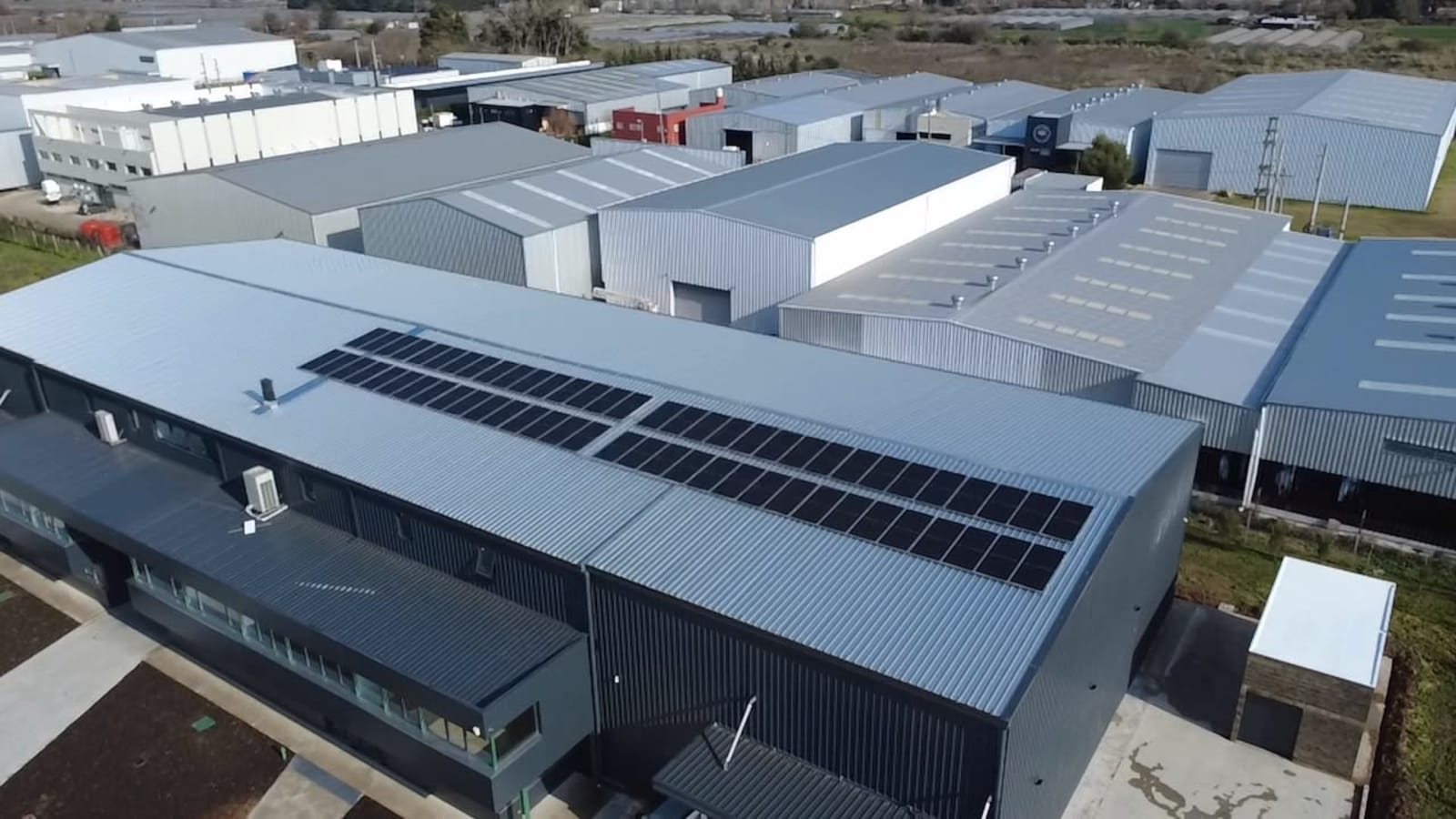
An example of solar generation applied to the food industry is the project carried out by Sunrise Solar Energy for Frahel Ice Cream , in Merlo, Buenos Aires province.
The installation has 90 photovoltaic modules of 610 Wp, equivalent to approximately 55 kWp of installed power, and was designed to take advantage of the available surface area in the plant and meet part of the energy demand associated with production and cold storage.
The project also includes the use of surplus energy through a bidirectional meter, so that generation can provide economic value even during periods when factory activity decreases.
This case highlights a key characteristic of the food industry: the profitability of a facility depends not only on how much energy it produces, but also on how much of that generation matches actual consumption and how unused energy is managed.
The orientation of the modules, the installed capacity, and the plant's operating hours are all factors that determine the return on investment. Therefore, two facilities with similar roof areas may require different designs to achieve their energy goals.
Another project in the sector currently under development is that of Arsama SA, the company behind the Aloha Ice Cream brand, in Villa Bosch, Buenos Aires province. The planned installation features 210 Trina 630W panels, representing a total photovoltaic capacity of 132.3 kWp.
The system includes two 100 kW Deye on-grid inverters and an array of modules across two rooftops. To accommodate the available space, two mounting configurations will be used: 140 panels with a coplanar structure and another 70 with a triangular structure. The installation also incorporates an injection limiter to control the energy delivered to the grid.
Due to its scale, the project demonstrates how photovoltaic generation can be integrated into food industry facilities with significant electricity demand. Its economic performance will depend on the plant's consumption profile, the alignment between generation and demand, and the grid connection conditions.
Both experiences illustrate a key point: the design of an industrial facility is not simply a matter of calculating how many panels can fit on a roof. It also requires understanding how the activity operates, its consumption patterns, and the objectives it aims to achieve with the generated energy.
When the continuity of the cold chain requires storage
In certain establishments, simply reducing the electricity bill is not enough. Supply stability becomes an operational requirement that must be considered from the infrastructure design stage.
This is the case of a company in the pharmaceutical sector that incorporated a hybrid system in its La Plata warehouse, intended for the storage of products under controlled conservation conditions.
The project developed by Sunrise Solar Energy integrates 64 panels of 630 Wp, totaling 40.32 kWp of photovoltaic power, a 50 kW hybrid inverter and a high voltage battery bank with a capacity of 30.6 kWh.
In this installation, storage serves a different function than it would in a project focused exclusively on maximizing self-consumption: providing backup for essential loads in the event of certain grid contingencies.
The solution allows for the management of solar power generation, batteries, and electrical supply according to the operational priorities configured for the facility. Response time in the event of a power outage depends on the system architecture, the loads connected to the backup power supply, and the available autonomy.
Experience shows why, in certain segments of the cold chain, the economic evaluation must also consider the potential cost of a disruption. The value of the system is not limited to the energy that is no longer purchased: it includes protecting operations and reducing exposure to supply failures.
Logistics also needs its own energy strategy
The cold chain doesn't end at the production plant or the warehouse. Distribution centers are part of an infrastructure that combines storage, order preparation, merchandise movement, and, depending on the activity, refrigeration and vehicle loading.
In these establishments, the relationship between operating hours and solar generation can be decisive.
One example is the project developed by Sunrise Energía Solar for LOGIAL SRL , an official Arcor distributor in Ituzaingó, Corrientes province. The installation features 60 photovoltaic panels and a capacity of 37.2 kWp, with a design focused on maximizing solar energy generation throughout the day.
The solution uses an east-west orientation to distribute generation between the early morning and late afternoon, rather than concentrating it exclusively around midday. This configuration aims to adapt solar production to the consumption profile of the logistics operation.
The project also addresses a particularity of the local grid: the inability to feed surplus energy back into the grid. To resolve this, the system incorporates a smart meter that regulates photovoltaic production based on the facility's demand, preventing the export of energy to the grid.
This case study illustrates how the design of an industrial solar installation must be tailored to the specific conditions of each company. In a logistics operation, the goal is not simply to install panels, but to align generation with actual consumption, extend the hours of solar utilization, and manage surplus energy according to available grid connection conditions.
How to define the right solution for each establishment
Choosing between a grid-connected installation and a hybrid system requires analyzing the specific conditions of each company. Key variables include:
- Consumption profile: how much refrigeration consumes and what proportion of the demand coincides with the hours of solar generation.
- Available power: whether the existing electrical connection allows the installation's needs to be met, especially during periods of higher demand.
- Quality of supply: the frequency and characteristics of outages, voltage fluctuations and other incidents that affect the equipment.
- Critical loads: which systems must remain active in the event of an interruption and what power they need to do so.
- Required autonomy: how many hours of backup are needed and what storage capacity is adequate.
- Economic conditions: initial investment, potential savings, cost of interruptions and characteristics of the electricity tariff.
Storage capacity should not be defined solely by the size of the photovoltaic installation. A battery can deliver a certain power for a limited period, but the actual autonomy depends on the available energy and the consumption of the loads it must power.
Therefore, the sizing must consider both the electrical requirements and the company's operational priorities. In some cases, backing up only the cold storage rooms and control systems may be more convenient than trying to keep the entire plant running during an outage.
It is also important to distinguish between systems designed to reduce grid consumption and those that must maintain critical loads in the event of an outage. Although both functions can be combined, they require specific equipment and designs, and not every photovoltaic installation automatically offers backup capacity.
The cold chain as an opportunity for industrial solar solutions
Projects applied to the food, pharmaceutical and logistics industries show that the energy needs of the cold chain encompass different scenarios: from photovoltaic installations to reduce the purchase of electricity to hybrid systems designed to provide support to critical processes.
This diversity expands the application possibilities of solar energy in activities that need to maintain their operations under controlled conditions. It also demands an engineering approach that considers actual consumption, grid conditions, and the operational consequences of an outage.
For companies that rely on refrigeration, the question is no longer just how much they can save through in-house generation. It's also about how to integrate different technologies to improve control over their supply and reduce the risks associated with business continuity.
The answer is not to install more panels or batteries in all cases, but to identify what each establishment needs to protect and design a solution according to those needs.
At that point, industrial solar energy ceases to be an isolated component of the infrastructure and becomes part of an energy strategy that combines efficiency, predictability and operational continuity.
 By Emilia Lardizabal
 By Energía Estratégica
 By Matías Medinilla
 By Ailén Pedrotti