Mexico's Federal Electricity Commission (CFE) is presenting a new portfolio of hybrid solar power generation, energy storage, and green hydrogen projects, alongside 32 electricity transmission projects that will require investments of approximately 35.904 billion pesos . These developments are part of the updated 2026-2030 Expansion Plan and are being announced as the state-owned company prepares the next phase of its mixed investment scheme with private developers.
The presentation includes new concentrated solar power (CSP) and photovoltaic (PV) plants in Baja California Sur, a hybrid complex incorporating batteries and hydrogen production, and cogeneration projects. In transmission, the program covers 2,152 circuit kilometers, 107 line interventions, and 138 substation interventions , with contracting procedures scheduled between October 2026 and March 2027.
The announcement coincides with a crucial moment for the Mexican electricity market. According to information obtained by Energía Estratégica, the second joint bidding process, coordinated by the Ministry of Energy (SENER) and the Federal Electricity Commission (CFE), has 66 solar and wind projects totaling 8,241 MW under evaluation, submitted by 34 economic groups seeking to advance toward the awarding of contracts. The CFE stated that decisions are expected between November 2026 and January 2027.
The information comes from the Second Roadshow of the CFE Expansion Plan 2026-2030 , held on October 23, where the company outlines the technical characteristics of its new facilities, the electrical infrastructure needs and the financial schemes planned to mobilize capital.

New in-house projects: solar power generation, storage and green hydrogen
One of the main new developments appears in Baja California Sur , where CFE identifies two hybrid projects that combine concentrated solar thermal technology with photovoltaic generation and thermal storage.
These are CSP Termosolar I «El Crucero», of 100 MW, and CSP Termosolar II «Comondú», of 50 MW , which add up to 150 MW of power at their interconnection points.
Both initiatives respond to a different configuration from conventional photovoltaic parks, by incorporating concentrated solar power generation and heat storage to extend the availability of electricity outside of peak radiation hours.
In the case of El Crucero , the design includes two 50 MW power plants, each consisting of two solar thermal towers and two photovoltaic fields. The documentation identifies 50 MW AC solar components per unit, which will operate in a coordinated manner.
The facility is projected to generate 582 GWh annually, with a plant factor of 66.5% and 12 hours of thermal storage . CFE also estimates that it would prevent 407,400 tons of carbon dioxide emissions, although the presentation does not detail the methodology used to calculate that reduction.
The technical concept seeks to guarantee "Continuous Dispatch" by integrating solar technologies and utilizing thermal storage to reduce dependence on instantaneous photovoltaic production.
For its part, Comondú is considering a 50 MW hybrid power plant at the interconnection point, consisting of a thermosolar unit and a photovoltaic unit, both identified with a capacity of 50 MW in the technical data sheet.
The project incorporates more than 10,000 heliostats, a 160-meter solar concentrating tower and a 12-hour thermal storage system , in addition to a reference irradiation of 2,180 kWh per square meter.
The Oasis Hybrid Power Plant , located in Guerrero Negro, in the municipality of Mulegé, Baja California Sur, has been added to this portfolio. The project combines photovoltaic generation, batteries, hydrogen electrolysis, and fuel cells to produce electricity.
The installation includes 72 MW of direct current photovoltaics, equivalent to 60 MW of alternating current , along with a 20 MW and 80 MWh battery storage system, designed to operate for four hours.
The complex also incorporates 20 MW of electrical capacity for electrolyzers , which will use the electricity to produce hydrogen. This hydrogen will be stored in tanks and subsequently used by four 1.5 MW fuel cells, with a combined generation capacity of 6 MW.

The combination introduces a storage architecture of different durations, although the document does not specify the energy capacity of the hydrogen tanks or the overall performance of the conversion cycle.
According to the estimates presented, Oasis could supply electricity equivalent to the consumption of 40,000 homes and generate 1,960 direct and 500 indirect jobs during its development.
Beyond renewable technologies, the roadshow also includes a cogeneration project in Tula de Allende, Hidalgo , whose capacity is set at 681 MW under summer conditions and 710 MW of average annual power.
The facility includes a 3x3x1 configuration, steam production of between 320 and 842 tons per hour and natural gas consumption of 150 million cubic feet per day.
The presented timeline anticipates the start in 2027, a construction period of 45 months and the start of operations in 2030, although the dates require further clarification on the construction milestones.
It's worth noting that CFE is also making progress on the construction of Sequence III of the Rafael Galván Maldonado Photovoltaic Plant in Puerto Peñasco, Sonora , which will incorporate 300 MW of solar power and 103 MW of battery storage with a three-hour lifespan . This project is more than 27% complete and is scheduled to begin operations by the end of 2027.
The new phase involves the installation of approximately 563,000 photovoltaic modules , while the first two phases of the complex already contribute 420 MW to the National Electric System . Once all four phases are completed, the plant will reach a generation capacity of 1,000 MW, according to CFE's planning.
CFE plans 32 transmission projects worth 35.904 billion pesos
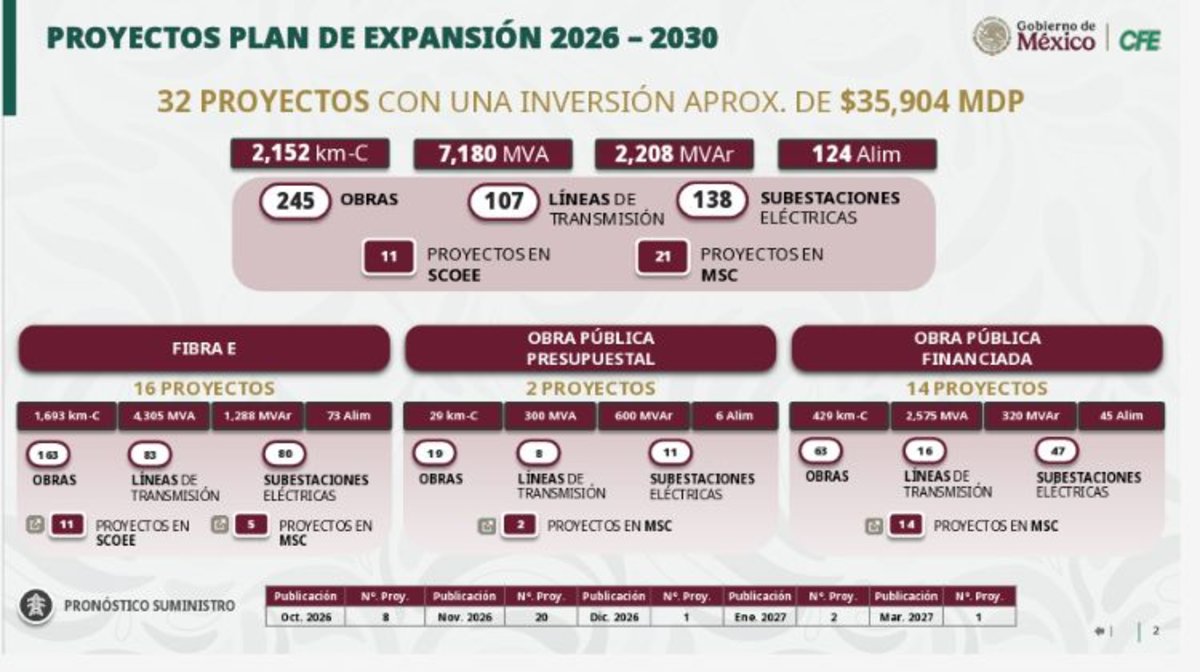
In parallel with the new generation portfolio, the state-owned company identifies 32 electrical projects comprising 245 works , with interventions on transmission lines, substations and compensation equipment for the system.
The approximate investment amounts to 35,904 million pesos , allocated to infrastructure that includes 2,152 circuit kilometers, 7,180 MVA of transformation, 2,208 MVAr of reactive compensation and 124 feeders.
The distribution of these developments includes 16 projects under Fibra-E, two budgeted public works and 14 through financed public works , with different contracting procedures.
Fibra-E concentrates 1,693 circuit kilometers and 4,305 MVA of transformation, while budget initiatives add 29 circuit kilometers and 300 MVA.
For its part, the financed public works modality comprises 429 circuit kilometers, 2,575 MVA and 320 MVAr , according to the breakdown presented in the roadshow.
The contracting schedule distributes eight projects in October 2026, 20 in November, one in December, two in January 2027 and one in March of that year .
Continue reading
These are planned dates for publishing procedures, not commitments for the facilities to become operational.
One of the largest projects corresponds to the reinforcement works of Puerto Peñasco Sequence III , in Sonora, intended to accompany the expansion of one of CFE's main photovoltaic complexes.
The initiative includes 617.78 circuit kilometers, 375 MVA of transformation and 749.8 MVAr of compensation , with actions in the Cucapah, Golfo de Santa Clara and Puerto Peñasco substations.
Among the interventions, the 289.30 kilometer-circuit line between the photovoltaic plant and Golfo de Santa Clara stands out, as well as the laying of a second 290.48 kilometer-circuit line towards Cucapah.
Also included is a STATCOM in Golfo de Santa Clara, intended for dynamic voltage control and reactive power support, a relevant need in systems that incorporate inverter generation.
Another action corresponds to the Northwest-North generation integration project , whose fourth stage includes a 238-kilometer circuit line between Torreón Sur and Derramadero, in a 400-kilovolt network.
This work is scheduled for publication in March 2027 and is part of a larger development that includes four other stages for the second half of next year.
Taken together, the subsequent stages include routes such as Hércules Potencia-Río Escondido, El Encino-Hércules Potencia and Moctezuma-Chuvíscar , in addition to new electrical transformation and compensation facilities.
In Guanajuato, CFE is incorporating projects to strengthen industrial supply in Irapuato, Silao and Puerto Interior , with capacity expansions and new transmission connections.
The project to address the supply in Irapuato includes 375 MVA, while the intervention in Puerto Interior incorporates another 300 MVA and 24.38 circuit kilometers.
In Michoacán, the expansion of the Uruapan and Apatzingán zones comprises 530 MVA and 65.8 circuit kilometers , while the works in Zapotlán and Costa, between Jalisco and Colima, add 500 MVA and 80.7 circuit kilometers.
The program also includes transformation reinforcements in Querétaro, modernization of underground networks in Veracruz, reactive compensation in Tijuana and Chihuahua, and new facilities in Coahuila, Durango, Sinaloa, Morelos, Chiapas and Tabasco.
For suppliers and contractors, the tenders also represent a demand for electrical equipment. The proposal includes, at a minimum, 30 autotransformers, eight transformers, 72 circuit breakers, 196 disconnect switches, and two STATCOM units .
This is in addition to approximately 79,997 tons of structures, 1,955 kilometers of conductor cable, 618 kilometers of guard cable with fiber optics and 124,575 insulators .
The second round: 66 projects, four CFE initiatives and new conditions for private companies
The progress of their own projects comes as the Ministry of Energy (SENER) and the Federal Electricity Commission (CFE) develop the second call for mixed investment, a procedure that initially brought together 126 renewable generation initiatives.
As previously reported by Energía Estratégica, the pre-selection comprises 66 projects for 8,241 MW, distributed between 57 photovoltaic plants for 6,310 MW and nine wind farms for 1,931 MW.
The portfolio far exceeds the 3,995 MW of required capacity identified by the authorities and keeps 34 business groups competing to advance to the next stages of the procedure.
Among the companies with the greatest pre-selected capacity are GEMEX, Freeman, Fisterra, AES Mexico and Invenergy, in a process that brings together national and international developers.
Regarding the composition of the participants, 18 Mexican economic groups stand out, followed by Spanish and American companies, reflecting the diversity of actors involved in the call.
In this context, the roadshow confirms that CFE is preparing a second stage of mixed investment with four projects of its own and more than 60 initiatives proposed by private developers, with decisions expected between November 2026 and January 2027.
For the regional projects, the company plans to begin the competitive bidding process in the second half of October and schedules the analysis, negotiation, and decision-making for November. In contrast, the four proprietary projects would begin their competitive bidding process in the first half of December, with decisions expected by January 2027.
What will the mixed investment contract look like?
The model presented by CFE contemplates the formation of mixed investment companies in which the state-owned company retains 54% of the common shares, while the private partner participates with the remaining 46%.
The financial structure anticipates that between 20% and 30% of the resources will come from capital contributions and between 70% and 80% from debt, with potential participation from financial entities, development banks and other institutional investors.
One of the central elements is the marketing of energy. The documentation establishes a power purchase agreement (PPA) for 70% of the products, through which CFE would act as the main buyer of a significant proportion of the production.
According to the presentation, this configuration allows for reducing the exposure to commercial risk of projects and provides a contractual reference for structuring their financing.
Additionally, the private partner would receive project cash flows until reaching a target internal rate of return (IRR), although the document does not publicly specify the percentage of profitability or the particular economic conditions of each initiative.
As background, CFE reports that the first round of mixed investments reached 8,025 MW distributed across 38 projects, with estimated investments of $10.598 billion, representing 106% of the goal originally set for that process.
However, the 8,241 MW shortlisted in the second call for bids do not yet represent awarded capacity. The final decisions will depend on technical evaluations, interconnection costs, commercial negotiations, and compliance with the established requirements for each project.


 By Energía Estratégica

 By Emilia Lardizabal
 By Matías Medinilla