


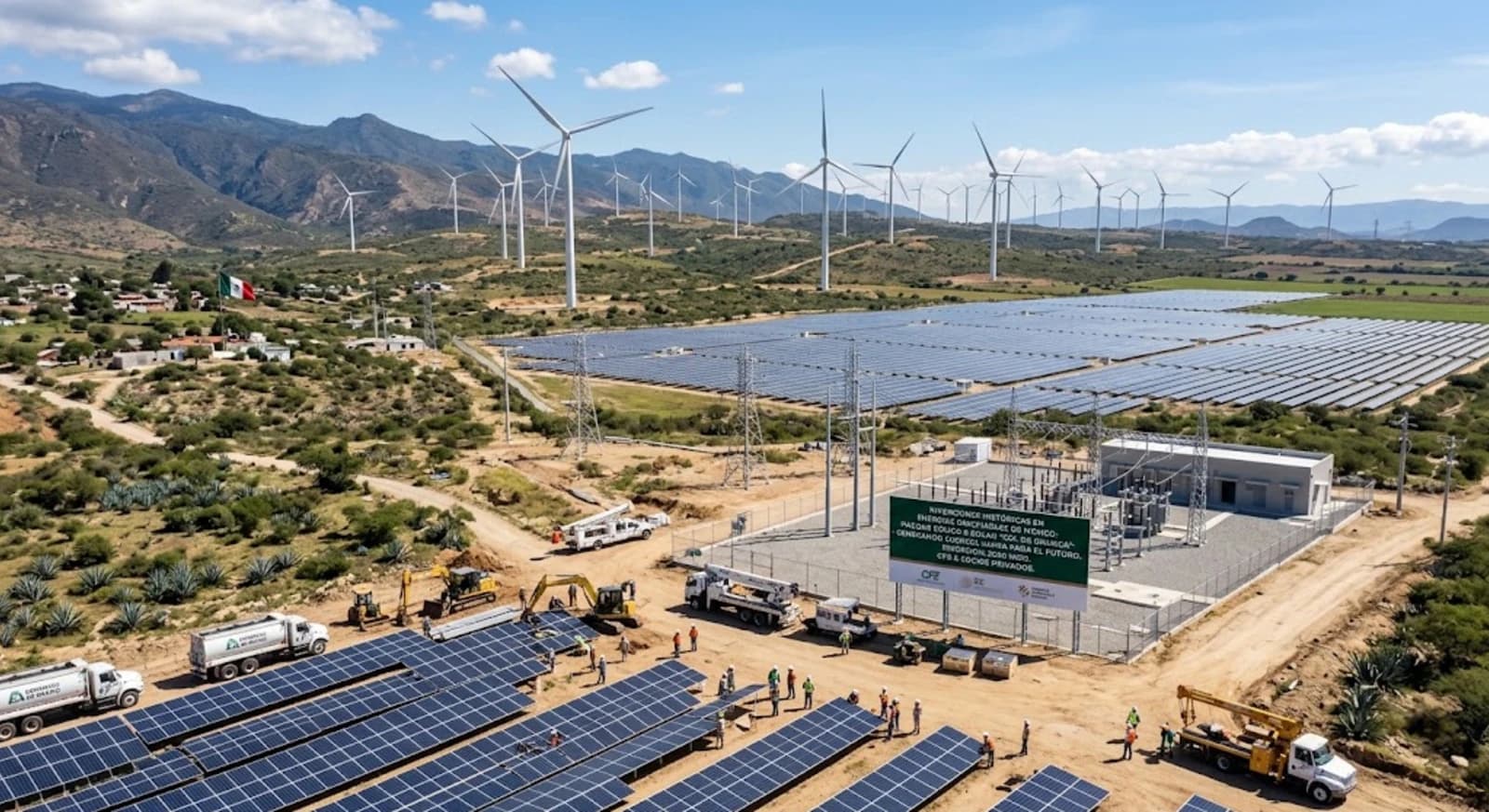
The Federal Electricity Commission (CFE) put figures to its next stage of expansion and sent a strong signal to the Mexican renewable market: between 2026 and 2030 it plans to incorporate 15203 MW of capacity that the company itself classifies as renewable , within an Expansion Plan of 18597 MW.
This volume represents 82% of the new renewable capacity additions planned for the current administration and, according to CFE, constitutes the largest renewable capacity expansion in its history. However, the figure requires clarification: it includes 1,694 MW of cogeneration , which is considered emission-free. Excluding this component, the remaining renewable technologies total 13,509 MW , approximately 73% of the entire expansion.
The transformation will be considerable compared to the current fleet. CFE projects that its generation capacity, excluding Independent Power Producers, will increase from 46.6 GW in 2025 to 70.7 GW in 2030 , a growth of 52% in five years .
The increase combines the 18,597 MW of the new Expansion Plan with another 5,486 MW from the Strengthening Plan of the previous administration, which will be fully incorporated between 2026 and 2028. Together, both packages represent 24,083 MW of additional capacity .

Solar and wind power account for the bulk of the expansion
One of the main new features for the private sector appears within projects under mixed development schemes.
CFE has identified 38 photovoltaic and wind power projects totaling 8,026 MW already allocated . Of that total, 30 solar power plants represent 4,897 MW and eight wind power projects another 3,129 MW , with operations expected to begin between 2028 and 2030.
The program also maintains an additional 4,151 MW of capacity under mixed schemes pending allocation . The document does not yet assign all of this capacity to a single technology, making it one of the main areas within the program that remains to be defined.
The mixed portfolio is complemented by 582 MW of geothermal energy, 150 MW of concentrated solar power, and 20 MW of green hydrogen , in addition to a 900 MW cogeneration plant. This is further enhanced by sections III and IV of the Puerto Peñasco photovoltaic plant, developed as CFE's own projects, which will add 580 MW and are scheduled to begin operations in 2028.
The portfolio composition marks a significant change for a company that, at the end of 2025, had only 433 MW of photovoltaic and 86 MW of wind power of its own . The planned expansion would thus significantly increase the weight of both technologies within its portfolio.
Nearly USD 17 billion for mixed schemes
Renewable energy growth is not solely based on self- investment . The Development Program stipulates that a significant portion of the new capacity will be developed through mixed partnerships with private entities .
These projects represent approximately 335.258 billion pesos, or about USD 16.7 billion , including renewable energy developments and cogeneration projects under this model. The majority of the resources for these initiatives will be provided by the partners.
The scheme is part of a much larger financial strategy. The Expansion Plan includes approximately 651 billion pesos—about US$32.9 billion— for generation, transmission, and distribution, with a significant portion of the financing structured off the company's balance sheet.
Continue reading
The strategy takes on added importance after a 2025 that will bring increased pressure on operating results. CFE's total costs rose 12.7% , from 510.2 billion to 575.1 billion pesos, while EBITDA fell from 245.28 billion to 200.624 billion pesos and its margin declined from 36.8% to 29.4% .
In this context, CFE projects that the increased use of renewable energy sources, combined with more efficient thermal technologies, will reduce generation costs and improve its profit margins in the coming years. The Program itself links the incorporation of renewables to less dependence on fossil fuels and lower variable generation costs.
Transmission must keep pace with renewables
The size of the new portfolio shifts part of the challenge to the infrastructure needed to transport that electricity.
CFE is planning 175 transmission projects , with an investment of 131.889 billion pesos , which will add 7,545 kilometers of lines . An additional 51.770 billion pesos are earmarked for distribution, including 97 new substations, expansions of 95 existing substations, and network modernization .
In total, transmission and distribution will account for 183.659 billion pesos . The company indicates that these investments will be necessary to integrate the new power plants, increase transmission capacity, and make progress in decongesting critical nodes in the network .
The challenge takes on greater significance given the expected shift in the energy mix. CFE estimates that the share of renewables in its generation will increase from 21% in 2025 to 34% in 2030 .
At the same time, the state-owned company seeks to increase its share of total National Electric System generation from 43% to 53% . If FONADIN's power plants are included, the state's share would reach 62% by 2030 .
Batteries, still without a concrete goal
Storage appears considerably less defined compared to the announced volume of solar and wind power.
CFE recognizes battery storage systems among the resources that can contribute to ensuring the reliability of the National Electric System, along with the expansion of transmission and the modernization of infrastructure.
However, the Development Programme does not assign a specific target in MW or MWh of BESS within the 2026-2030 Expansion Plan , unlike what happens with solar, wind, geothermal, concentrated solar power and even green hydrogen.
The absence leaves one of the questions in the roadmap: the renewable expansion already has scale, investments and a good part of its projects defined, but the incorporation of additional flexibility resources still does not have an equivalent objective.