Chile will modify the economic evaluation criteria for bids in its next supply tender for regulated customers , by incorporating a threshold of 40% of energy not covered during the first stage of awarding.
The new provisions will govern the current procurement process for 2625 GWh per year for a 15-year contract, in a process whose submission of proposals is scheduled for December 4th.
Unlike the 2025 call, the calculation of the outstanding energy cost will no longer depend exclusively on the reserve price, but will also take into account a value called the base case price.
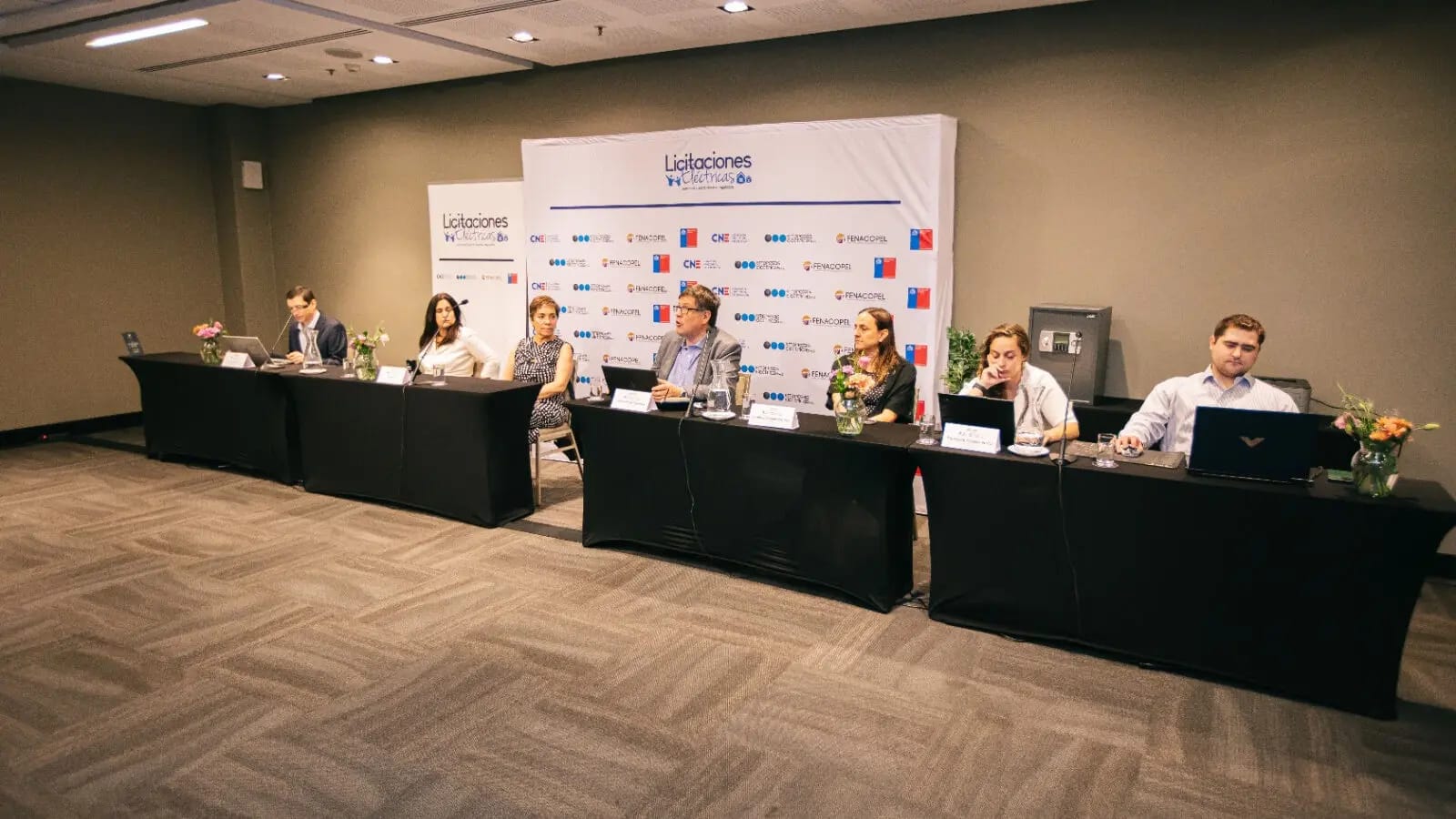
“We ask ourselves if the uncovered energy is less than or greater than 40%. If it is less, then the uncovered energy is valued at the base case price,” explained Alonso Martínez , from SPEC, the consulting firm that developed the allocation software tool together with the National Energy Commission (CNE) .

If the uncontracted volume reaches or exceeds that percentage, the reservation price will be maintained as a reference, as was the case in the previous process.
While the latter sets the economic limit for accepting proposals, the base case arises from identifying the cheapest combination that respects equality in the number of subblocks awarded among the three time slots in each zone .
Its calculation will be performed before solving the first stage, which will allow that parameter to be incorporated from the beginning of the evaluation.
The existence of offers to cover the entire demand will not necessarily imply that all the energy will be contracted at the initial stage.
To illustrate this situation, SPEC developed seven hypothetical scenarios. In one of them, the system achieved 95.8% coverage and left the supply to zone 4 pending, because accepting certain proposals was less economically advantageous.
The remaining volume then goes to auction, where the selection criteria change: the priority will be to contract the largest possible amount and, among the combinations that allow the same coverage, choose the one with the lowest levelized or weighted average price.
However, the combined result of both stages must be more economically advantageous than the base case . Otherwise, the alternative calculated at the beginning of the procedure will prevail.
In another exercise presented by the consulting firm, the incorporation of the second stage allowed a price of USD 65.2 / MWh to be reached compared to USD 65.9 / MWh of the initial reference.
“The innovations incorporated into the foundations of this process seek to broaden the possibility or scope of participation in the auction. It does not guarantee that the auction bids will be awarded, but it expands the scope of participation in this mechanism,” the organization stated.
Would the previous awards have changed?
The changes come after two consecutive calls in which Enel Generación Chile concentrated 100% of the awarded supply , despite the participation of other competitors.
In tender 2025/01, six companies submitted 708 bids, representing a volume equivalent to 3.9 times the required energy. Ultimately, the company secured all the contracts at a price of USD 64,499/MWh.
According to CNE data, Enel submitted 384 proposals, followed by Colbún (120), Guacolda Energía (93), BTG Pactual (72), GR Power (27) and Evol (12).
The result replicated what happened in the 2023/01 call, awarded in May 2024, when the same firm won the 3600 GWh per year tendered at USD 56,679/MWh.
When asked about the possibility of applying the new rules to previous processes, the organizers explained that the modifications would not necessarily alter the outcome when the most economical proposal also allows for covering the entire demand.
“I dare say that this model, run on the 2023 auction, for example, which awarded an entire volume to a single bidder, or the 2025-01 auction, would also give the same result,” they indicated.
The central region accounts for 76% of the energy to be tendered
The next call for tenders includes two supply blocks: the first for 1470 GWh per year, valid between 2029 and 2043, and the second for 1155 GWh per year, for the period between 2030 and 2044.
Both are distributed across four geographical zones and three time slots. The highest demand is concentrated in the central zone, with 1993 GWh annually.
Companies will be able to simulate different award scenarios using the tool developed by SPEC, whose public availability was announced by those responsible for the process.
The evolution of the procedure is gaining relevance with regard to future contracts in the regulated market. According to the CNE's 2026 Final Tenders Report, the next projected calls for tenders include approximately 19,300 GWh of baseload component annually .
 By Matías Medinilla

 By Florencia Guglielmetti

 By Ailén Pedrotti
 By Energía Estratégica