


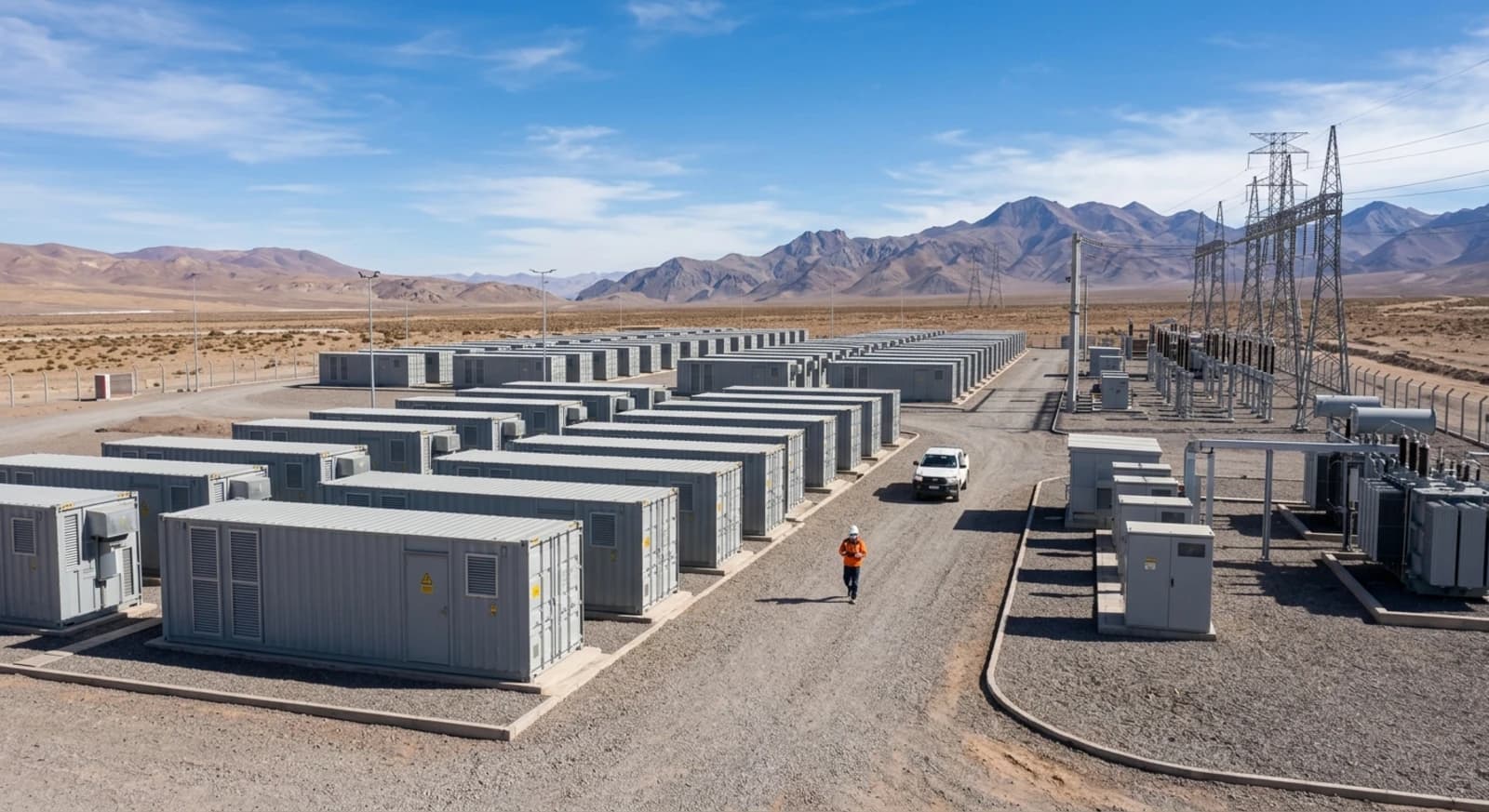
The energy storage portfolio surveyed by ACERA in Chile reaches 39,739 MW when combining projects at various stages of development . Of this total, 3,116 MW are operational, 2,686 MW are undergoing testing, and 5,217 MW are under construction , forming an initial block of 11,019 MW . In addition , 18,371 MW have been approved and 10,349 MW are in the qualification process , while another 28,720 MW remain in earlier stages of development.
The size of the portfolio also coincides with strong growth in the capacity that is already operational. During the first eight months of 2026, Chile practically doubled its operational storage capacity , going from 1,575 MW at the end of 2025 to 3,116 MW in August , an increase of nearly 98% .
In terms of energy capacity, the increase was from 6,384 MWh to 13,522 MWh during the same period. Projects undergoing testing also increased: they rose from 737 MW in December 2025 to 2,686 MW in August of this year .
Thus, if only the systems that are already operational or in testing are considered, Chile currently has 5802 MW , compared to the 2312 MW that ACERA counted between both categories at the end of last year.

With the additional 5,217 MW currently under construction , the total capacity across the three most advanced stages reaches the aforementioned 11,019 MW . In terms of energy, operation, testing, and construction collectively account for 48,260 MWh .
The largest volume, however, is concentrated in earlier phases: 18371 MW are already approved and 10349 MW remain in qualification .
It is worth clarifying that ACERA notes that information on energy capacity in MWh is not available for all approved and qualifying projects , so these two categories are expressed only in terms of power.
Solar energy concentrates storage under construction
Hybridization with photovoltaic solar generation represents the majority of storage systems currently under construction.
Of the 5217 MW under construction , 3657 MW correspond to hybrid solar photovoltaic projects , associated with 15248 MWh of energy capacity.
This represents 70% of the storage capacity under construction , according to ACERA.
Second place goes to stand-alone BESS systems, with 1184 MW and 5577 MWh , equivalent to 23% of the total.
The remainder is distributed between 340 MW and 1360 MWh linked to hybrid solar photovoltaic and wind projects and 36 MW and 144 MWh associated with wind developments.
Overall, the systems currently under construction have an average autonomy of 4.3 hours .
Continue reading
BESSs concentrate the portfolio
BESS technology accounts for virtually all of the storage capacity surveyed by ACERA.
Of the approved projects, 17761 MW out of a total of 18371 MW correspond to BESS .
Of that volume, 8743 MW are associated with hybrid solar photovoltaic projects and 8022 MW correspond to stand-alone systems .
These are in addition to 439 MW of hybrid wind storage and 557 MW linked to projects that combine solar photovoltaic and wind generation .
Outside of the BESS projects, the report records among the approved projects 560 MW under Carnot Battery technology and 50 MW corresponding to LAES .
In the segment under rating, the 10,349 MW surveyed correspond to BESS ( Basic Solar Energy System). There, hybrid solar photovoltaic projects account for 5,093 MW , followed by stand-alone systems with 2,790 MW , hybrid wind projects with 1,240 MW , and solar photovoltaic plus wind developments with 1,226 MW .
BESS contributed 562 GWh in August and reached a share of 7.2%.
The growth of the infrastructure is also beginning to be reflected more strongly in the operation of the National Electric System.
During August 2026, ACERA recorded 562 GWh associated with BESS systems , equivalent to 7.2% of the electricity recorded during the month .
The volume was 21.7% higher than in July and 212.7% higher than that recorded in August 2025 , according to ACERA.
This growth is occurring in parallel with a high presence of variable renewable energy sources in Chile's energy mix. Between January and August 2026, non-conventional renewable energy sources (NCRE) accounted for 42.5% of cumulative electricity generation , while in August alone they reached 42.1% .
Solar photovoltaics contributed 1637 GWh that month, equivalent to 21% of total generation , while wind power reached 1218 GWh , with a share of 15.6% .
Meanwhile, between January and August , 3014 GWh of renewable generation was cut, 3.5% less than in the same period of 2025 , according to ACERA.
This scenario leaves two speeds within the Chilean storage market: a capacity that already expanded strongly during 2026 , with more than 3.1 GW operational and another 2.7 GW in testing , and a much larger portfolio that still has to go through different stages before materializing.