


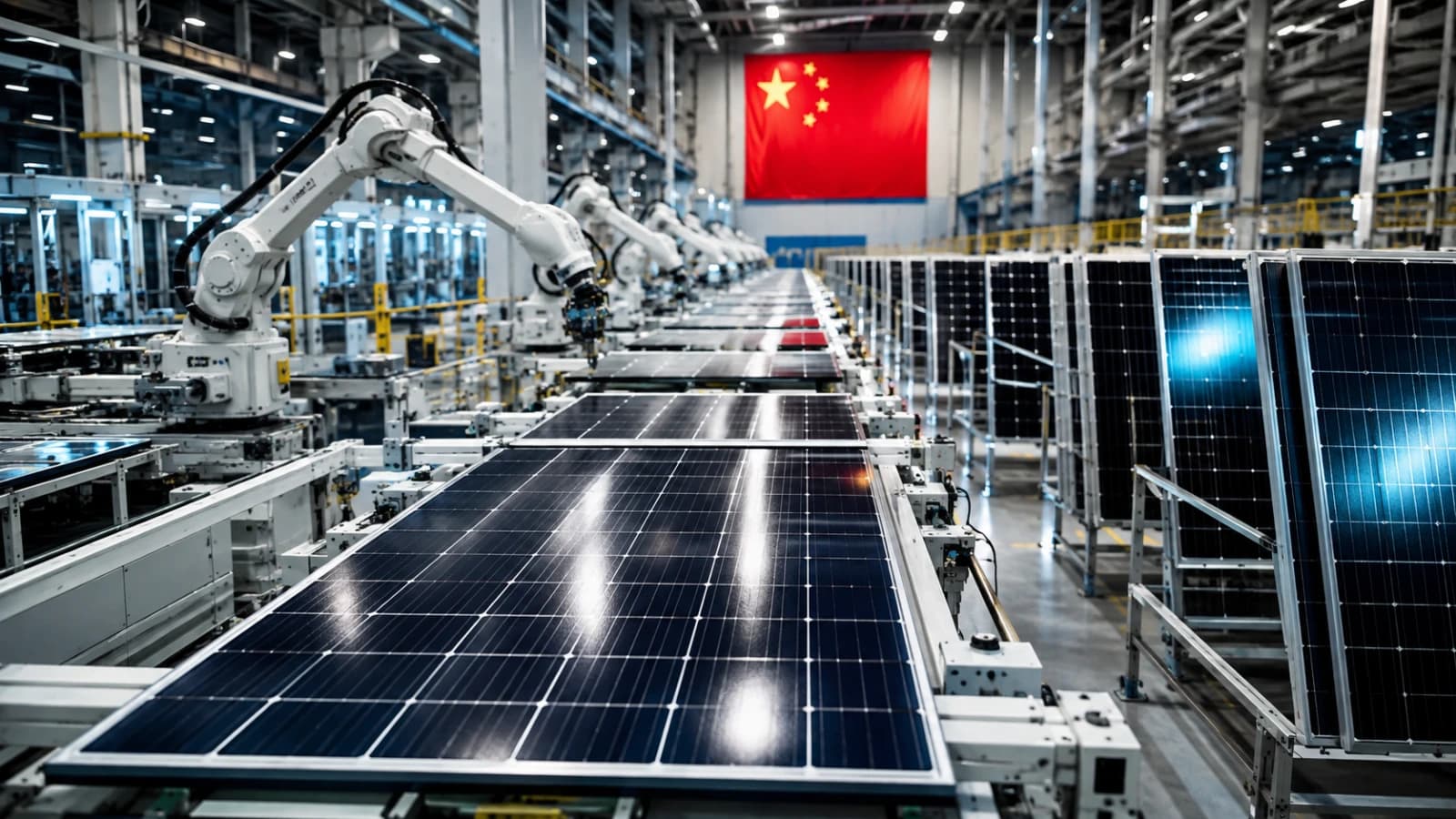
China is preparing for a new leap in the demands of its photovoltaic industry by January 1, 2027 , with standards that put pressure on both the efficiency of the modules and the energy consumption of the factories and the ability of producers to sustain technologically competitive lines.
Specifically, the new framework raises the efficiency floor of the modules to over 23% and takes as a commercial reference 630 W equipment on a standardized format of 1134 x 2382 millimeters .
For the different architectures, the requirements stipulate at least 23.2% efficiency for TOPCon and heterojunction (HJT) and 23.5% for Back Contact (BC) , along with minimum bifaciality levels of 75%, 85%, and 70%, respectively. This increase means that 620W and 625W models, currently widely available, would fall below the new industry standard.
But behind the percentages lies a potentially far more disruptive consequence for the global market: a significant portion of China's manufacturing capacity may not be able to immediately comply with the new regulations . And in an industry where the country accounts for a large share of international supply, any significant reduction could be passed on to the rest of the supply chain.

Alberto Cuter, vice president of JinkoSolar , put numbers to that scenario.
“If we currently have 1000 GW of capacity, only 500 GW can comply with this new regulation. And the market is 700 GW, so a problem is going to be created,” the executive stated in an interview with Energía Estratégica .
The estimate does not imply that 500 GW will automatically disappear on January 1st , because some plants will be able to modernize processes, invest in efficiency, or adapt their lines before the new regulations take effect. However, it highlights the magnitude of the gap that some stakeholders see between existing nominal capacity and the capacity that could be competitive under the new framework.
Cuter anticipates precisely this adaptation process will take place in the coming months. Factories that currently fall below the established standards will have to invest to continue production , while others may reduce volume or abandon certain product lines.
“But it is very likely that the supply in January of next year will be lower than what we have now,” warned the vice president of JinkoSolar.
The impact could also be felt on references that currently have a high commercial penetration.
“ 620 or 625 W can no longer be sold. It no longer meets the 630 requirement ,” the JinkoSolar executive stated.
The tightening of standards is not isolated from the financial situation facing Chinese industry. After years of overcapacity and competition that drove prices to record lows, Cuter links the government's decision to the need to regulate a market in which numerous manufacturers are operating under cash flow pressure and at a loss.
For his part, Marcos Donzino, Head of Sales South LATAM at JA Solar, stated: “ At JA Solar, we see this regulation as a positive and necessary development for the Chinese photovoltaic industry .” The executive links the measure to a period of strong expansion, price pressure, and high levels of overcapacity.
From his perspective, the change alters the competitive logic that has dominated the market in recent years. “Our interpretation is that China is seeking to shift from competition primarily based on capacity and price to an industry more focused on technological efficiency, quality, sustainability, and long-term performance,” Donzino told the website.
This shift also places a financial burden on companies that have not yet reached the new parameters.
“The main challenge will be time. The period between the publication of the regulations and their entry into force is relatively short for an industry with large-scale industrial assets,” warns the JA Solar executive. The manufacturer believes that some lines will require significant modernizations and may even be retired when the technological upgrade is no longer economically viable.
He added: "The second challenge is capital . Adapting processes for polysilicon, wafers, cells and modules, as well as modernizing production lines and improving the energy efficiency of factories, involves significant investments that not all manufacturers will be able to make under the same conditions."
Jorge Carlucci, Sales Manager at LONGi , shares a similar perspective, stating that “ the new national standards announced in China represent an important step in raising energy efficiency and performance requirements across the entire photovoltaic value chain .” He anticipates an acceleration of higher-performance technologies and increasingly competitive competition focused on quality, innovation, and sustainability.
For his part, Omar Ávila, Regional Sales Manager at Tongwei , focuses on another variable that will limit the race for physically larger modules: international logistics . The executive points out that the industry will have to move towards “ better efficiency within the same module sizes ,” given that container dimensions also impose a practical limit on product growth.
Less supply, higher prices?
The eventual exit or reconversion of part of the production capacity opens a second consequence for the international market: the possibility that the excess supply that has put downward pressure on module prices in recent years will decrease .
Cuter warns that the equation could change if a significant number of manufacturers fail to meet the new parameters in time. “ What could happen is a price increase, because right now prices are low due to supply and demand—supply is higher than demand ,” explains the vice president of JinkoSolar.
The executive avoids projecting a specific percentage, but suggests that the direction of prices will be directly related to how much the effective supply decreases relative to global demand . If available volumes approach actual consumption, the imbalance that sustained extremely competitive prices could moderate.
For JA Solar, the scenario is closer to a “capacity rationalization” than to an automatic disappearance of manufacturers .
Continue reading
“ We will likely see a more concentrated market, with modernization, consolidation, and the divestment of less competitive capacity ,” Donzino anticipates. He adds that regulation will act in conjunction with other factors already putting pressure on the sector, including overcapacity, lower margins, and the speed of technological evolution.
The market is already entering this new adjustment with upward pressure on prices. It's worth remembering that China eliminated the VAT refund on photovoltaic product exports on April 1, 2026 , a benefit that had previously been reduced from 13% to 9% for wafers, cells, and modules.
At that time, specialists consulted by Energía Estratégica projected that the elimination of the incentive could lead to price increases of between 10% and 15% for solar panels during 2026. This expectation also triggered advance purchases before the measure took effect and sparked debate about the end of the "ultra-cheap" module cycle.
This combination is relevant for international developers and buyers. A market with higher export costs and, at the same time, less available capacity would have less room to replicate the extreme oversupply scenario that drove prices to record lows in recent years .
Along these lines, Marcelo Álvarez, a member of the Global Solar Council, interprets the measures as part of a broader process of streamlining the Chinese photovoltaic industry , where standardization allows progress towards more interchangeable modules and, simultaneously, establishes a technological floor capable of displacing less efficient capacity.
According to industry experts, standardization can benefit large buyers by promoting greater product homogeneity, but its effect will not be identical across all segments . In distributed generation, where roofs and facades impose physical constraints, efficiency per square meter takes on much greater economic importance.
Álvarez also warns that for this segment, the new regulation could represent “a threat depending on how it is implemented,” because “ it could impact module prices when there is insufficient capacity .” This observation focuses precisely on the transition period: if the capacity that meets the requirements is insufficient to meet demand, the pressure could be passed on to buyers.
The effect would not necessarily be uniform across manufacturers. Companies already producing above the new minimum production levels "have a head start," while those forced to invest in upgrading their processes will have to absorb the cost of the conversion in a market that has been operating with very tight margins .
Cuter is particularly emphatic about this distinction. “ It doesn't change anything for us; on the contrary, it helps us a lot so that the market can once again buy quality modules ,” says the vice president of JinkoSolar. The executive believes that producers with less efficient modules will face the greatest difficulties in adapting.
For his part, Donzino notes that JA Solar will continue working on greater module efficiency and performance, optimizing the energy consumption of its processes, and evolving its technological roadmap beyond current platforms . TOPCon will remain part of this transition, although the manufacturer is also working on other architectures for future innovation cycles.
LONGi, for its part, highlights its commitment to innovation and high-level manufacturing, while Tongwei identifies increasing efficiency while maintaining dimensions compatible with international logistics restrictions as one of the keys.
The various strategies converge on the same unknown for 2027: how much of China's enormous nominal capacity will remain truly competitive under the new conditions .
“ Rather than focusing on a total percentage, we believe the key issue will be how much of the current capacity will remain competitive under the new standards. Size alone does not determine the ability to compete ,” the executive maintains. Some smaller players could retain market share through specialization, efficient processes, access to capital, or strong positions in specific niches; others will have to opt for modernization, alliances, consolidation, or the divestment of certain product lines.
From size to technology: the new filter for TOPCon, HJT and Back Contact
The regulatory changes don't end with the 630W limit or exceeding 23% efficiency . The new requirements also extend to manufacturing, with energy consumption limits for different links in the supply chain, from polysilicon and wafers to cells and modules. For manufacturers, this means modernizing production lines, improving processes, and reducing the energy intensity of their plants to maintain their competitiveness.
“ The new standards not only raise the minimum technical requirements for market entry, but also the level of industrial competitiveness needed to remain competitive ,” Donzino argues. The JA Solar executive warns that adapting processes and improving the energy efficiency of factories will require significant investments that not all producers will be able to afford under the same conditions .
Meanwhile, the Chinese photovoltaic product classification project introduces an even more detailed scale for modules. TOPCon starts at 23.4% efficiency in category C and reaches 25% in A+; HJT advances from 23.4% to 24.8%; and Back Contact from 23.7% to 25.2% .
The evaluation is not limited to efficiency either. The document establishes minimum bifaciality requirements of 75% for TOPCon, 85% for HJT, and 70% for BC , in addition to tests against thermal cycling, humidity, mechanical loads, snow, hail, sand, and marine environments. It also incorporates environmental criteria: the highest recyclability category requires at least 92%, and the best carbon footprint level is set at up to 320 kg of CO₂ equivalent per kWp .
This evolution could further differentiate between utility-scale and distributed generation . Large parks have more scope to incorporate large-format modules and take advantage of the bifacial properties of TOPCon and HJT. On residential, commercial, and industrial rooftops, however, the available surface area makes efficiency per square meter a critical variable.
This is where the analysis by Marcelo Álvarez, a member of the Global Solar Council , becomes relevant: in distributed generation, increasing panel size encounters physical limitations that don't exist in the same way in large-scale power plants. Therefore, obtaining more power from a similar surface area acquires a significant advantage .
This scenario opens up space for Back Contact technology , which shifts the metal contacts to the back, freeing up the front surface to capture radiation. The technical material analyzed features compact modules of approximately 1.8 square meters and around 490 W, with efficiencies of 24% to 24.8% , compared to the approximately 400 W that PERC technologies previously delivered in similar dimensions.
The transformation, which will formally begin in January 2027, goes far beyond simply removing certain 620W or 625W modules from the market . China is simultaneously raising the bar on the product, the factories, and the technological performance of the supply chain.
And therein lies the main unknown for the international market: not how many gigawatts China can manufacture on paper, but how many will actually be ready to comply with the new regulations by January 1st . If the adaptation progresses quickly, the industry will be able to absorb a good part of the adjustment. If the conversion lags behind demand, Cuter's warning about the 500 GW limit will cease to be merely an industry discussion and will become a direct variable affecting availability, prices, and purchasing decisions in the global solar market .
