


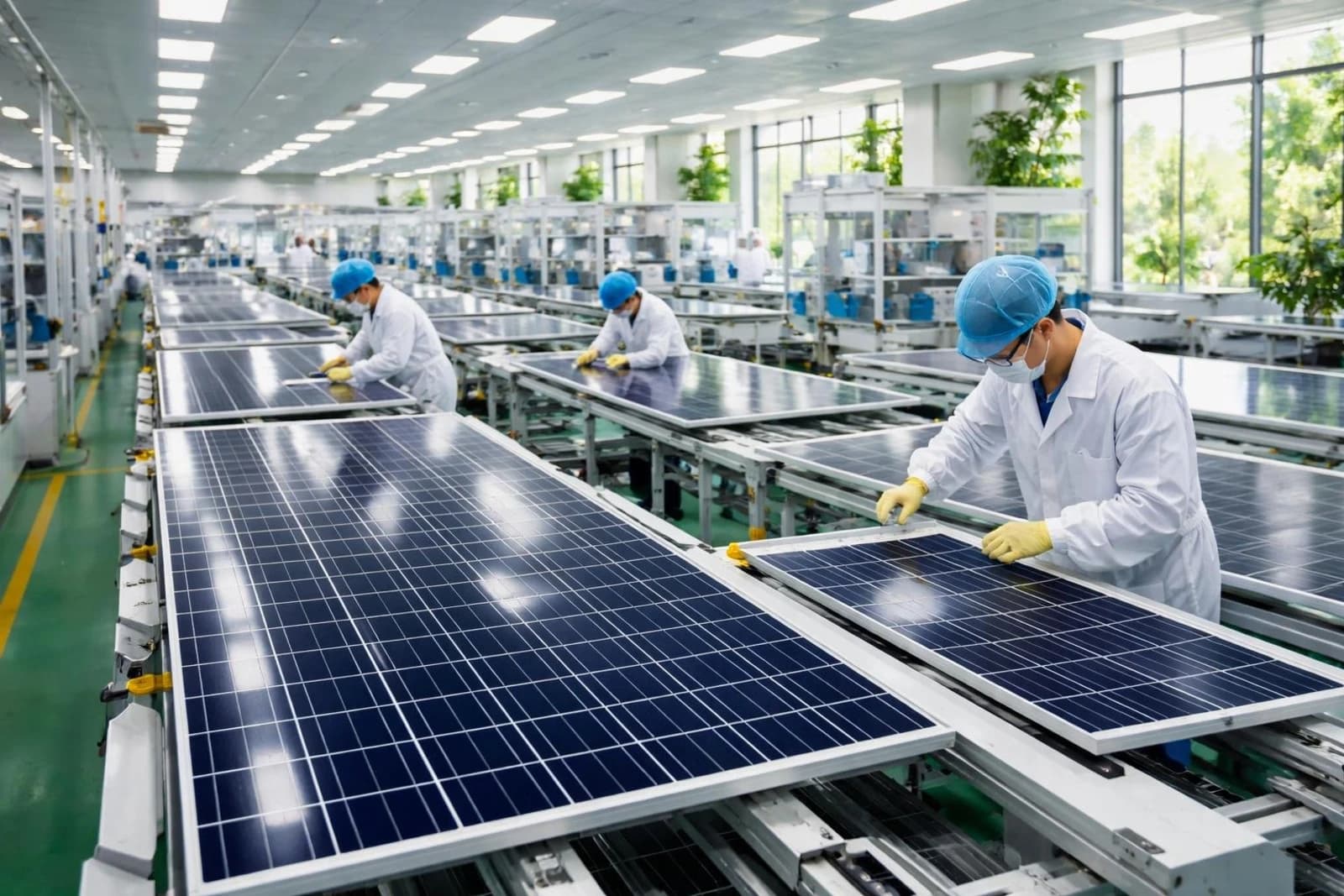
China proposed incorporating 12 photovoltaic technologies into its export control system , in a move aimed at more rigorously supervising the international transfer of know-how and equipment related to the manufacture of advanced solar components.
The initiative was presented by the Ministry of Commerce together with the Ministry of Science and Technology and is part of a broader review that also includes artificial intelligence and biotechnology technologies.
The focus is not on blocking the export of finished modules, cells, or wafers as a commercial product, but on controlling technologies, processes, and manufacturing equipment that China considers strategic.
Among the developments achieved are technologies used to produce ultrathin silicon wafers, perovskite and tandem cells , as well as large-scale polysilicon production processes using fluidized bed technology.

In these cases, the proposal includes export bans.
At the same time, other advanced cell manufacturing technologies, such as TOPCon, heterojunction (HJT) and back-contact (XBC) , would be subject to restrictions and authorizations, but not an outright ban.
The differentiation is relevant because it directly affects some of the architectures that today concentrate a good part of the technological evolution of the photovoltaic industry.
Perovskite, for example, appears as one of the emerging technologies with the greatest potential for efficiency improvement, while tandem cells seek to combine different layers to capture a greater proportion of the solar spectrum.
In the case of polysilicon, the fluidized bed process offers cost and energy consumption advantages over the Siemens process, which is still dominant in the industry.
Know-how becomes central to China's industrial strategy
The proposal reinforces a trend that was already taking shape during 2026: the country not only seeks to organize its internal manufacturing capacity, but also to preserve control over the technological processes that sustain its industrial leadership .
Until the revised catalogue formally comes into effect, exporters will need to register certain technology transfers, including transactions related to intellectual property and licenses abroad.
Authorities justify the increased level of oversight on national security grounds, noting that some solar technologies are beginning to see growing applications in sensitive sectors such as aerospace and defense.
The move also comes amid increased global competition to develop photovoltaic supply chains outside of China.
The United States and India have been developing new industrial capabilities and seeking to reduce their dependence on Chinese equipment, supplies, and technology.
In that scenario, a more restrictive policy on know-how can have direct effects on the speed at which other markets manage to scale up their own production lines.
China adds technological controls to a series of adjustments to its solar industry
The proposal to monitor the export of know-how is not an isolated measure. It is part of a series of steps the country has been taking to reorganize its photovoltaic industry, raising technical requirements, removing tax incentives, and seeking to reduce some of the distortions caused by overcapacity and intense price competition.
One of the most significant changes will come on January 1, 2027 , when a new framework of standards for modules and manufacturing plants will take effect. The regulation will raise the minimum efficiency requirement to over 23% and will use 630W modules in a standardized format as the commercial benchmark.
In terms of technology, the requirements include at least 23.2% efficiency for TOPCon and heterojunction (HJT) and 23.5% for Back Contact (BC) , along with bifaciality minimums of 75%, 85% and 70%, respectively.
This leap could exclude 620W and 625W products that still have a significant presence in the market from the new parameters and force part of the manufacturing capacity to update processes and production lines.
The adjustment is not limited to module performance. The new framework also introduces stricter requirements for factory energy consumption and the technological competitiveness of production lines , putting particular pressure on older or less efficient facilities.
In addition, there is another change that has already begun to impact export costs.
As of April 1, 2026 , China eliminated the VAT refund for photovoltaic product exports , after having previously reduced the benefit from 13% to 9% for wafers, cells and modules.
At that time, specialists consulted by Energía Estratégica projected that the elimination of the incentive could translate into increases of between 10% and 15% in panel prices during 2026 , in addition to generating advance purchases before the measure came into effect.
Now, the proposal on technology transfer adds a new layer to the process.
China is not only tightening the conditions for producing and exporting modules, but is also seeking to more precisely control what strategic knowledge, processes, and equipment can leave the country .
The result is a broader industrial policy: raising domestic standards, reducing incentives for low-margin exports, and at the same time preserving dominance over technologies that could define the next generation of photovoltaic manufacturing.