


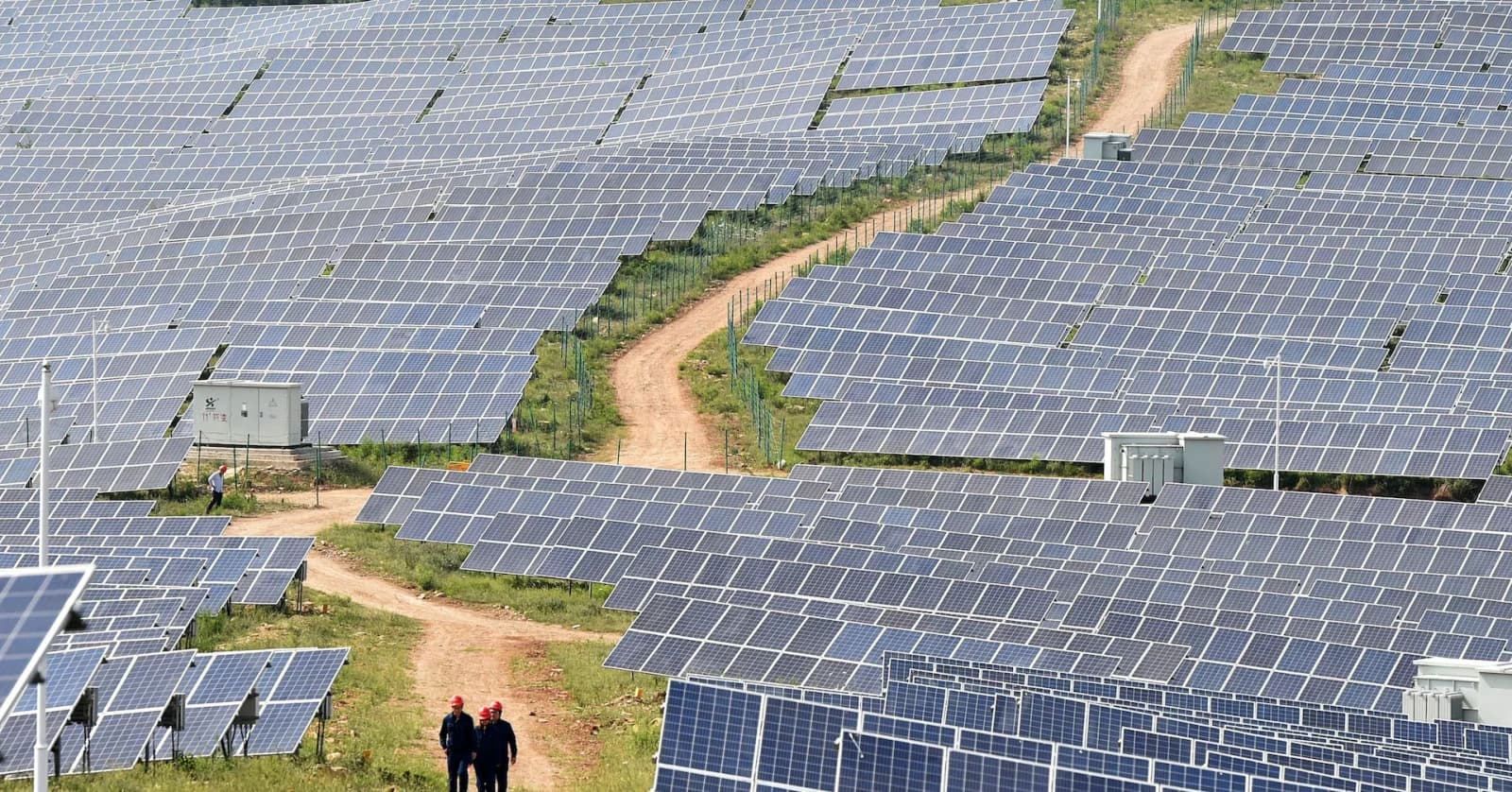
China accelerated its solar installations again in July 2016, although the rebound is still far from offsetting the sharp decline accumulated throughout the year. The country added 14.08 GW of new photovoltaic capacity , according to the latest data from the National Energy Administration (NEA).
The volume represents a 27.5% year-on-year improvement and also exceeds the 12.48 GW installed in June and the 8.68 GW recorded in May, showing a recovery in activity after the sharp slowdown observed during the first half of the year.
However, the contrast with 2025 remains considerable. Between January and July, China added 86.15 GW of solar power , 61.4% less than the 223.25 GW added during the same period last year.
The comparison is heavily influenced by the exceptional performance of 2025. In May of that year alone, 92.92 GW were installed, driven by developers racing to connect projects before the new pricing mechanism for renewables came into effect.

From June 1, 2025, China began to move away from the previous feed-in tariff regime to move towards a scheme where project revenues depend more on the conditions and prices of the electricity market.
That change triggered a massive acceleration of installations during the preceding months and left a particularly high baseline for comparison in 2026.
At the same time, the new rules changed the economics of projects and helped to moderate the pace of capacity additions this year.
In the first half of the year, China had installed 72.07 GW of photovoltaic capacity , 66% less than during the same period in 2025, according to data from the China Photovoltaic Industry Association (CPIA).
The 14.08 GW added in July partially reduce that gap and represent the third consecutive month of recovery from the 8.68 GW recorded in May.
However, this data does not yet allow us to speak of a return to the extraordinary levels that characterized the Chinese market during the previous year.
The market is looking for a new rhythm after the regulatory change
The 2026 evolution reflects a market reorganization after the strong boost prior to the price reform.
Continue reading
With greater exposure to electricity market signals, the profitability of new projects now depends more on variables such as hourly prices, asset location, and their ability to manage periods of high renewable production.
In that scenario, the CPIA revised its expectations for solar installations for all of 2026 downwards and currently projects an annual volume of approximately 180 GW to 240 GW .
Other market estimates place the range between 160 GW and 200 GW , reflecting the uncertainty regarding the speed at which development can be maintained during the second half of the year.
Analyst Frank Haugwitz of Apricum-The Cleantech Advisory anticipates relatively stable demand in the short term, given that August and September typically see lower installation levels before the national holidays in October.
Distributed generation appears as one of the segments that could sustain volumes for the rest of the year, especially the residential market, whose performance has been exceeding some expectations.
Despite the slowdown in new additions, the overall scale of the Chinese photovoltaic system continues to grow .
At the end of July, the country reached approximately 1.29 TW of installed solar capacity , 16.1% more than a year ago.
Wind power capacity, meanwhile, reached approximately 690 GW , with a year-on-year increase of 19.5%. The country's total electrical capacity reached 4.08 TW.
By the end of June, solar and wind power together accounted for around 1.98 TW , equivalent to 48.4% of all installed electrical capacity in China.
The Chinese market is thus going through a particular scenario: it continues to add tens of GW and expand a photovoltaic base that already far exceeds TW, but it does so at a considerably lower rate than the exceptional deployment recorded in 2025.
The 14.08 GW in July shows a monthly recovery , although the evolution of the rest of the year will determine whether this is the beginning of a sustained acceleration or simply a normalization after the abrupt change caused by the market reform.