


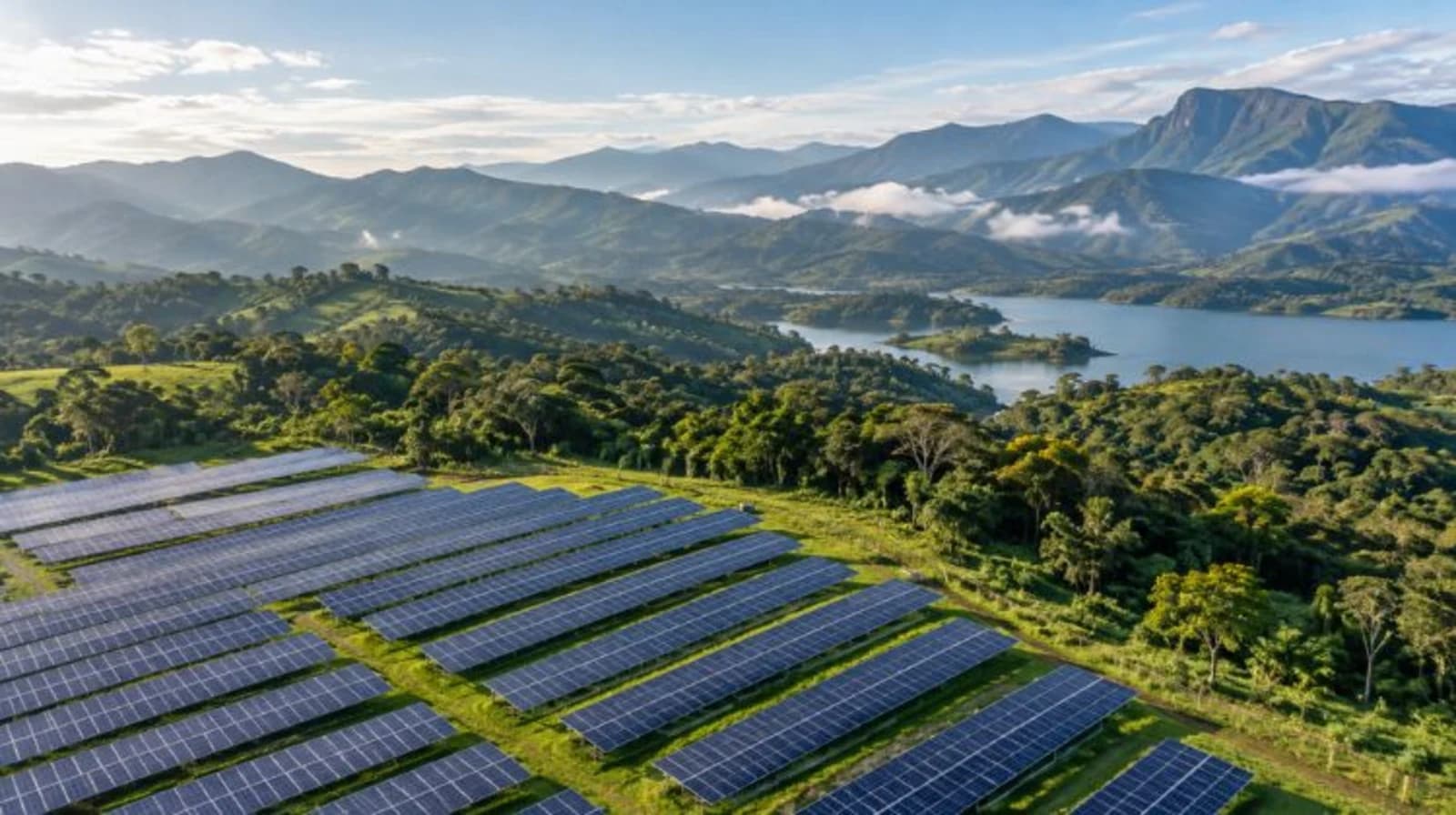
The Ministry of Environment and Sustainable Development of Colombia issued a legal opinion clarifying the conditions under which solar photovoltaic projects smaller than 9.9 MW must obtain an environmental license, establishing that their location within certain regional protected areas is a determining factor for the requirement of this instrument.
Through legal concept 13002026E2030067, dated August 14, 2026, the environmental portfolio specified that the facilities projected within a Regional Integrated Management District (DRMI) are subject to environmental licensing, even when their installed capacity is lower than the threshold usually considered for this type of development.
The interpretation responds to a query submitted by GreenYellow Energía de Colombia SAS ., which requested clarifications on the application of Decree 1076 of 2015 to small-scale photovoltaic projects located in protected areas whose zoning allows renewable generation activities.
In particular, the company raised the question of whether the mere location of a solar installation within a DRMI automatically generates the obligation to obtain an environmental license, or whether it is appropriate to analyze the characteristics, capacity, and potential impacts of each initiative.

In response to this inquiry, the Ministry maintains that numeral 21 of article 2.2.2.3.2.3 of Decree 1076 of 2015 constitutes the regulatory basis for requiring the procedure, as it contemplates infrastructure construction projects within regional public protected areas other than the Regional Natural Parks.
In that regard, the document states that developments included in this category "require prior obtaining of the environmental license", provided that their execution is compatible with the uses defined for the corresponding protected area.
The portfolio also determines that photovoltaic generation facilities are part of the energy infrastructure and, therefore, are included within the assumptions contemplated by the regulations.
Thus, the ruling concludes that a small-scale photovoltaic project located within an Integrated Management District “will require an environmental license, as a prerequisite for its development”, regardless of whether its power is less than 9.9 MW.
The definition is particularly relevant in a market that continues to incorporate new renewable capacity. According to information published by Energía Estratégica , Colombia has surpassed 5 GW linked to the 6GW+ Plan, with solar power accounting for 99% of the reported capacity and centralized and distributed developments that are reshaping the sector.
In this context, the ministerial interpretation introduces a consideration for promoters of smaller-scale facilities: the power of the project is not the only parameter for determining their environmental obligations, as its location and the protection category of the territory must also be verified.
Environmental zoning does not eliminate the obligation to process the license
Another key aspect of the statement concerns the relationship between the management plans of the Regional Integrated Management Districts and the authorizations required to build photovoltaic installations.
The consultation specifically raised the question of what happens when a project is located within a development subzone, in which the Environmental Management Plan allows the construction of infrastructure or the development of energy generation activities from renewable sources.
On this point, the Ministry recalls that the Integrated Management Districts are part of the National System of Protected Areas (SINAP) and have different zoning categories, including areas designated for preservation, restoration, sustainable use and public use.
Within the sustainable use zones, development subzones are contemplated where certain productive activities and infrastructure initiatives can be carried out, provided they are compatible with the conservation objectives.
The document defines these spaces as areas where “the construction and execution of development projects is permitted, under a scheme compatible with the conservation objectives of the protected area.” However, the existence of this territorial authorization does not imply an automatic exemption from the licensing procedure.
According to the concept, the activities permitted within these areas “must be previously authorized, permitted, granted or licensed by the environmental authority administering the protected area”, which also establishes the technical conditions for their execution.
Continue reading
Consequently, the compatibility of a photovoltaic plant with the land use regime of the Integrated Management Regional District is an element that must be analyzed during the environmental assessment, but it does not replace the license required by the applicable regulations.
The Ministry specifies that, for solar projects smaller than 9.9 MW located in these areas, it is necessary to "take into account the permitted uses in this area" during the corresponding evaluation procedure.
In this way, developers must pay special attention to the location of their projects within the development subzones and their compatibility with the conservation objectives established in the respective management plans.
For companies, this means incorporating the review of the territory's environmental conditions from the initial pre-feasibility stages, in addition to considering in the technical and financial structuring the studies and procedures associated with a possible license application.
Although the concept does not establish new deadlines or costs for these procedures, its application may affect development schedules, environmental budgets and investment planning for facilities that, due to their capacity, would not normally be subject to licensing.
How does this requirement relate to Environmental Licenses for solar and wind power?
The statement also addresses the relationship between the general environmental licensing regime and the specific mechanisms promoted by Colombia to facilitate the development of new renewable facilities.
In particular, it analyzes Decrees 1033 and 1186 of 2025, corresponding to the Solar Environmental License with Optimized Design (LASolar) and the Wind Environmental License with Optimized Design (LAEólica), respectively.
Both instruments are geared towards projects that are between 10 MW and 100 MW, provided they meet the conditions and criteria established in their provisions.
Consequently, these mechanisms do not apply to solar installations under 9.9 MW, as addressed in the consultation. The Ministry explains that the new provisions allow for the optimization of specific licensing procedures, but do not eliminate the general environmental requirements established in Decree 1076 of 2015.
In that sense, it clarifies that the optimized licensing instruments "do not disregard, as mentioned above, the regime of Decree 1076 of 2015."
It also states that projects that do not meet the conditions set out in the specific decrees must follow the corresponding ordinary procedure.
This distinction is relevant for companies that develop photovoltaic portfolios of different capacities, since regulatory optimization mechanisms do not replace the environmental obligations derived from the location of each installation.
Furthermore, the document does not introduce a legislative amendment or a new licensing category for all solar projects smaller than 10 MW.
This is a legal interpretation by the Ministry of Environment of current provisions, the application of which depends on the location characteristics and the corresponding protection regime.
In fact, the portfolio states that the pronouncement is issued in practical terms, reinforcing the importance of evaluating the territorial location along with the installed capacity when structuring new photovoltaic projects in Colombia.
Thus, for developers of facilities smaller than 10 MW, the early identification of protected areas, the review of management plans, and the assessment of licensing obligations become relevant components in determining the regulatory viability of their investments.