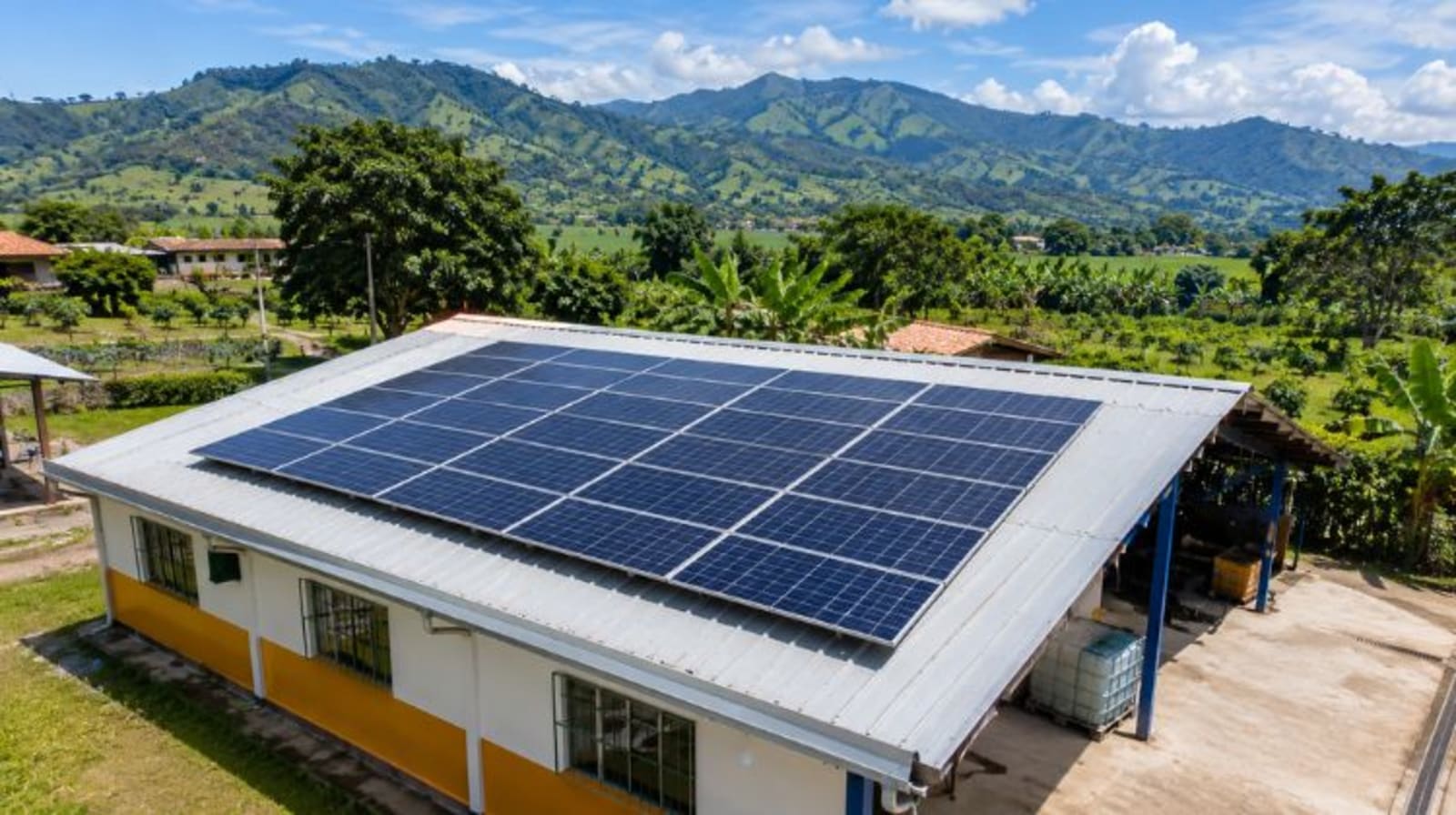
Colombia's Energy and Gas Regulatory Commission (CREG) presented a draft resolution to incentivize the entry of new renewable self-generation and energy communities, through a transitional scheme of benefits of up to 24 months , zero-cost backup contracts and connection times reduced to three business days.
The initiative arises in a scenario of pressure on the Colombian electricity system, where only 730 MW of the 4,475 MW of new generation planned for 2026 have been added , while the storage level of the reservoirs is at 77.87%, below the government's target of 80%.
In this context, the CREG Resolution Project 701 160 of 2026 seeks to accelerate the incorporation of energy resources into the National Interconnected System (SIN), both to mitigate the impacts of the El Niño phenomenon 2026-2027 and to contribute to reducing the firm energy deficits projected until 2030.
The proposal targets small-scale self-generators (AGPE) and collective self-generators (AC) of energy communities , with installations of up to 1 MW, although the specific economic benefits for the delivery of surpluses are aimed at capacities greater than 100 kW and less than 1 MW.

One of the main incentives consists of giving special treatment to generation surpluses during a differentiated period depending on the date of entry into commercial operation.
Projects that begin operating within the first six months after the resolution is issued would have access to the mechanism for 24 months.
For their part, facilities that enter after the sixth month and before 36 months have passed would receive the benefit for 12 months.
In this way, the regulation proposes an economic signal aimed at anticipating the commissioning of new capacity.
As the Commission explains in the document, the objective is to "have additional energy in the system in the short (6 months) and medium term (36 months)" , given the uncertainty about water supplies, the evolution of demand and the behavior of reservoirs.
The need to accelerate projects is also related to the difficulties Colombia is experiencing in completing the expansion of its energy infrastructure.
According to figures released by María Nohemí Arboleda, Minister of Mines and Energy , the difference between the planned capacity and the capacity actually incorporated during 2026 reaches 3,745 MW , equivalent to 83.7% of the annual target.
"Of the 4,475 new megawatts that were supposed to come online this year, only 730 have actually been added," Arboleda warns, according to statements collected by Energía Estratégica .
Added to this scenario are 275 energy projects that are more than a year behind schedule , which limits the availability of new facilities to meet the growth in electricity consumption.
Energy credits, free backup, and three-day connections
The CREG project proposes modifications to the remuneration of self-generation surpluses that use non-conventional renewable energy sources.
The mechanism establishes that the surplus electricity delivered to the grid can be offset by the energy consumed during the same billing period, up to the imported volume.
In that regard, the proposal states that “The accumulated energy surpluses that are less than or equal to their energy import from the grid will be exchanged, in the same amount, for their electricity import from the grid in the billing period.”
For the compensated electricity, the marketer will apply the marketing component established in the regulation, while non-regulated users will pay the agreed cost.
Continue reading
For volumes that exceed the electricity consumption from the grid, the CREG proposes a different economic treatment.
The document states that “they will be settled at the corresponding hourly energy exchange price” , subject to regulatory limits linked to the scarcity price.
This scheme would represent a transitional change compared to the provisions introduced during 2025, which established the valuation of certain surpluses through the weighted average of contracts.
However, to access the new benefit, self-generators must market their surplus energy with the agent integrated into the network operator of the corresponding market during the incentive application period.
Another relevant aspect is the temporary elimination of the charge for network backup capacity availability.
The initiative establishes that the beneficiaries included in this provision will sign their support contracts "for a value of zero pesos" during the 12 or 24 months foreseen.
Once that period has expired, they must update the contractual conditions according to their backup needs and the operator's technical availability.
In turn, the Commission proposes a reduction in administrative times to accelerate the entry of additional generation.
Article 4 states that the network operator “must carry out the visit for connection, testing and entry into commercial operation within 3 business days after the user requests it” .
However, the procedure may have a cost for the applicant, since the connection visit fee is enabled, even from the first inspection.
The incentives would be available exclusively for new projects, ongoing connection requests that have not yet entered commercial operation, and expansions exceeding 30% of installed capacity , without exceeding the corresponding regulatory limits.
The proposal also prevents existing facilities from canceling their registrations or restarting their activity solely to access the new economic conditions.
In the case of energy communities, the project incorporates additional facilities related to the measurement and settlement of electricity.
Users included in certain collective self-generation configurations who only register consumption may keep their current meters until they are included in the advanced metering infrastructure deployment plans.
This flexibility would apply to communities that become operational within 36 months of the issuance of the regulations and meet the specific conditions of Article 5.
Furthermore, marketers will not be required to unify the billing cycles of all members, while the settlement of surpluses will be carried out through distribution percentages established for each participant.
The proposal was approved for public consultation in session 1508 on October 29, 2026, with a period of five calendar days from the day after its publication on the official portal .
If it moves towards final approval, Colombia would incorporate a temporary regime aimed at accelerating distributed renewable generation, in parallel with the operational and demand management measures adopted to address supply risks during El Niño.

 By Emilia Lardizabal

 By Matías Medinilla

 By Energía Estratégica