


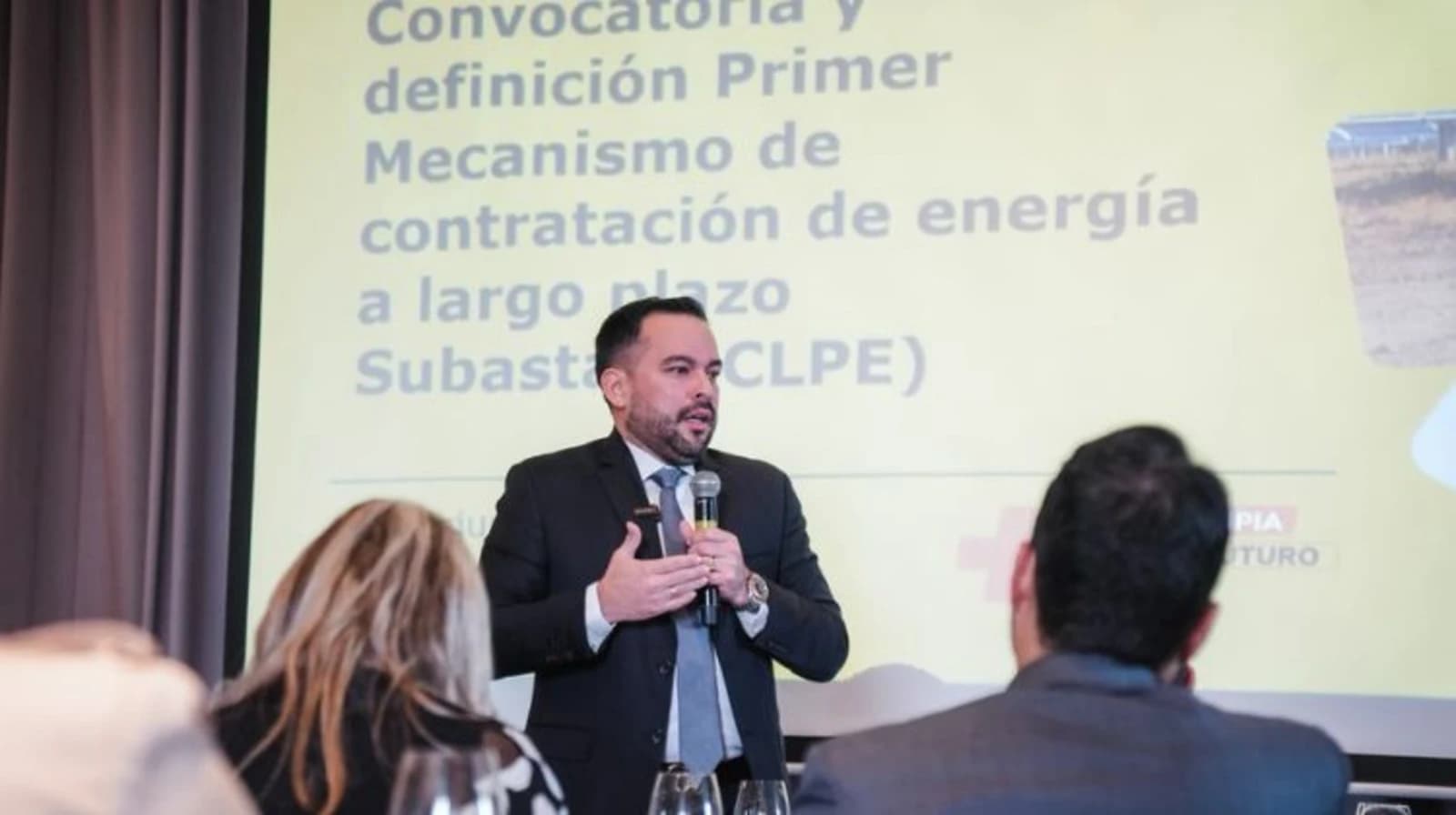
On June 10, the Colombian Ministry of Mines and Energy launched the auction for long-term clean energy contracts, with the awarding scheduled for July 23 and 24.
The initiative includes four differentiated products: energy contracts with flat delivery for entry into operation in 2030 and 2035, specific blocks for photovoltaic solar generation and two products aimed at projects that incorporate battery storage.
The timeline is already underway. Registration for interested parties will be open until June 11 , while the submission of required documentation , including the performance bond, will take place between June 22 and 26. Subsequently, during July, the technological platform's implementation and training phases will be carried out, before the contract is awarded on July 23 and 24.
The allocation will be carried out through sequential auctions for each product, a scheme designed to facilitate the contracting of new generation and storage capacity in a context of growing electricity demand and the need to diversify the country's energy mix. In addition to promoting new investments, the auction aims to strengthen the reliability of the Colombian electricity system in the face of low water levels, through long-term contracts that provide certainty for both buyers and project developers.

How is the auction structured?
The call for proposals was designed around four products with different technological profiles and schedules. Product 1 includes energy contracts with flat delivery 24 hours a day and will have two separate processes for projects starting operations on January 1, 2030, and January 1, 2035. In both cases, the contracts will have a duration of 15 years.
For Product 1, new renewable generation plants with a net effective capacity equal to or greater than 5 MW may be submitted, expansions of existing renewable plants that incorporate at least 40% new capacity, and new self-generators from FNCER with surpluses greater than or equal to 5 MW.
Product 2 is exclusively for photovoltaic solar projects, with energy deliveries between 6:00 AM and 6:00 PM, taking advantage of the natural generation profile of this technology. For this segment, participation will be limited to new photovoltaic solar plants and new photovoltaic solar self-generators with surplus energy equal to or greater than 5 MW.
Product 3, on the other hand, will be aimed at renewable projects that incorporate Battery Energy Storage Systems (BASS), combining supply blocks during the day and in the hours after sunset.
Meanwhile, Product 3 will focus on new plants from FNCER with a minimum net effective capacity of 5 MW that incorporate SAEB within their generation assets.
Finally, Product 4 will focus on delivering energy during peak system demand hours, between 6:00 PM and 10:00 PM , allowing the participation of new or existing projects with integrated battery storage in their generation assets, with a net effective capacity of 5 MW or greater, provided they deliver energy through a battery storage system integrated into their assets. In these cases, the minimum required capacity corresponds to the generation plant and not the associated storage system.
During the meeting with the main associations in the sector, the Minister of Mines and Energy, Edwin Palma, highlighted that storage will be one of the pillars of energy expansion in the coming years.
“We are talking about decarbonized energy storage, because storage is one of the products of the auction and one of the regulations that is about to be issued. I have asked the Superintendency of Energy to help expedite the concept so that we can release the regulation,” stated Minister Palma.
The official also assured that the specific regulation for storage will allow them to start building economic signals to accelerate the development of this technology in the country.
Continue reading
“It’s ready now, it may be perfected because it’s the first rule we’re going to have for price and remuneration signals, but it’s always better to start than to remain still,” he added.
From the private sector, one of the main attributes of the mechanism is the possibility of financially supporting new investments through long-term supply contracts, considered fundamental to achieving the financial closure of renewable projects.
Alexandra Hernández , CEO of SER Colombia , highlighted: “Long-term contracting mechanisms are essential for an investment project to obtain the required financing from banks.”
The executive explained that the auction will bring together buyers, sellers, and developers in one place, facilitating the signing of contracts that will later serve as backing for the construction of new energy infrastructure.
“ At SER Colombia, we celebrate this milestone, which comes from more than a year of collaborative work with the Ministry of Mines and Energy, the Regulatory Commission, the UPME, our fellow associations, and the banking sector ,” he added.
On the other hand, the inclusion of two products associated with storage makes this technology one of the main new features of the auction and reflects the Government's intention to strengthen the firmness of the system through decarbonized resources capable of complementing the growth of renewable energies.
For Palma, this call is part of a broader strategy aimed at preparing the electricity system for growing demand driven by digitalization and new economic activities.
“This country needs energy, and we’re going to need more energy if we want to get into artificial intelligence and data centers,” the minister said.
Finally, the official reaffirmed the Government's vision for the future of the Colombian energy sector.
“ Our political decision, this Government and this Ministry, is to regulate in order to decarbonize the economy ,” Palma concluded.
Following the award, the selected agents must proceed with the signing of long-term contracts and the establishment of the corresponding guarantees, with the aim of realizing projects whose supply will begin from January 1, 2030 or January 1, 2035, depending on the awarded product.
The publication of the bidding documents and the progress of this auction also coincide with a moment of political definition for Colombia, which is heading towards the second round of the presidential election on June 21, in which Abelardo de la Espriella and Iván Cepeda will compete.
In this context, the renewable energy sector is closely monitoring the signals that both candidates may give regarding the future of the energy transition and the continuity of long-term contracting mechanisms, considered fundamental to sustaining the pace of investment in new technologies over the next few years.
Long-term auction schedule
