


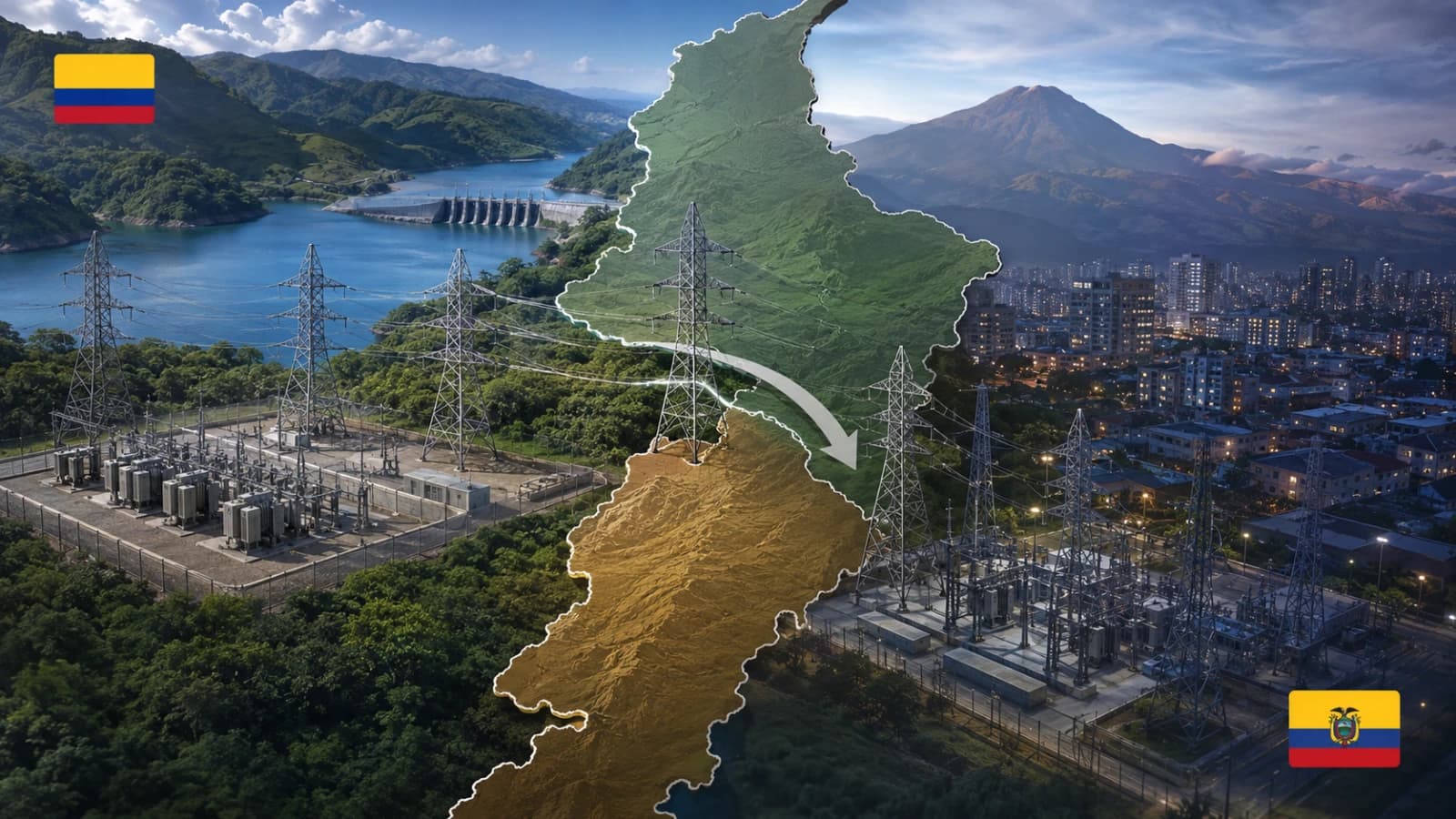
Colombia resumed electricity exports to Ecuador on August 5 , with a schedule of approximately 8.6 GWh per day , a volume sufficient to supply more than 8% of Ecuador's demand .
The operation represents an average power of approximately 358 MW and will occupy about 78% of the total capacity of the international transmission lines between the two countries. The interconnection allows for a maximum import power of around 450 MW.
“ Starting tomorrow, August 5, energy exports to Ecuador will resume ,” announced Edwin Palma Egea, Colombia’s Minister of Mines and Energy , before the end of Gustavo Petro’s government.
The official explains that the exchange responds to the backup and security needs of the Ecuadorian electrical system, which in recent years has faced difficulties in expanding its firm generation capacity and reducing its exposure to periods of drought.

Reservoir protection and new contracts
The Colombian government assures that the reactivation was authorized after verifying that the shipments will not compromise the internal supply or the conservation of water stored in the reservoirs.
According to Palma, this condition allows Colombia to protect its sovereignty and energy security, as well as strengthen the system's preparedness for the possible effects of the El Niño phenomenon.
The measure also incorporates a significant change for bilateral trade. Colombia has enabled mechanisms for electricity companies from both countries to enter into export contracts , an alternative that, according to the official, had not been implemented during the 23 years of transactions between the two nations.
The minister believes that this scheme can provide greater commercial predictability and help stabilize the prices of exported electricity , compared to a model historically conditioned by short-term transactions and the cyclical availability of generation.
Continue reading
The resumption comes after several months of restrictions. Sales had been suspended on January 22, 2016 , amid a trade dispute between Colombia and Ecuador that resulted in reciprocal tariff measures.
“ We did everything in our power to strengthen energy cooperation with Ecuador ,” says Palma, who asked the Daniel Noboa government to act with “the same spirit of reciprocity without political opportunism.”
Ecuador seeks to cover its deficit
The restoration of the exchange provides a solution, but it does not resolve the structural generation deficit that Ecuador has been experiencing since at least 2023. The lack of timely addition of firm power, the high dependence on hydroelectric power, and periods of drought have exposed the system to restrictions and supply cuts.
Official estimates currently place the shortfall at around 1,000 MW . In response, the country is preparing a call for bids to incorporate 1,250 MW of renewable energy , supported by new regulatory frameworks and a trust fund designed to guarantee payments to developers.
Meanwhile, the market is considering adding up to 2,100 MW of new capacity . The Ecuadorian Association of Renewable Energies and Energy Efficiency maintains that there is interest from developers and a sufficient investment portfolio, although it warns that the realization of these investments will depend on contractual guarantees, legal certainty, clear regulations, and orderly implementation.
Therefore, imports from Colombia serve as a short-term backup for operational security , while Ecuador advances in structural solutions aimed at diversifying its matrix and expanding private participation.
“ We have prepared the conditions for energy to cross the border again ,” Palma stated in a message addressed to Ecuadorian President Daniel Noboa.
