


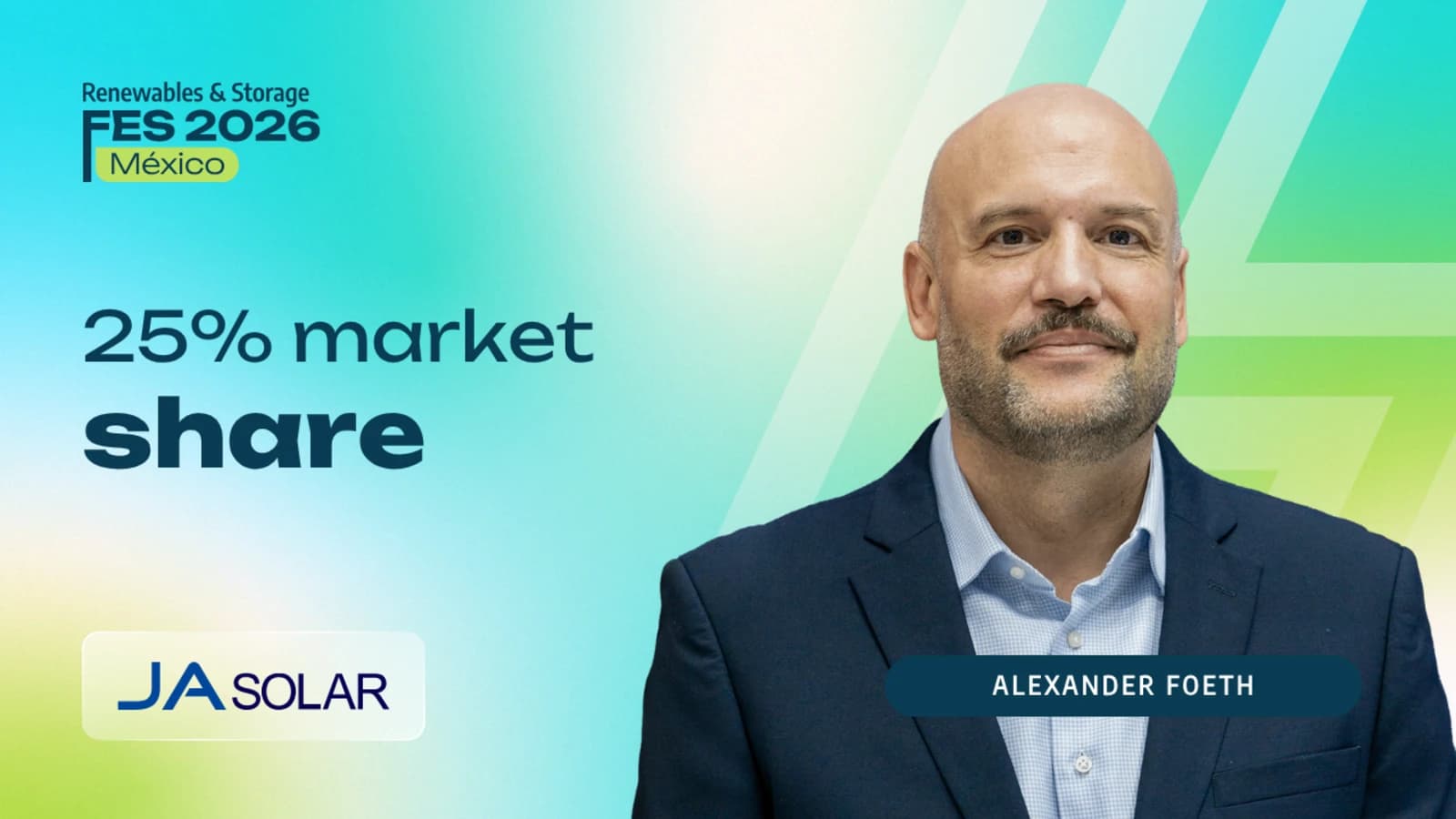
The commercial and industrial (C&I) segment in Mexico is once again at the heart of the solar strategy , driven by increased demand for self-consumption and a regulatory framework aimed at facilitating larger-scale projects. In this context, JA Solar seeks to maintain a market share of between 20% and 25% in this segment.
During the Future Energy Summit (FES) Mexico 2026 , Alexander Foeth , country manager of JA Solar , assured that the company reaches this stage with a consolidated position.
“We have been number one for the third year in a row and in 2026 we also have very good prospects to finish again as the number one panel in that highly competitive, hard-fought and diverse section,” the executive stated.
The context supports this expectation. The Single Window for Self-Consumption for initiatives between 0.7 MW and 20 MW opens a specific pathway for projects that go beyond traditional distributed generation and directly target industrial, commercial, and corporate consumers with greater supply needs.

It's worth noting that both new projects and initiatives that have already begun the permitting process, such as applications for permits, studies submitted to the National Energy Control Center (CENACE) , environmental impact statements, social impact assessments, or unified technical reports, were eligible to participate. This process is already underway, and notifications will be issued on August 18. From that point forward, developers will need to proceed with guarantees, interconnection agreements, and construction monitoring.
For manufacturers, distributors, and integrators, this opportunity presents a concrete chance: more C&I projects, greater installed capacity, and a more sophisticated demand for photovoltaic technology . In this arena, JA Solar aims to defend the position it has achieved in recent years.
“We have a percentage between 20 and 25% each year, which means first place,” Foeth stated.
He added that this result is explained by a strategy that does not depend on isolated operations, but on a sustained commercial network: "That is our standard that we have and that we are reproducing every year through a very solid distribution strategy in Mexico."
“That segment is a completely different market, very fragmented,” the executive warned. The fragmentation of clients, competition between brands, and the diversity of projects necessitate a more comprehensive territorial, technical, and commercial strategy.
The current position did not arise in isolation. JA Solar had already played a significant role in Mexico's first utility wave, supplying 1 GW between 2014 and 2018 , experience that the company considers key to facing this new stage of the market.
Continue reading
“We have been very successful in managing the panels for large projects,” Foeth noted. This learning curve, he affirms, allowed them to understand the local conditions for the execution, logistics, and commissioning of solar projects in the country.
Now, the focus is shifting towards more decentralized demand. C&I projects not only aim to reduce electricity costs, but also to ensure supply, incorporate efficient technology, and evaluate hybrid models that integrate solar generation with storage.
New business opportunity: batteries
This is where JA Solar's second growth focus in Mexico emerges: batteries and BESS systems . The company already has a presence in other Latin American markets such as Argentina and Brazil, but in Mexico it is taking its first steps with a more selective strategy.
The executive indicated that the company is already holding initial talks with clients and that the offer targets both the C&I segment and the utility market.
However, JA Solar avoids presenting storage as a simple extension of its photovoltaic business. For Foeth, it is an activity with a different logic of investment, operation, and risk.
“We have to be very cautious and do things very well, because the investments are significant and the risks involved in the operation are also completely different,” he pointed out.
The company's strategy aims to leverage the trust built in solar modules to move towards more comprehensive solutions. In this regard, energy storage is emerging as an increasingly important component for industrial customers who need to manage demand, backup power, and quality of supply.
According to the executive, the Mexican market is beginning to show signs of being ready for deeper conversations with clients already familiar with the company's photovoltaic technology. This shift is also changing how solar technology is sold. The conversation is no longer limited to the module, but extends to the complete design of the energy system. "The industry is moving towards complete solutions, energy solutions," stated the country manager of JA Solar in Mexico.
On the one hand, the goal is to consolidate its participation in industrial distributed generation in an increasingly competitive market. On the other hand, it aims to initiate discussions about BESS (Basic Energy Storage Systems) with clients seeking more robust, efficient projects prepared for the evolving demands of the electrical system. For JA Solar, Mexican commercial and industrial demand could become the bridge between its photovoltaic leadership and its entry into energy storage. The roadmap combines two fronts.
“ We are still in Mexico and have been able to strengthen those experiences and turn them into practices and strategies,” he concluded.