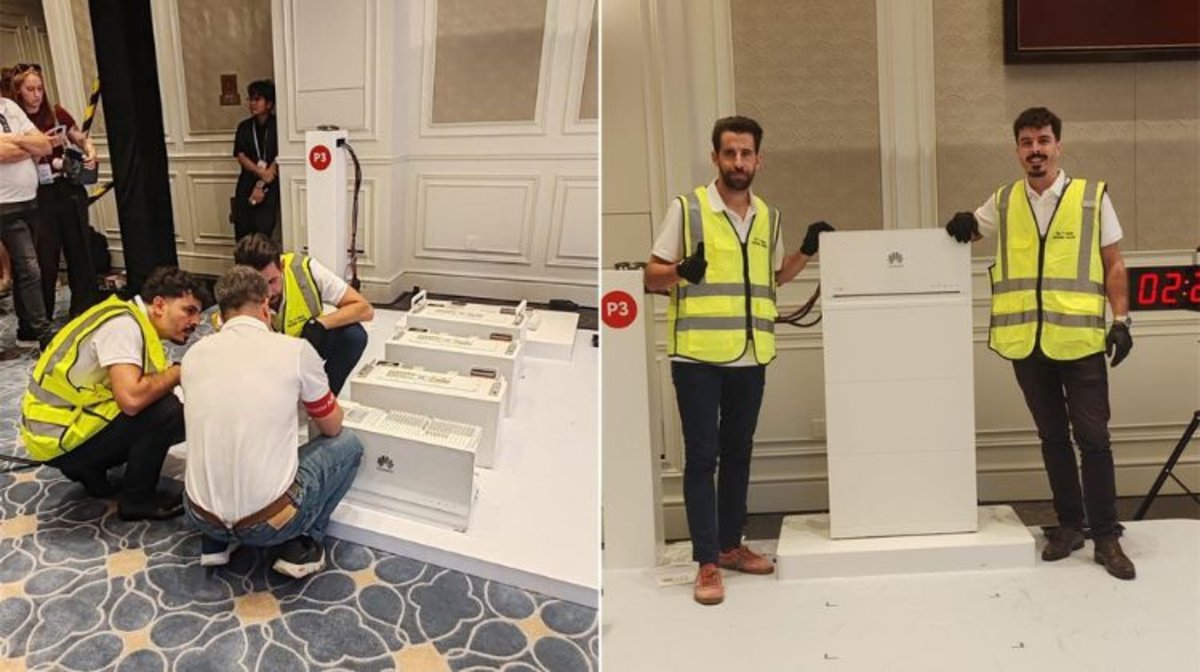
On the workbench were a toolbox, a push button, and disassembled equipment. A camera recorded the test, and a judge ensured the rules were followed. Before the timer started, the two Spaniards agreed on how to divide the work: first, they would stack the modules, and Roberto would take care of screwing them together.
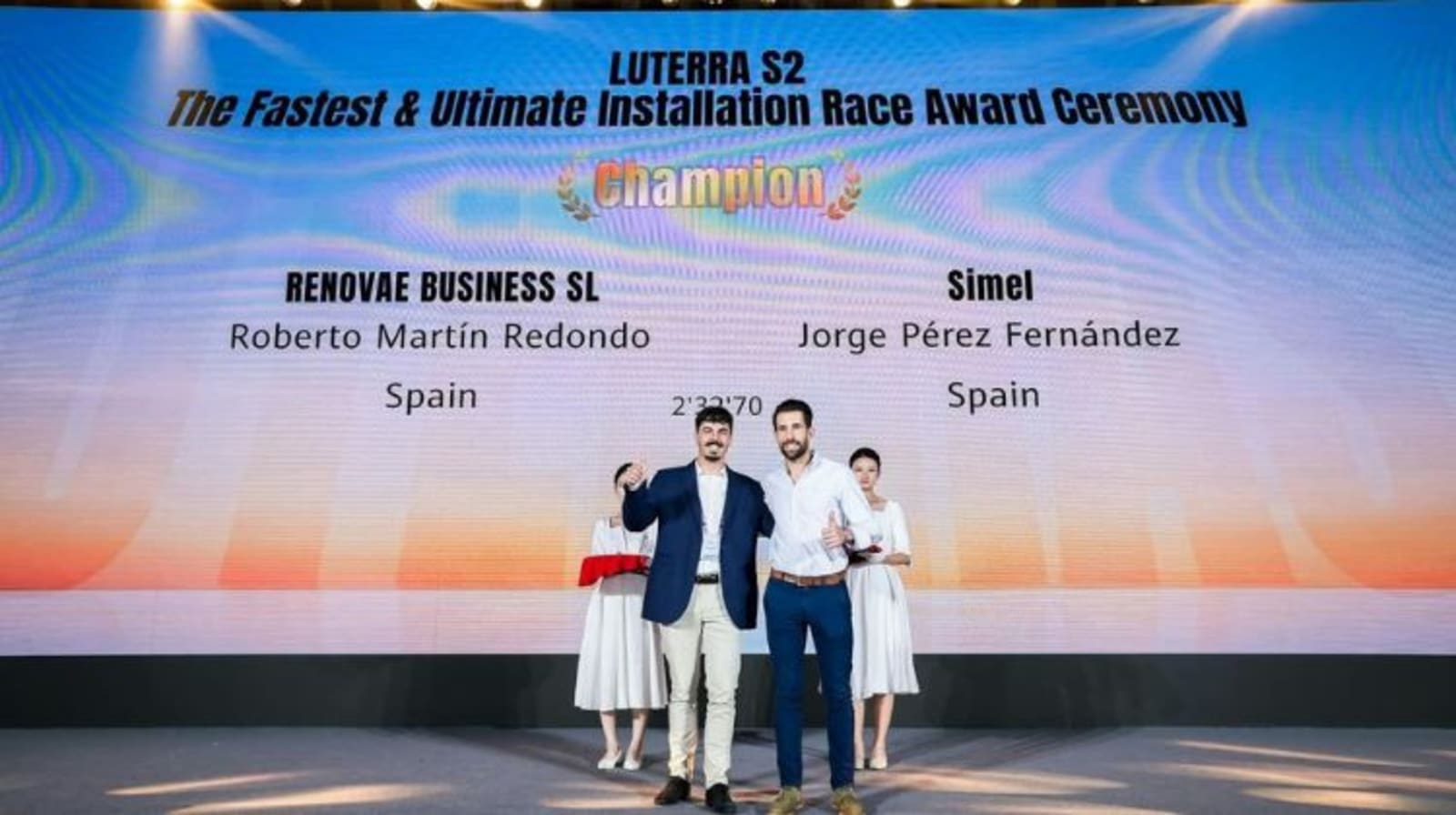
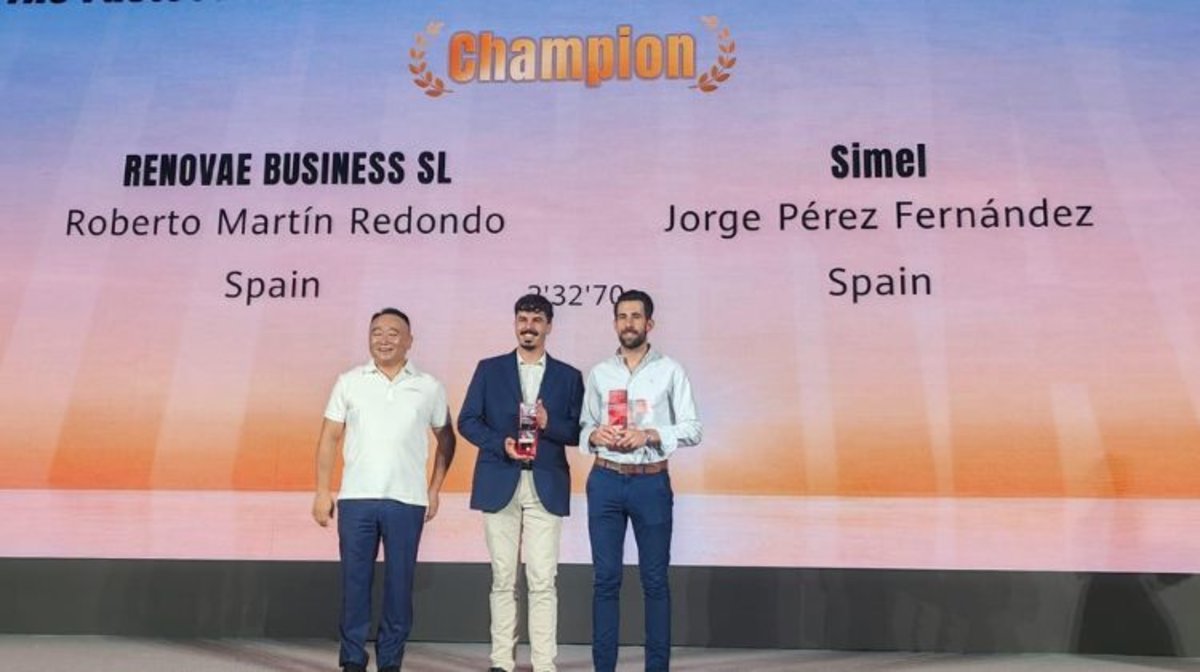
At the awards ceremony, the screen displayed the names of the two winners along with the time that gave them the victory.
Roberto is a project manager at Renovae Business, the division of Grupo Renovae specializing in the design and execution of photovoltaic installations of various types, such as self-consumption projects.
Jorge represented Simel, a company dedicated to the design, execution and maintenance of electrical and photovoltaic installations.

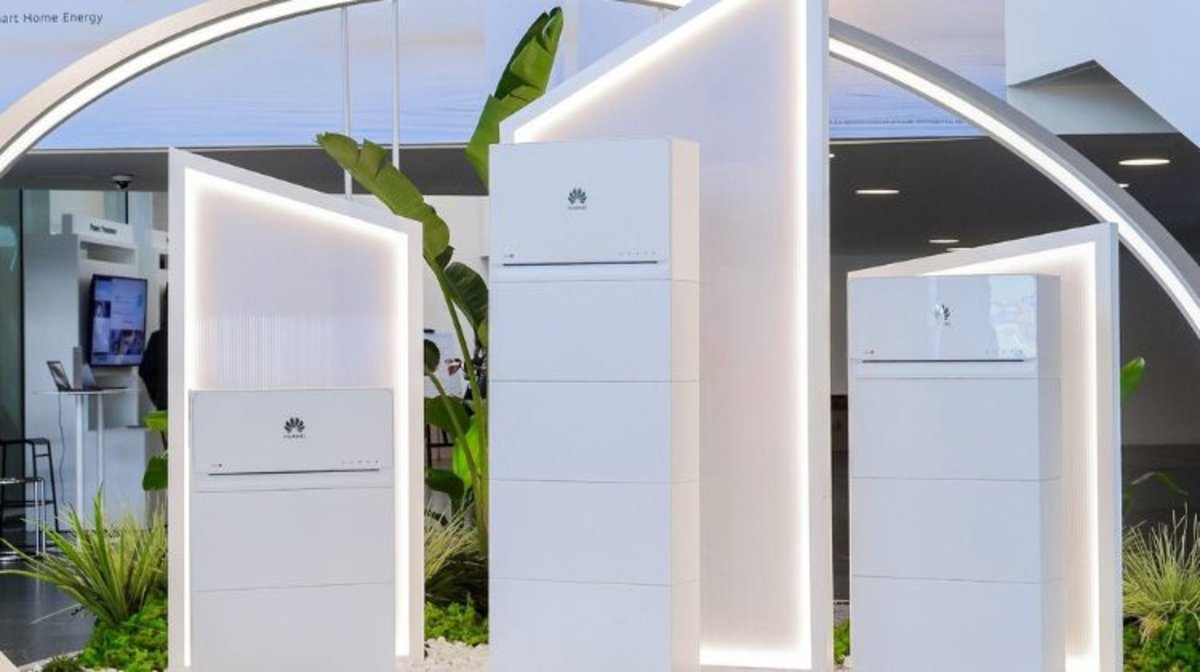
Huawei had gathered installers and professionals from different countries at its “Global Installer Summit” in Shenzhen to present the LUTERRA S2 , a residential system that integrates a hybrid inverter, a modular battery and electrical backup in a stackable unit.
"Like Lego," says Roberto, describing how the modules fit together.
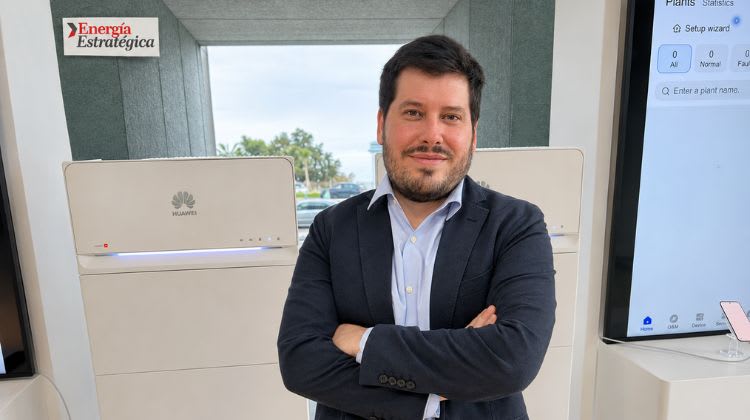
In a dialogue with Energía Estratégica, Roberto Martín Redondo , from Renovae Business, recounted how he experienced the competition, what tasks were included in the timed schedule, and why he remembered his father, a mechanic, when he had to screw things together against the clock.
How did the experience begin and how did you come to participate in the trip to Shenzhen?
It was a series of coincidences. Everyone in the department wanted to go to Shenzhen. Amara NZero, one of our suppliers, first mentioned it to a colleague because I was on vacation. He, in good faith, waited until I returned, and then we held a draw.
Was the draw to decide who would travel to China?
Yes, simply to decide who was going.
And you won.
It was my turn. I was lucky, and that was the first coincidence.
And already in China?
Once in Shenzhen, there was another selection process among the clients who were there. We were told that Grupo Renovae could participate representing Spain. I asked what exactly it entailed.
Did you really want to be selected to compete?
Given everything that's happened, I'm glad I was selected. At the time, I didn't really know what it was all about. When Selina explained the procedure and what the test involved, I said, "Okay, let's go for it."
What preparation did they have before assembling the team?
We had a presentation. Although that model wasn't yet on sale and used different technology. The "all-in-one" systems already on the market are similar in how they are installed.
The competition was a team event. From Spain, they selected Jorge Pérez Fernández from Simel, and me. We barely knew each other. We met right then and there and had to quickly decide how to proceed. We agreed to stack the modules first and then have me start screwing them together.
Was the first thing to do to divide up the tasks?
Continue reading
Exactly. We had to get organized because the test followed a procedure and there were rules and penalties. It was quite an elaborate competition.
What did they find on the workbench?
Everything was explained. At each station, we had the toolbox, the scoreboard, the trigger, and a camera recording at all times. There was also a judge making sure everything was done according to the rules. And, of course, the equipment was disassembled. As soon as the starting signal was given, we started assembling at full speed.
In a test where the installation was supposed to take less than ten minutes, you finished in just over two and a half minutes. What allowed you to go so fast?
We went all out. That's what the competition was all about: doing it as quickly as possible. We organized ourselves a bit beforehand, and it also helped that, although I'm a project manager and not an installer, I'm quite handy. My father was a mechanic, and I've been familiar with tools, mechanics, and electricity since I was little. I owe him my ability to screw things in quickly, which was the task I was assigned.
What did the timed interval include?
The bench and base were already prepared. The time spent included product assembly and all wiring, as well as the AC and DC electrical connections and the communications connection.
Do you think that agility can be transferred to a day-to-day installation?
I think it can be done even faster. That speed was due to the competition, so to do the installation correctly, it might take a little longer, though not much. Mostly to make sure all the screws are tightened properly, lift the battery modules correctly, and so on.
After having assembled and handled the equipment, what features do you think will be most valued?
I'd highlight how compact and lightweight the batteries are. We're talking about at least 45 kilos per module. If you go for a 60-kilo module, for example, handling it becomes more complicated. From my point of view, that's a plus.
Besides the weight, what detail caught your attention when moving the modules?
The detachable handles seem like a great idea to me. It matters how much the module weighs and also how you can grip it. If you have to lift it in an awkward position, the effort is multiplied. For me, that detail is quite important.
I also liked that the assembly is like Lego. Once the modules are stacked, setup is quick: you scan a QR code, connect to the Wi-Fi network, and you're all set.
Was this your first time in China?
I had been to China before for a wedding. What was new to me was participating in an event like this.
Would you come back next year?
If I can, I'm definitely in. I had a great time. It was an amazing event in every way.
About LUTERRA S2
The Huawei LUTERRA S2 is a residential energy system that integrates a hybrid inverter, a modular battery, and a backup power system into a single stackable unit. It is available in single-phase versions from 3 to 10 kW and three-phase versions from 5 to 20 kW. Storage capacity can be expanded with 5 or 7 kWh modules, depending on the installation's requirements.
Its energy management platform combines forecasts of solar generation, consumption, and electricity prices to optimize self-consumption. It can also coordinate the charging of electric vehicles and the operation of compatible heat pumps. In the event of a grid outage, the backup system allows for powering loads in off-grid mode.
According to Huawei, the device achieves up to 99% conversion efficiency and operates below 29 dB under test conditions, with natural cooling and no fans.

 By Ailén Pedrotti
 By Emilia Lardizabal

 By Energía Estratégica