


During its participation in FES Caribe, Axial reinforced its position within the Caribbean solar market by revealing that it already has almost 1.3 GW in projects developed in the region , while reaffirming the Dominican Republic as a long-term strategic bet within its Latin American operation.
“Everyone is very aware of the phrase that the good land ran out in 2016,” said Pablo Oliva , Sales Manager LATAM of Axial, summarizing one of the structural changes that the Dominican market is beginning to go through.
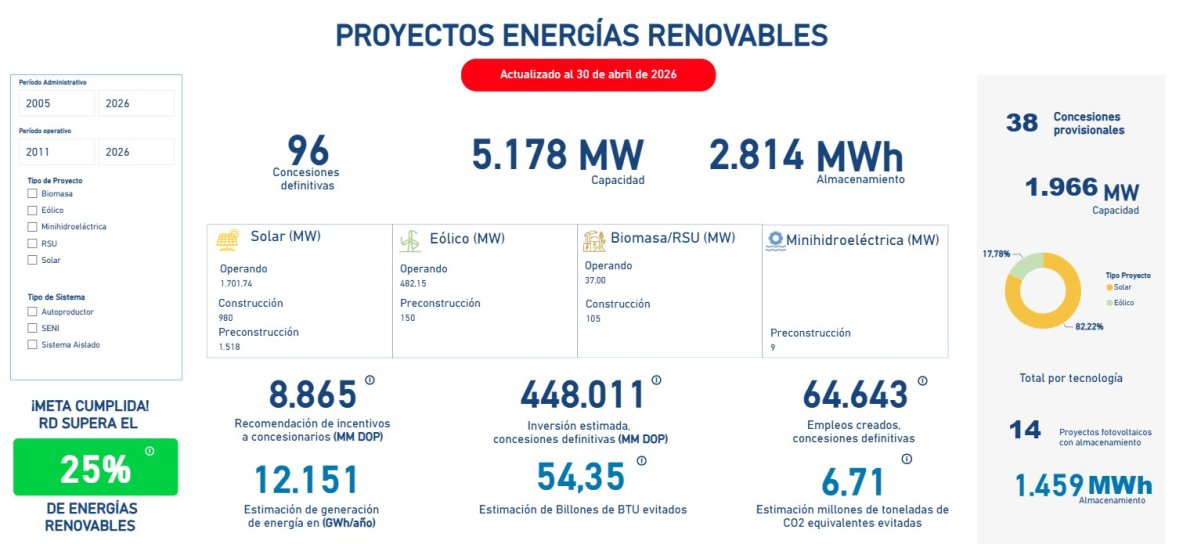
The announcement comes at a time of strong growth for the country's energy sector. According to data from the National Energy Commission (CNE) updated as of April 30, 2026, the Dominican Republic has 5,178 MW of renewable energy capacity under concession , with 1,701.74 MW of solar already operational , another 980 MW of photovoltaic under construction , and 1,518 MW in the pre-construction phase .
In addition, there are 38 provisional concessions equivalent to 1966 MW , plus 14 photovoltaic projects with storage representing 1459 MWh , consolidating a matrix where the Dominican Republic already exceeds 25% renewable participation .

This growth coincides with new signs of market selectivity. The recent BESS tender awarded only 325 MW compared to the expected 600 MW , leaving out nearly 280 MW , in a process marked by prices as low as USD 0.131/kWh .
In that scenario, Oliva reaffirmed the company's commitment to the Dominican market.
“ It is a market in which we have complete confidence, which we continue to support and will continue to support for, I hope, many years ,” he stated during the event.
Relive Day 1 of FES Caribe: https://www.youtube.com/watch?v=OfB3DaSHJSM
The firm, which specializes in fixed structures and trackers for photovoltaic projects, maintains that its regional experience allowed it to develop solutions adapted to one of the most demanding geographies for solar infrastructure.
According to Oliva, that journey already has a tangible scale: "We have not suffered problems in all the projects that add up to almost 1.3 GW in the area."
He explained that the sustained growth of the Dominican market was made possible by the progressive adaptation of the entire value chain —developers, EPC contractors and equipment suppliers— to the specific conditions of the country.
The expansion of renewable energy in the Caribbean also necessitates navigating technical requirements that are quite different from those in other markets. Exposure to extreme weather events influences design decisions, technology selection, and structural criteria for assets with operational horizons of up to 35 years.
Continue reading
“ The climate we have in the Caribbean is, if not the worst, one of the worst in the world ,” Oliva said.
Along those lines, he noted that hurricanes are a structural part of the design equation.
“There have always been hurricanes with wind speeds of 300 to 340 km/h,” he warned.
That experience also explains a less aggressive technological stance than in other markets.
“We in the Caribbean don’t usually recommend trackers; they are very high wind speeds for assets that have to remain on the ground for a long time,” he explained.
Relive Day 1 of FES Caribe: https://www.youtube.com/watch?v=OfB3DaSHJSM
Oliva's statement about available land reveals a typical dynamic of expanding markets: the most competitive locations have already been occupied and new developments are advancing on more complex surfaces, with steeper slopes and restrictions on earthmoving.
This forces us to abandon standardized schemes and move towards solutions designed on a case-by-case basis.
“You can’t standardize a solution when you have average slopes of 25% in a plant; it’s a plant that has to be completely designed ad hoc,” he explained.
Added to this is an operational bottleneck that could become more significant if the current pipeline progresses in parallel.
“One of the main problems we have in the Dominican Republic is that we don’t have enough people to build the parks,” he warned.
From Axial's perspective, engineering that is more adapted to the terrain not only responds to structural requirements, but also allows for reduced execution times, contingencies on site, and dependence on scarce human resources.
With a portfolio of nearly 1.3 GW in the Caribbean and a Dominican Republic that continues to expand its renewable capacity, the company makes it clear that its commitment to the market responds to a long-term vision for one of the most dynamic solar hubs in the region.
Relive Day 1 of FES Caribe: https://www.youtube.com/watch?v=OfB3DaSHJSM