


Colombia moved forward with the second day of the Long-Term Electricity Contracting Mechanism (CLPE-MME 2026) and awarded 4,174 MWh-day of photovoltaic solar energy , associated with plants with a declared joint capacity of 725 MW .
Product 2 reached a weighted average price of 246.13 Colombian pesos per kWh , excluding the Real Equivalent Energy Cost (CERE). This award expands the volume committed after the first day, which focused on renewable energy projects with battery storage.
This segment is exclusively for new photovoltaic solar plants and new solar self-generators with surpluses equal to or greater than 5 MW . The contracts stipulate energy deliveries between 6:00 AM and 6:00 PM , in line with the natural production profile of this technology.
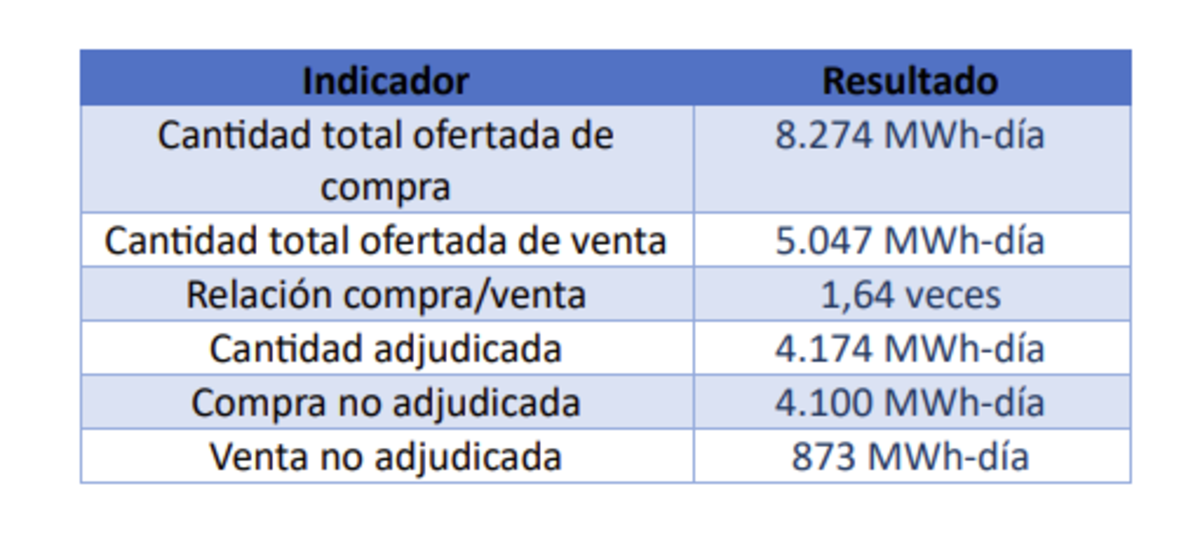
According to the results published by the Colombian Mercantile Exchange (BMC) , which acts as the auctioneer for the mechanism, buyers submitted bids for 8,274 MWh-day , while sellers offered 5,047 MWh-day .
Thus, the amount requested was 1.64 times greater than the energy made available by the generators . The allocation covered approximately 50.4% of the demand offered and 82.7% of the seller's proposal .
Following the exchange of bids, 4,100 MWh/day remained unallocated on the buyer side and 873 MWh/day among the seller proposals . This gap shows that contractual demand continued to exceed offered capacity, although with a substantially smaller imbalance than that observed in Product 3.
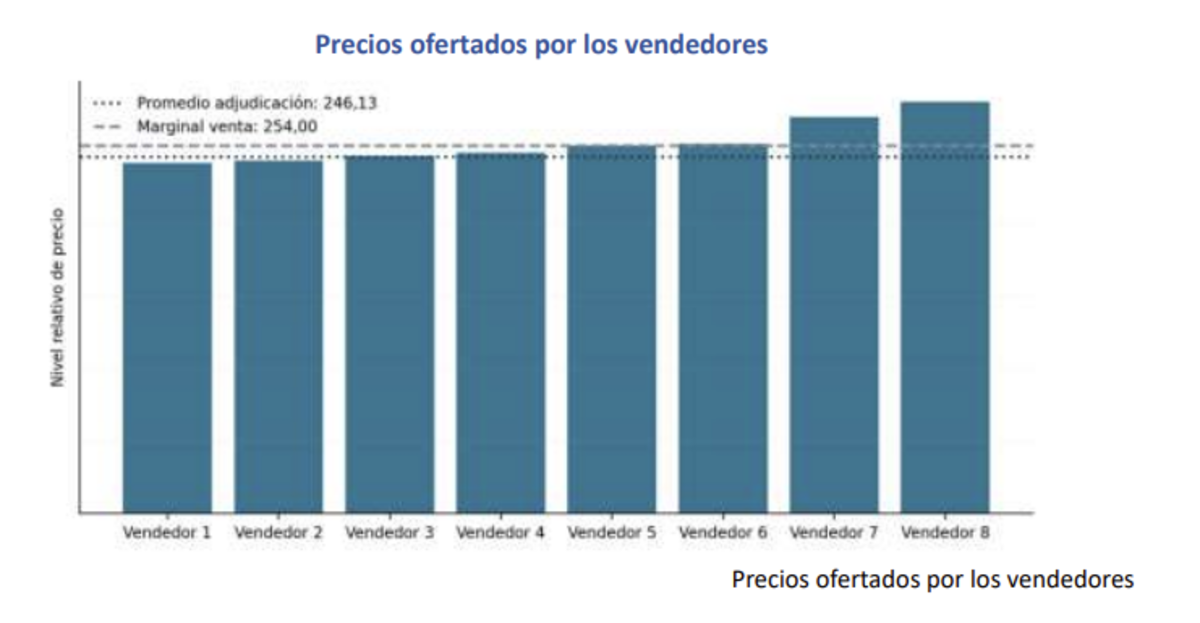
The curve published by the BMC shows that the selling price of Product 2 consisted of three price tiers . The first tier was around 245 pesos per kWh , while the remaining tiers were around 255 and 260 pesos per kWh.
The average closing price of 246.13 pesos per kWh was very close to the lower end of the range. This reflects that a majority of the contracted volume was concentrated in the lower-priced bids, while the more expensive blocks had limited participation or were not awarded.
On the buyer side, maximum bids ranged from levels close to 280 pesos per kWh to values below 200 pesos per kWh. A significant portion of the demand expressed a willingness to contract above the closing price, but the available quantity limited the allocated volume.
The result also provides a benchmark against previously observed values in the Colombian bilateral market. Before the auction, specialists placed private PPAs in a range of $83 to $95 per MWh , with an extreme equivalent to approximately 320 Colombian pesos per kWh .
The price of Product 2 is around 74 pesos per kWh lower than the higher reference price, a difference of approximately 23%. However, the comparison is not straightforward due to potential differences in duration, time-of-use profile, guarantees, indexation, delivery obligations, and risk allocation.
In this case, the product specifically compensates for a 12-hour daytime solar block. Therefore, the awarded value does not necessarily equate to the price of a contract that includes continuous supply, coverage outside of sunlight hours, or additional reliability mechanisms.
Even with these differences, the closing constitutes a relevant economic signal for new Colombian photovoltaic capacity , given that long-term contracts can provide income predictability and support the financing of selected projects.
The sales volume also allows us to qualify some of the concerns raised during the previous stage. Although the call for bids registered 43 interested parties , market players had warned that the actual number of generators could be limited by bank guarantees, connection points, and the process timeline.
Product 3: Batteries to extend renewable energy supply
The first day awarded projects comprising 270 MW of solar capacity and nearly 100 MW of battery storage , for a total of approximately 370 MW between both components. The closing price for Product 3 was 315.87 Colombian pesos per kWh .
Continue reading
Product 3 is aimed at renewable projects that incorporate Battery Energy Storage Systems (BASS) , combining supply blocks during the day and in the hours after sunset.
The category is focused on new plants developed from Non-Conventional Renewable Energy Sources (NCRES) , with a minimum net effective capacity of 5 MW and storage systems integrated within their generation assets.
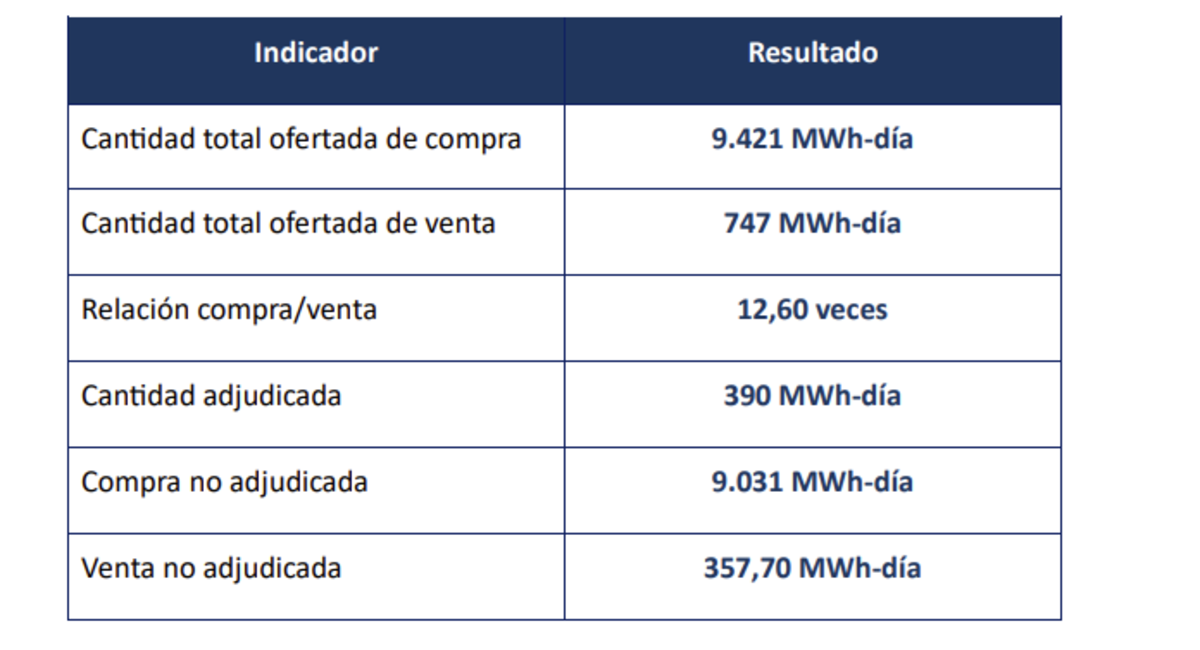
In this category, buyers submitted bids for 9,421 MWh/day , compared to only 747 MWh/day offered by sellers. The buy-sell ratio reached 12.60 times , well above the 1.64 times recorded for Product 2.
Finally, 390 MWh/day were awarded, equivalent to approximately 4.1% of the energy demanded and 52.2% of the available supply. 9,031 MWh/day of purchase and approximately 357.70 MWh/day of sale remained uncontracted.
Thus, Product 3 closed at 69.74 pesos per kWh above Product 2 , a difference of approximately 28.3%. This gap reflects that these are not equivalent products: the segment with batteries incorporates additional infrastructure and allows for shifting some renewable energy to periods after solar generation.
While Product 2 directly harnesses solar production between 06:00 and 18:00 hours, Product 3 seeks to extend the availability of that energy and serve blocks after sunset.
The comparison between the two days reveals two distinct realities. Conventional photovoltaic generation managed to offer a supply close to the volume demanded, while the segment with storage showed a much more pronounced restriction on projects capable of competing .
Together, both products awarded assets totaling approximately 995 MW of solar capacity and nearly 100 MW of battery storage . This capacity is associated with 4,564 MWh/day of contracted energy , considering the 4,174 MWh/day of Product 2 and the 390 MWh/day of Product 3.
The auction will continue with Product 4
The mechanism will continue with the publication of the results of Product 4 , focused on the delivery of energy during the hours of highest demand of the Colombian system, between 6:00 p.m. and 10:00 p.m.
This category is open to new or existing projects that have Energy Storage Systems with Batteries integrated into their generation assets , with a net effective capacity equal to or greater than 5 MW .
Participants must deliver energy through the SAEB (Energy Storage and Energy Saving System) integrated into the asset. The minimum required capacity corresponds to the generation plant and not the associated storage system , a relevant distinction for determining which facilities are eligible.
Product 4 will allow us to see how much storage is available to transfer energy to the night block, when photovoltaic production disappears and a significant part of the system's demand is concentrated.
The BMC had planned to proceed with the auction for this category from 2:00 p.m. on July 29 , after the close of Product 2. The release of its results will complete another stage of the mechanism and provide a new price benchmark for energy supplied by batteries.
The process is also unfolding during the transition between administrations. On August 7, Abelardo de la Espriella will assume the Presidency of Colombia , replacing Gustavo Petro.
That same day, María Nohemí Arboleda is scheduled to take office as Minister of Mines and Energy. The electrical engineer comes from the general management of XM, the company responsible for operating the National Interconnected System and managing the Wholesale Energy Market.
The new administration will inherit the monitoring of awarded contracts and the challenge of converting the selected capacity into operational projects. Implementation, grid connection, and financial closure will be crucial for the auction results to translate into new electricity supply for Colombia.