


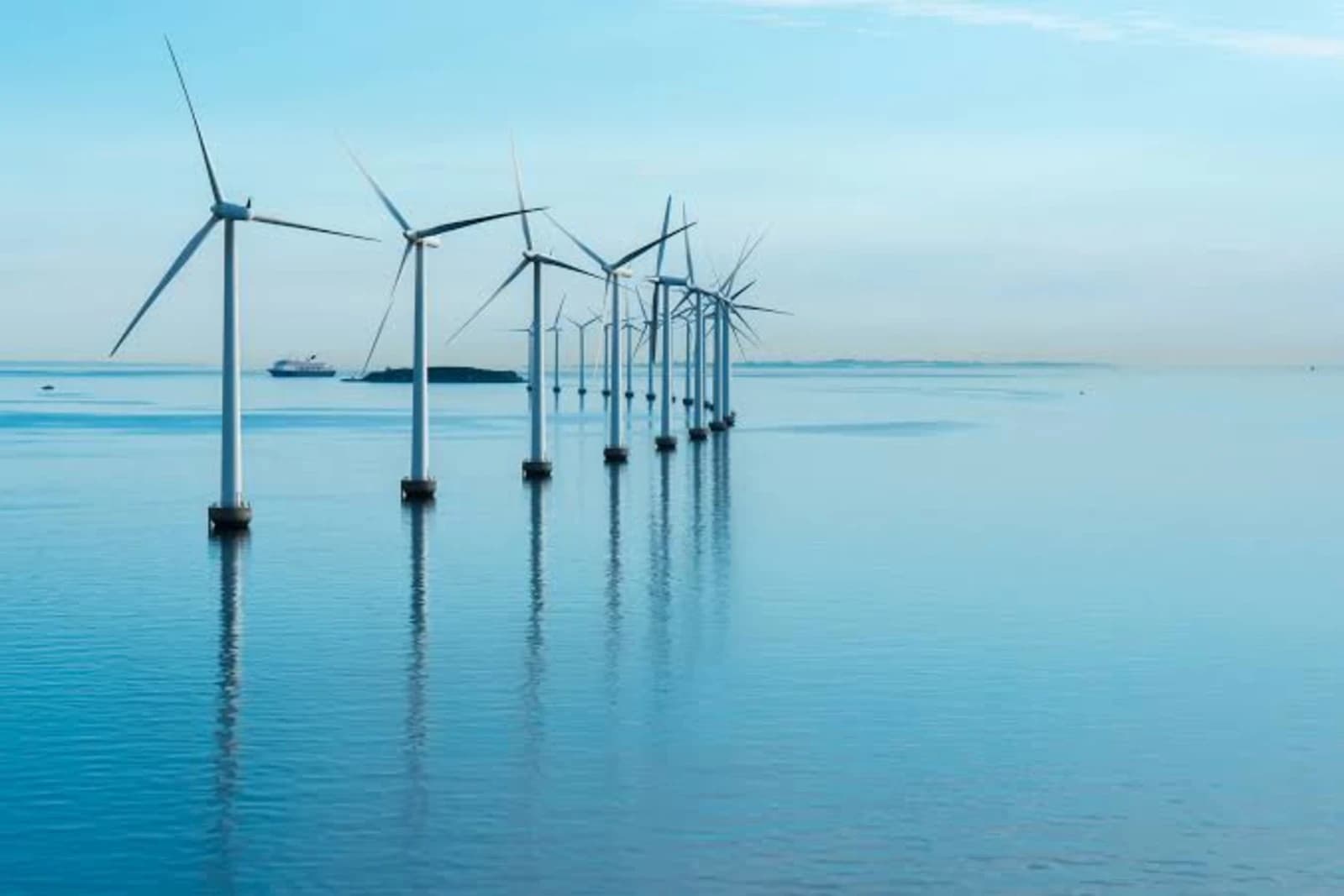
South Korea awarded 1786 MW in the offshore wind auction for the first half of 2026, a process that received bids for 3.6 GW and once again demonstrated the strong interest of the sector in one of the offshore markets with the greatest growth potential in Asia.
The Ministry of Climate, Energy and Environment distributed the capacity between fixed and floating foundation projects, while Copenhagen Infrastructure Partners (CIP) consolidated its position as the main winner by obtaining more than 1 GW in awarded initiatives.
In addition, the Government reduced the maximum price for fixed foundation projects by 3% compared to the previous round, setting it at 171,229 KRW/kWh , while for floating wind the cap was set at 175,100 KRW/kWh .
CIP leads in awards
The Danish firm was awarded two of the five selected projects. In the fixed foundation category, CIP won the Haesong 3 project, with a capacity of 504 MW .

In addition, there was Haewoori 2 , a 532 MW floating offshore wind farm, developed in partnership with SK Group .
With both projects, Copenhagen Infrastructure Partners exceeded the gigawatt awarded in the tender, consolidating its presence in the South Korean offshore market.
Five projects were selected
In total, the auction awarded five initiatives.
In the fixed foundation category led by public companies , the only project selected was Geomodo , 160 MW , developed by DL E&C and Korea Midland Power .
Within the general fixed foundation segment, in addition to Haesong 3 , Hanbit , of 340 MW , promoted by B.Grimm , and Guupdo , of 250 MW , promoted by Hanwha Group and SK Group , were awarded.
Meanwhile, the floating offshore wind category was comprised solely of Haewoori 2 , with 532 MW .
Over £9 billion in investments
According to estimates from EnergyPulse Costs Dashboard , the awarded projects represent an investment of over £9 billion in development and infrastructure.
The initiatives include the use of domestic 10 MW wind turbines , manufactured by Unison or Doosan , as well as international 15 MW turbines, whose local production is expected to expand beyond assembly.
The Ministry also indicated that it will strengthen post-award controls to verify compliance with project execution schedules and safety standards.
With this new tender, South Korea continues to accelerate the deployment of offshore wind as part of its decarbonization strategy and strengthening of the local supply chain.