


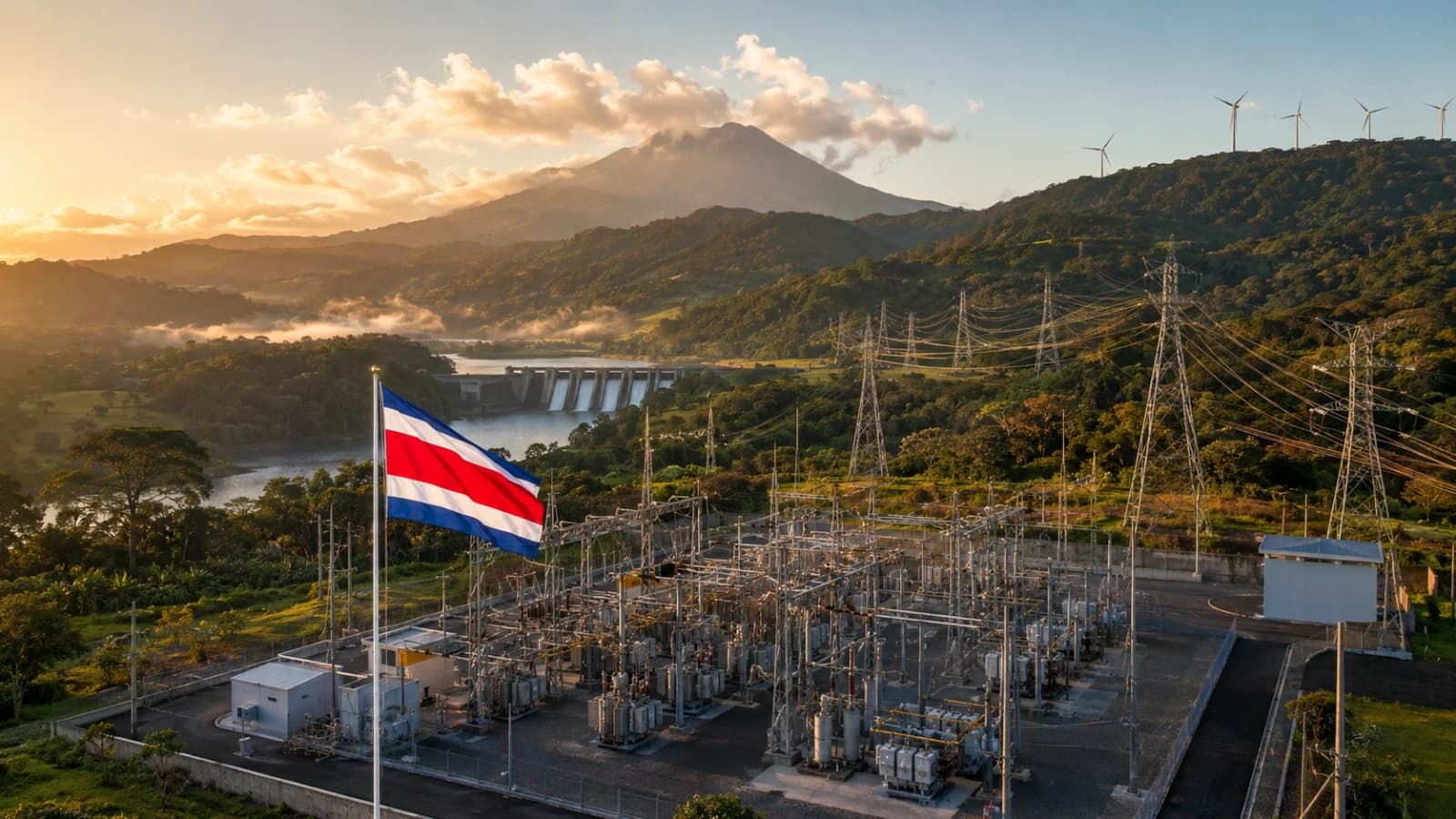
Costa Rica has entered a crucial stage in defining the future of the reform that could transform the structure of its electricity market . The bill received approval from the Legislative Assembly in its first debate, although it still needs to pass a second vote with a qualified majority of 38 representatives.
The main threat is the expiration of its legislative deadline in October. If the second debate does not take place before then, nor is the validity of the bill formally extended, the proposal will be shelved.
“The second vote is the one that is pending. If it takes place, then the law would be approved,” explained the Costa Rican Association of Energy Producers (ACOPE) in a dialogue with this media outlet.
The National Electric System Harmonization Bill was approved in its first debate at the end of May. The vote garnered 27 votes, while the final stage requires the support of two-thirds of the Legislative Assembly, equivalent to 38 of the 57 deputies .

ACOPE estimated that the proposal currently has between 30 and 31 endorsements, so it would still need to add between seven and eight legislators to guarantee its approval.
“The second vote would need 38 votes. At this time, the bill has about 30 or 31, but not the 38,” the association stated.
The lack of a guaranteed majority prevents the bill from being taken immediately to the second debate. Its proponents believe that submitting it to the plenary session without first securing the necessary support could lead to its outright rejection.
“If it is put to a vote and the 38 votes are not reached, the project dies, that is, it is shelved, because it is a necessary condition,” ACOPE warned.
Given this situation, the government and major business organizations intensified their contacts with legislative blocs. These efforts aim to have the representatives review the proposal and build the necessary consensus before bringing it back to the floor.
ACOPE pointed out that, given the lack of votes, the business sector and the Executive Branch constantly requested the political factions to move forward with the analysis of the text and enable its voting.
The discussions also took place in public and business forums, including the National Energy Congress organized by the Costa Rican Chamber of Industries. There, industry representatives analyzed the future of the electricity system and the regulatory changes needed to attract new investment.
The main difficulty lies with the position of the National Liberation Party (PLN) , one of the largest parliamentary blocs. According to ACOPE, this bloc has not yet endorsed the initiative, and its votes are crucial for achieving the required supermajority.
“We have not yet managed to get the second largest political faction, which would be National Liberation, to endorse the project and vote for it,” the organization stated.
The union believes that the alternatives promoted by that political group do not offer a comprehensive response to the needs of the Costa Rican electricity market.
“National Liberation has consistently stated that it is not yet in favor of the project and proposes other alternatives, but these may only generate partial solutions,” ACOPE added.
The disagreement reflects the broader debate surrounding the reform. Its proponents argue that Costa Rica needs to modernize its institutional framework, expand competition, and facilitate the adoption of new technologies.
Opposition sectors, on the other hand, warn of a possible weakening of the Costa Rican Electricity Institute (ICE), the solidarity model, and tariff regulation.
Continue reading
The start of the Legislative Assembly's ordinary sessions changed the political context of the matter. During the extraordinary session, the Executive Branch determines which bills are convened and debated.
In ordinary sessions, initiatives incorporated into the legislative agenda can be addressed without depending on a specific call from the Government.
“ Starting in August, we move to regular sessions, which means that all bills are added to the agenda. They don't need to be formally convened; everything that's already on the agenda is reviewed, ” the association explained.
The change opened a new possibility for the bill to be reviewed by legislators. However, its inclusion on the agenda does not resolve the lack of agreement nor guarantee that the text will be put to a vote immediately.
The priority for the Government and the business sector will be to secure between seven and eight additional endorsements, according to ACOPE's calculations, and to prevent the second debate from taking place without having the required majority secured.
In addition to this negotiation, there is the regulatory deadline. Bills have four years to complete their processing, a period that in this case will end in October.
“ According to the regulations of the Legislative Assembly, bills have a four-year term to be processed, and in this particular case, it expires in October ,” ACOPE warned.
If the Assembly does not approve the reform before that time, the deputies could still extend the deadline for the bill. However, the extension would also have to be voted on before the original deadline.
“ If there is no vote in the second debate before the deadline or if the deadline is not extended before October, then it will also be shelved ,” the organization emphasized.
A structural reform for the electricity market
The initiative aims to modify one of the most centralized electricity systems in Central America. Currently, ICE maintains a central role in generation, operation, and planning , in addition to acting as the main purchaser within the system.
Among the proposed changes is the creation of the National Electric System Coordinating Entity (ECOSEN) , which would manage the market and assume planning and coordination responsibilities. The text also contemplates a wholesale market and greater participation from private generators.
Costa Rica boasts electricity coverage of nearly 99.5% and an energy mix based on over 95% renewable sources . However, there is still room to expand the use of technologies such as solar and wind power, as well as the deployment of energy storage systems.
For the private sector, a new market design could enable renewable developments, battery solutions and new investments, provided that regulation establishes predictable contracting mechanisms, clear rules of access and conditions of legal certainty.
The outcome of the discussion will also be relevant to the country's competitiveness, meeting growing electricity demand, the electrification of transport, and the eventual arrival of energy-intensive industries.
The content of the proposal has not changed recently. The political landscape has shifted, however, with the start of the regular sessions, the persistence of the vote gap, and the approaching deadline.
“ We are racing against the clock. As a country, we must expedite the discussion of the second debate so that this project is not shelved in October ,” ACOPE emphasized.
Costa Rica thus has less than three months to resolve one of the most important regulatory debates in its energy sector. The future of the initiative will depend on its proponents achieving a qualified majority or, alternatively, managing to extend its legislative validity.
“ The text has not changed, but we have the race against the October deadline, the start of the ordinary sessions, and the lack of votes needed for the second debate ,” the association concluded.