


A battery can meet its manufacturer's warranty conditions, generate revenue through electricity arbitrage and tuning services, and still be losing economic value due to inefficient operation. The cost of degradation and its incorporation into optimization algorithms have emerged as key variables for the profitability of BESS systems in Spain , especially given the proliferation of commercial opportunities for energy storage.
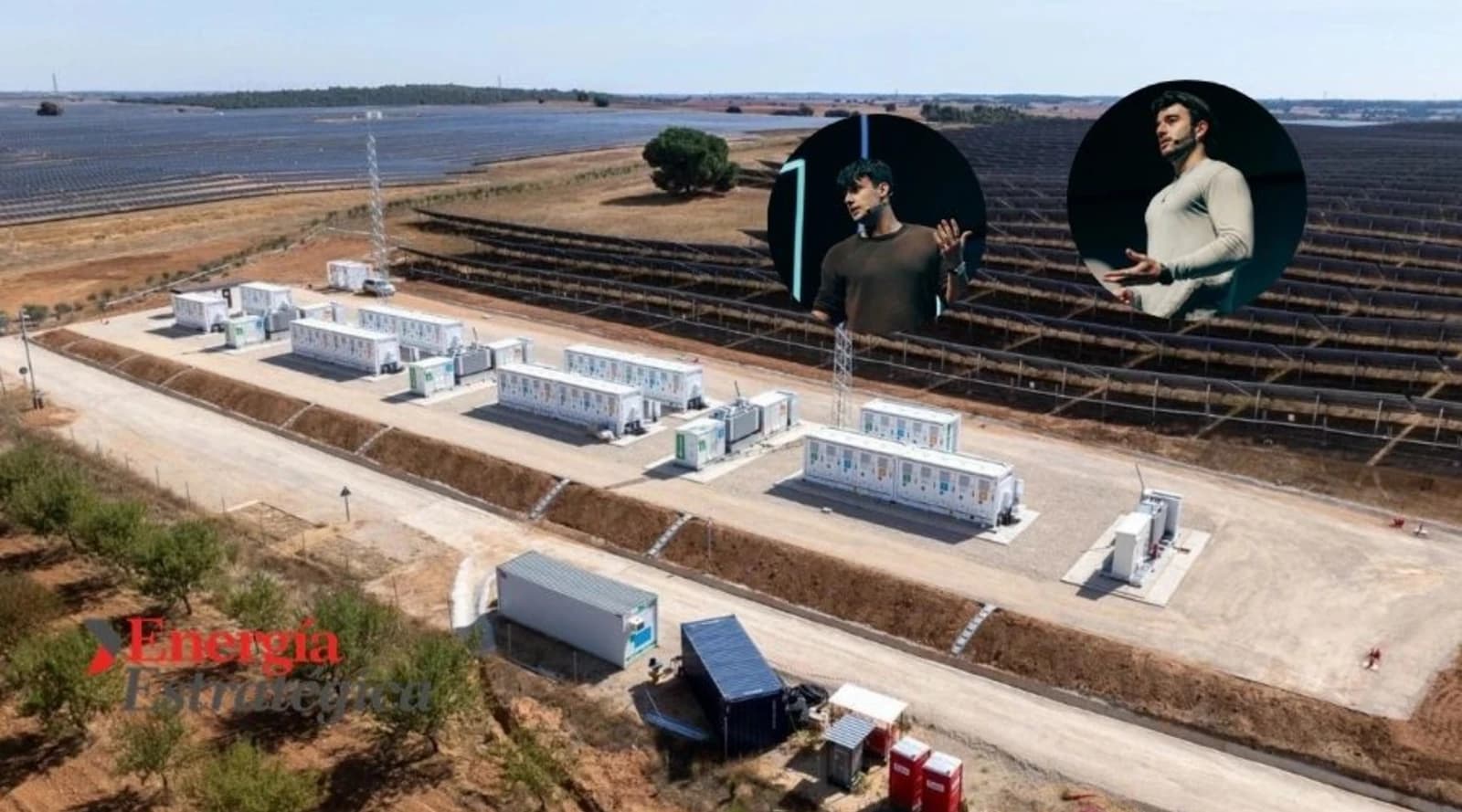
In an interview with Energía Estratégica , Alejandro Ausina Álvarez and Adrián Solís, CEO and co-founders of NeuraSun , analyzed the limitations of traditional energy management models, the impact of battery aging, and the need to coordinate different revenue streams without compromising the useful life of assets.
The debate gained prominence with the approval of Order TED/966/2026 , which created the Spanish capacity market in September and established contracts of up to 15 years for new investments in generation and storage , while existing facilities could access twelve-month commitments. The mechanism incorporated pay-as-bid auctions and remuneration linked to firm capacity, although firmness coefficients, price limits, and specific participation conditions remained subject to further development.
This new revenue stream complemented the arbitrage opportunities in the day-ahead and intraday markets and the provision of balancing services. However, the coexistence of different income sources also increased the demands on the programming and management of storage systems.

The degradation that economic models do not always take into account
According to NeuraSun, one of the main errors in the BESS operation was using the cycle limit set by the manufacturer as the only reference for managing battery aging, without incorporating the economic cost of each operation.
“The question is almost always framed incorrectly, and I include myself in that. It is formulated as 'how many cycles can I afford,' which is a constraint, when it should be formulated as 'how much is a cycle worth,' which is a price,” Solís argued.
The difference between the two approaches changed the dispatch criteria. While a model based on maximum constraints could execute operations as long as there was margin within the warranty, one that incorporated the marginal cost of degradation had to assess whether the expected revenue compensated for the associated loss of useful life.
The analysis included both cycle degradation, linked to loading and unloading processes, and calendar aging, conditioned by factors such as temperature, load status and the time spent in certain operating conditions.
During its industrial pilots, NeuraSun identified a case where two identical batteries exhibited very different utilization patterns . By incorporating degradation only as an upper limit, the algorithm concentrated operations on one unit while the other remained significantly underutilized.
“From the perspective of annual cost, the solution is correct; from the perspective of the asset, it is a disaster, because you are consuming the useful life of one piece of equipment while the other ages by calendar without contributing,” the co-founder explained.
This behavior highlighted a limitation of models that optimize economic results for a period without adequately considering the individual wear and tear of each piece of equipment. The uneven distribution of cycles could affect the state of health (SoH), available usable capacity, and future revenue of the facility.
“The warranty is a contract, not a physical description of aging: it defines an envelope of cycles, throughput and SoH, and operating within it does not mean operating well,” Solís warned.
Revenues don't always add up: competition between markets
The discussion about the downgrade also extended to the financial projections of BESS projects. In a market where profitability increasingly depended on combining different services, NeuraSun questioned models that calculated each revenue stream separately and then added their results together.
The company identified two operational economies of scale. For systems directly connected to the grid, it identified day-ahead and intraday arbitrage as the main business exposure, complemented by regulation services and potential revenues contracted through the capacity market. In industrial installations behind the meter, on the other hand, savings on the electricity bill formed the economic basis, with additional opportunities linked to shifting consumption and flexibility.
Solís provided a comparison to illustrate the risk of using exceptional results as a financial benchmark. According to figures from NeuraSun, July presented an annualized opportunity equivalent to €477,000/MW/year for two-hour batteries , while the pure arbitrage benchmark for the previous twelve months was close to €68,000/MW . These figures corresponded to different measurement horizons and did not represent guaranteed revenue.
For the co-founder, the financial structure had to differentiate between the stability of the contracts and the return exposed to electricity volatility.
“The contracted buys the debt, the merchant buys the IRR,” he summarized.
During the development of its simulator, NeuraSun also identified revenue attribution problems among services. The same economic benefit could be assigned to different strategies depending on the order used to evaluate the operating opportunities.
“The service revenue breakdowns seen in the presentations are calculation artifacts, not causal breakdowns. Services don't add up; they compete for the same workload and the same cycle budget,” Solís stated.
This competition necessitated a joint consideration of power constraints, available energy, efficiency, availability commitments, and degradation costs. A decision to offload service to capture an attractive differential could limit subsequent participation in another, potentially more profitable, service.
However, expanding markets did not necessarily mean a greater number of cycles. According to NeuraSun's analysis, an optimizer capable of accurately assessing attrition could select fewer trades, even when the asset had more trading opportunities.
The Spanish market opens new opportunities for industrial storage
Royal Decree 88/2026 , approved in February, introduced the framework for independent aggregation and recognized the possibility for consumers to contract aggregation services with an agent other than their energy supplier. Effective participation in balancing markets was linked to the corresponding requirements and operational developments.
This figure opened up new possibilities for monetizing the flexibility of industrial facilities, whose economic model had been mainly focused on reducing supply costs, shifting consumption between tariff periods and managing peak demand.
For systems behind the meter, the new scenario raised the possibility of combining bill savings with services provided to the electrical system, provided that capacity was available and participation requirements were met.
However, the addition of extra revenue required assessing potential conflicts between the consumer's energy needs and commitments made in the electricity markets . Energy reserves for an industrial process could limit a commercial discharge, while an external activation could alter the facility's projected consumption profile.
Continue reading
The issue also became important for financing new investments. Order TED/966/2026 included remuneration for firm capacity and availability obligations, meaning that the value of a battery would not depend solely on hourly price differentials, but also on its ability to meet commitments during specific periods.
In that context, NeuraSun positioned the joint optimization of services as a condition for capturing revenue without compromising benefits or unnecessarily accelerating aging.
Artificial intelligence enters the management of BESS cycles
NeuraSun's technological strategy focused on developing predictive models capable of anticipating energy demand, photovoltaic generation, and market conditions to determine battery scheduling.
Ausina explained that the system projected solar consumption and production for 24- to 48-hour periods, using historical data, weather forecasts, and electricity price information. With these variables, it generated an operational plan for the next 24 hours.
The software also incorporated updates as deviations appeared between the forecasts and the actual behavior of the facility, with the aim of modifying loading and unloading decisions.
“Obviously, the algorithm can make mistakes. Artificial intelligence can also deviate. But it is constantly reviewing the predictions and comparing them with the actual values. If it detects a deviation, it reprograms and recalculates battery usage,” the CEO explained.
According to Ausina, the company validated energy savings of 30% or more in its tests , after that percentage initially emerged as a development hypothesis. The interview did not specify a sample that would allow these results to be extrapolated to any industrial configuration.
Improving predictions was one of the startup's main areas of work, along with interoperability between batteries, inverters, and control systems from different manufacturers.
For its founders, proprietary environments continued to pose a challenge for integrating heterogeneous equipment. The lack of common data and communication standards could increase implementation times and limit the use of independent optimization solutions.
Beyond AI: grid-forming as a new revenue frontier
When analyzing the technological trends that could change the BESS business, NeuraSun placed grid-forming ahead of new chemistries, longer-lasting batteries, and artificial intelligence itself .
Grid-forming inverters allow voltage and frequency references to be established and contribute to grid stability, unlike grid-following systems, whose operation depends on an external electrical reference.
In Spain, these capabilities gained relevance within the technical debate on the operation of a system with high renewable penetration, especially after the Iberian blackout of April 2025. However, their monetization will depend on the technical requirements and the contracting mechanisms that are enabled.
“Grid-forming turns the battery into an element that supports the grid instead of just following it, and that rewrites the question of how much storage the system needs and for what purpose,” Solís said.
The co-founder differentiated this transformation from the role of artificial intelligence, whose function was to optimize the use of already available capabilities, without modifying by itself the technical services that a facility could provide.
The expansion of technologies capable of participating in different markets also reinforced the need for operating models that incorporated technical constraints, commercial commitments, and degradation in the same decision.
From a photovoltaic idea to competing in industrial energy management
NeuraSun's proposal originated during the university years of its founders, initially with an idea focused on improving the economic use of photovoltaic installations.
Ausina, with a background in IT, and Solís, specializing in energy engineering, began developing tools for predicting and optimizing energy consumption. However, initial assessments showed that the residential segment offered a limited return on investment compared to the costs of implementing the technology.
The project evolved towards industrial storage, where higher consumption volumes and the ability to manage loading and unloading offered a broader field of application. The Iberian switch-off in 2025 further accelerated a transition that both had already begun to explore.
Their market entry was also marked by difficulties in securing facilities to validate their algorithms. Ausina, 23, acknowledged that the founders' youth and lack of commercial results presented obstacles when dealing with potential industrial clients.
“They would say to us, ‘We’re interested in the idea, what results have you had?’ We would reply that we had none yet because we wanted to try it out. And they would say, ‘Well, come back when you’ve tried it,’” he recalled.
The situation changed when a battery and inverter manufacturer allowed them to test their software in Spanish facilities. The results obtained facilitated further business discussions, although the company was still in the customer acquisition and initial sales negotiation phase.
With a team comprised of its two founders, NeuraSun focused its efforts on perfecting algorithms, expanding compatibility with different manufacturers, and consolidating its presence in the industrial segment.
Their strategy also sought to leverage a competitive advantage over large equipment suppliers: offering optimization independent of the brand of battery or inverter installed , instead of necessarily linking energy management to a specific manufacturer.
For Ausina, that flexibility was one of the main advantages of a small structure compared to established companies.
“We are like a sailboat. We can adapt very quickly,” he said.
The company's focus thus shifted to a segment of the BESS business whose importance grew along with the monetization possibilities of storage: the ability to decide which operations justify using the battery and which compromise its future profitability .